
Field camps and temporary structures at remote industrial sites carry a straightforward requirement: the people inside them need to be safe, rested, and ready to work the next shift. In high-ambient temperature environments, that requirement depends on effective cooling. Heat exhaustion and heatstroke develop more quickly than most supervisors anticipate, and a workforce that cannot recover properly between shifts progressively loses capability over the duration of a project. Cooling in field accommodations is not a comfort consideration. It is a workforce availability and safety issue.
Occupational health and safety regulations establish standards for thermal environment management in work-related accommodations. Compliance requires active controls, not passive mitigation. REIC Rentals supports oil and gas, mining, pipeline, and civil infrastructure projects across North America with cooling solutions sized for field camp and temporary structure applications, from single modular units to full camp climate systems supporting large crews through extended project durations.
What Heat Does to a Remote Workforce
The consequences of inadequate cooling in field accommodations accumulate in ways that are not always immediately visible. Core body temperature that does not return to normal between shifts affects cognitive function, reaction time, and physical output on the following shift. Workers operating in a chronic state of heat stress make more errors, take longer to complete tasks, and are more likely to be involved in safety incidents. On a project where the margin for error is already narrow, degraded performance compounds over the weeks.
Acute heat illness events, including heat exhaustion and heatstroke, trigger mandatory response protocols that remove workers from the site, generate incident documentation, and create regulatory reporting obligations. On a remote site where medical evacuation is time-consuming and crew replacement is not immediate, a single serious heat illness event can affect site capability for days. Prevention through adequate cooling infrastructure is the only viable approach. Response after the fact is always more costly.
Factors That Determine the Right Cooling Configuration
Field camp cooling is not a one-size-fits-all decision. The right configuration depends on a combination of site-specific factors that interact in ways that require assessment rather than assumption. Getting the specification wrong in either direction, undersized equipment that cannot hold temperature under load or oversized equipment drawing more power than the generator can reliably supply, creates operational problems that are difficult to correct once the camp is occupied and the project is running.
Climate type is the starting point. Humid environments require air conditioning units with dehumidification capacity, as evaporative cooling is ineffective when ambient relative humidity is high. Excess moisture in sleeping and common areas can accelerate heat stress by impeding the body’s natural cooling mechanisms. Dry heat environments can achieve effective cooling with lower power draw through evaporative cooling or hybrid configurations, extending the runtime available from a given generator capacity. Assessing the site’s humidity profile drives the equipment category decision before any other factor is considered.
Power availability is the second major constraint. Remote field camps typically run on diesel generation, and cooling loads compete with lighting, kitchen equipment, communications, and tool charging for available capacity. Energy-efficient cooling units with variable-speed compressors draw significantly less power at partial loads, which describes most nighttime operation when ambient temperatures drop, but the cooling system continues to run. Matching the cooling unit’s power draw profile to the generator’s available capacity across the full operating cycle prevents the overload events that shut down camp power at 2 AM.
Structure size, layout, and construction type determine the thermal load the cooling system needs to manage. A well-insulated modular building with reflective roofing retains heat more effectively than an open-frame tent or a standard shipping container converted for accommodation. Sharp corners, internal partitions, and restricted airflow paths affect how evenly a single unit can condition a space. The cooling assessment needs to account for the structure’s actual heat load under peak ambient conditions, not just the floor area.
Cooling Equipment Options for Field Camp Applications
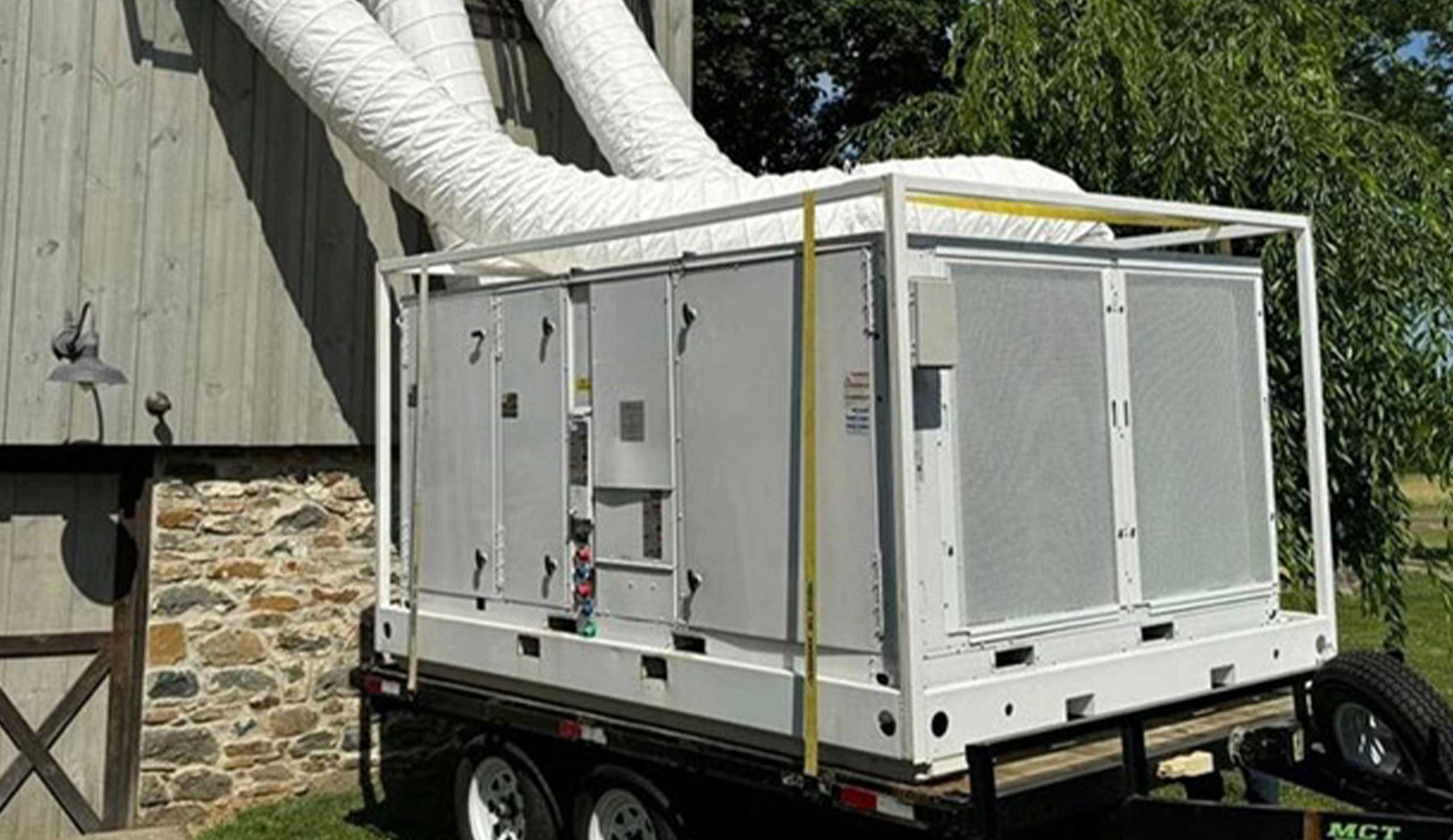
REIC Rentals offers a range of portable air conditioning and cooling equipment designed for field camp and temporary structure applications. Smaller units with capacities of 12 to 30 tons suit individual modular buildings, office trailers, and single-function spaces such as medical stations, communications rooms, and crew rest areas. These units connect to standard generator power via a single-point supply and operate over a broad ambient temperature range, covering conditions typical of summer industrial sites in North America.
Larger-capacity units from 45 to 80 tons cover full accommodation modules, dining and common areas, and multi-room structures, where a single high-capacity unit is more practical than multiple smaller installations. The 45-ton configuration includes two independent stages of dehumidification and reheat, giving operators precise control over both temperature and humidity in environments where ambient moisture is a consistent challenge. The 80-ton unit delivers both cooling and heating capacity from a single package, providing year-round climate control for camps operating across seasonal temperature extremes.
Environmental Control Units provide greater precision for applications that require tight control of both temperature and humidity. With consistent airflow at 10,000 CFM and high static pressure capability, these units suit field situations where the structure requires positive pressurization, where coating or surface preparation work is happening in adjacent areas, or where the application demands thermostatically regulated control with integrated humidity management rather than simple cooling.
Power, Logistics, and Delivery to Remote Sites
Remote field camp cooling works only if the equipment actually arrives, is installed correctly, and has a reliable power supply from day one. REIC Rentals supplies generators and temporary power distribution, along with cooling equipment, so the full system arrives as a coordinated package rather than components that require field integration by the site team. Generator sizing accounts for the total camp electrical load, not just the cooling units, preventing the capacity conflicts that compromise either power quality or cooling performance.
For sites in extreme locations, delivery logistics require the same planning discipline as any other major equipment mobilization. REIC Rentals operates across 55 locations in North America, with local teams that understand the access constraints, weight limits, and lead times that apply to remote-site deliveries in their markets. Equipment that arrives late leaves crews in uncontrolled temperature conditions during the mobilization phase, which is often the hottest and most physically demanding period of the project. Plan the cooling delivery timeline with the same rigor as the crew arrival schedule.
Operating and Maintaining Camp Cooling Through the Project Duration
Cooling equipment in field camp environments operates under conditions that accelerate wear and degrade performance more quickly than in typical commercial installations. Dust ingestion in arid sites clogs filters and reduces airflow across days rather than months. Unmanaged condensate drainage can cause standing water in accommodation structures. Units running continuously at high ambient temperatures operate closer to their rated limits than in temperate commercial applications.
Filter cleaning and replacement, scheduled to the site’s dust level, is the single most impactful maintenance task for sustaining cooling performance over a long project duration. A unit running with significant filter restriction delivers less cooling, draws more power, and runs hotter than a well-maintained unit of the same capacity. Assigning filter maintenance responsibility to a specific person with a defined schedule, rather than treating it as a shared task, is what actually gets it done consistently across a multi-week or multi-month project.
REIC Rentals provides on-site setup, operator orientation, and 24/7 field service response during active project deployments. When equipment requires attention, the response is a service call, not a parts order and a wait. We take that seriously on remote site deployments where a cooling failure at the end of a long shift has immediate consequences for the crew trying to recover before the next one.
Plan Cooling Into the Camp Setup Before Mobilization Begins
Field camp cooling that is planned during project setup is integrated, correctly sized, and operational when the first crew arrives. Cooling addressed after the camp is already occupied and temperatures are already creating problems requires faster mobilization, suboptimal equipment selection, and field improvisation that rarely produces the same results as a properly planned installation.
Tell us your site location, structure type and dimensions, crew size, shift schedule, ambient temperature range, and power availability. REIC Rentals will specify the appropriate cooling configuration for the camp, coordinate delivery to align with the mobilization schedule, and provide field support to keep it operational throughout the project.
1.888.356.1880 | in**@**ic.com | Get a Quote
Service You Trust. Equipment You Need.
