
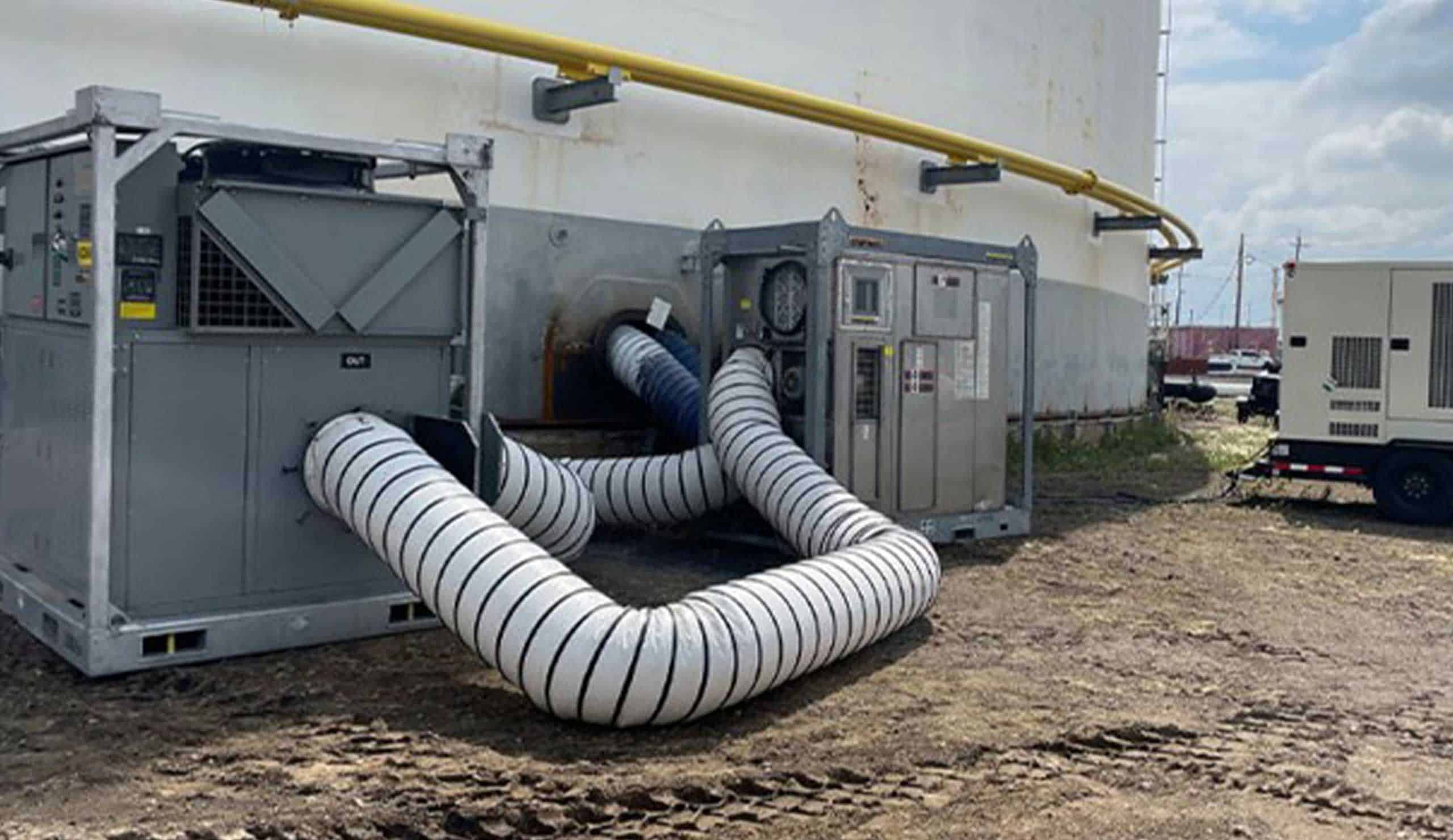
Industrial coatings are engineered to perform within defined temperature and humidity windows. In summer, those windows close fast. Ambient temperatures climb, black steel surfaces absorb and retain heat well beyond air temperature, and enclosed containment areas can become unworkable before the morning is over.
The result is predictable: flash drying, adhesion failures, blistered finishes, and crews that cannot safely sustain production in the heat. At REIC Rentals, we support painting, coating, and pipeline teams with temporary cooling solutions designed for the demands of summer field work, from enclosed blast and coating enclosures to open pipeline spreads and remote industrial sites.
This article covers the specific ways heat compromises coating and pipeline projects, the available equipment options, and how to plan cooling into a project before it becomes a problem.
How Heat Compromises Coating Quality and Project Schedules
Every industrial coating product carries a product data sheet that specifies acceptable temperature and humidity ranges for application and cure. Those ranges exist because coating chemistry is temperature-dependent. Applying outside the specified window is not a minor deviation. It is a direct cause of product failure.
On summer projects, elevated temperatures introduce several distinct failure modes:
Flash drying occurs when the coating skins over before proper substrate wetting and bonding can take place, leading to poor adhesion and surface defects.
Rapid solvent evaporation prevents the coating from leveling, resulting in lap marks, brush marks, and inconsistent film thickness.
Blistering develops when heat accelerates the expansion of trapped air, solvent, or moisture beneath the coating surface.
Premature system failure occurs when coatings are applied outside the manufacturer’s specified temperature range, resulting in reduced performance and potential warranty noncompliance.
Extended or irregular cure times can occur when certain coating chemistries respond unpredictably to extreme heat, delaying recoat windows and disrupting project schedules.
Pipeline projects are particularly exposed. Coatings applied in direct sunlight or within field-built containment structures are subject to ambient conditions that frequently exceed product specifications. Black steel surfaces in summer sun can reach temperatures 36 to 54°F above air temperature, creating surface conditions that are outside acceptable ranges even when the air temperature seems manageable.
The cost of these failures extends beyond rework. When a coating fails inspection, the project stops. Containment has to be re-established, surfaces prepared again, and the coating reapplied under controlled conditions. The schedule impact and the cost of mobilizing for a second application run far exceed the cost of controlling conditions correctly the first time.
Heat as a Worker Safety Issue
Coating and pipeline crews operate in conditions that pose a serious, well-documented heat-exposure risk. High PPE requirements limit the body’s ability to regulate temperature. Enclosed containment areas trap heat and humidity. Remote sites have limited access to emergency services. These factors elevate the risk of heat exhaustion and heat stroke well above that faced by crews on standard open-air construction work.
Heat-related illness does not just affect individual workers. It reduces productivity, increases the likelihood of errors and safety incidents, and in serious cases pulls crews off-site entirely. Managing the thermal environment is a production issue as much as it is a compliance issue. Regulated rest areas and cooled worker zones are not a comfort upgrade. They are part of keeping a project on schedule.
Regulatory Context
OSHA’s Heat Illness Prevention standards require employers to provide water, rest, and shade, and to acclimatize new workers to heat. On high-heat days, active cooling measures are increasingly expected as part of a site health and safety plan. Equipment that supports those requirements is part of project planning, not an optional add-on.
Cooling Equipment Options for Coating and Pipeline Projects
The right cooling solution depends on the work area type, space size, ambient conditions, and protecting the coating and the crew simultaneously. These are the primary options our team deploys on summer coating and pipeline projects.
High-Capacity Portable Air Conditioning for Enclosed Containment Areas
Blast and coating enclosures, whether built from poly sheeting, rigid panels, or scaffolding systems, trap heat rapidly in summer conditions. A properly sized portable air conditioning unit maintains internal temperatures within the product’s application window and keeps conditions safe for crews working inside.
This is the most common cooling deployment on tank lining, pipe coating, and shop coating projects where the work area is enclosed, and conditions can be controlled. The key is sizing the unit to the volume of the space and accounting for the heat load generated by equipment operating inside the enclosure.
Spot Coolers for Confined Spaces and Targeted Zones
When the work area is a confined tank, vault, or vessel, or when a specific application station needs targeted temperature control, portable spot coolers deliver conditioned air precisely where it is needed. They are compact, deployable quickly, and effective for controlling conditions in areas where a larger unit would not fit or would cool more space than necessary.
Spot coolers are also used to establish worker recovery zones adjacent to active work areas, giving crews a designated space to reduce core body temperature during breaks.
Evaporative Coolers for Open and Semi-Enclosed Work Areas
On pipeline right-of-way projects and scaffolding-based containment setups in dry climates, evaporative coolers efficiently reduce ambient temperatures without the power demands of refrigerant-based air conditioning. They work best in low-humidity conditions where the evaporative process is effective, making them a practical option for arid regions where summer pipeline work is common.
Evaporative coolers are not suitable for enclosed spaces where humidity control is part of the coating requirement, but in the right conditions, they provide significant temperature reduction at a lower operating cost than mechanical cooling.
High-Velocity Air Movers and Ventilation
Air movement alone reduces the perceived temperature in a work area and improves fume dispersion in coating environments. High-velocity fans and air movers are often deployed alongside air conditioning or evaporative cooling to distribute conditioned air evenly across larger work zones and prevent the hot spots and dead zones that affect coating consistency.
In confined space work, ventilation is a safety requirement independent of temperature management. Integrating cooling with the ventilation system required for confined space entry is standard practice on tank and vessel coating projects.
Worker Cooling Stations
Designated cooling areas equipped with shade, fans, or air conditioning give crews a structured place to recover between work cycles. On remote pipeline projects or sites where the nearest shelter is a significant distance from the active work area, a portable cooling station positioned close to the work zone reduces the time lost to heat breaks and lowers the risk of workers pushing through fatigue rather than taking the recovery time they need.
Planning Cooling Into a Summer Coating Project
Cooling is most effective when it is part of the project plan before mobilization, not a response to conditions that have already affected production or worker health. The questions that shape a summer cooling plan include:
- What are the manufacturer’s specified application and cure temperatures for each product in the coating system?
- What is the expected ambient temperature and solar exposure at the site during the planned work window?
- What is the substrate material, and how much heat will it absorb and retain?
- Is the work area enclosed, semi-enclosed, or open, and to what extent can the thermal environment be controlled?
- What is the power supply at the site, and what cooling equipment load does it support?
- What are the PPE requirements for the work, and how do they affect crew heat exposure?
- Are there confined space requirements that integrate with cooling and ventilation planning?
The answers determine which equipment is appropriate, how it should be configured, and whether integrated solutions combining cooling, ventilation, and worker safety equipment are needed. Our team works through these factors with project managers before equipment is specified, because a system that is sized or positioned incorrectly will not hold conditions through the hottest part of the day when it matters most.
Integrated Cooling Packages
Summer coating projects often need cooling, ventilation, and power to work together. REIC Rentals builds integrated packages that combine the equipment your project requires, coordinated to maintain conditions through the full application and cure window, with 24/7 support for the duration of the rental.
What REIC Rentals Provides
REIC Rentals supports coating and pipeline projects with portable air conditioners, spot coolers, evaporative cooling units, high-velocity air movers, and worker-cooling station equipment. We deliver to construction sites, pipeline spreads, tank farms, and industrial facilities across North America, including remote locations that require advanced logistics planning.
Our team assesses the project requirements, recommends the right equipment configuration, and handles delivery and setup. For critical projects or tight schedules, 24/7 support is available throughout the rental period. If conditions change mid-project and the cooling plan needs to be adjusted, we respond.
Getting temperature control right on a summer coating project protects the coating system, the crew, and the schedule. The best time to build that plan is before mobilization. Our team can help you do that.
Build your summer cooling plan with REIC Rentals.
1.888.356.1880 | in**@**ic.com | Get a Quote
Service You Trust. Equipment You Need.
