
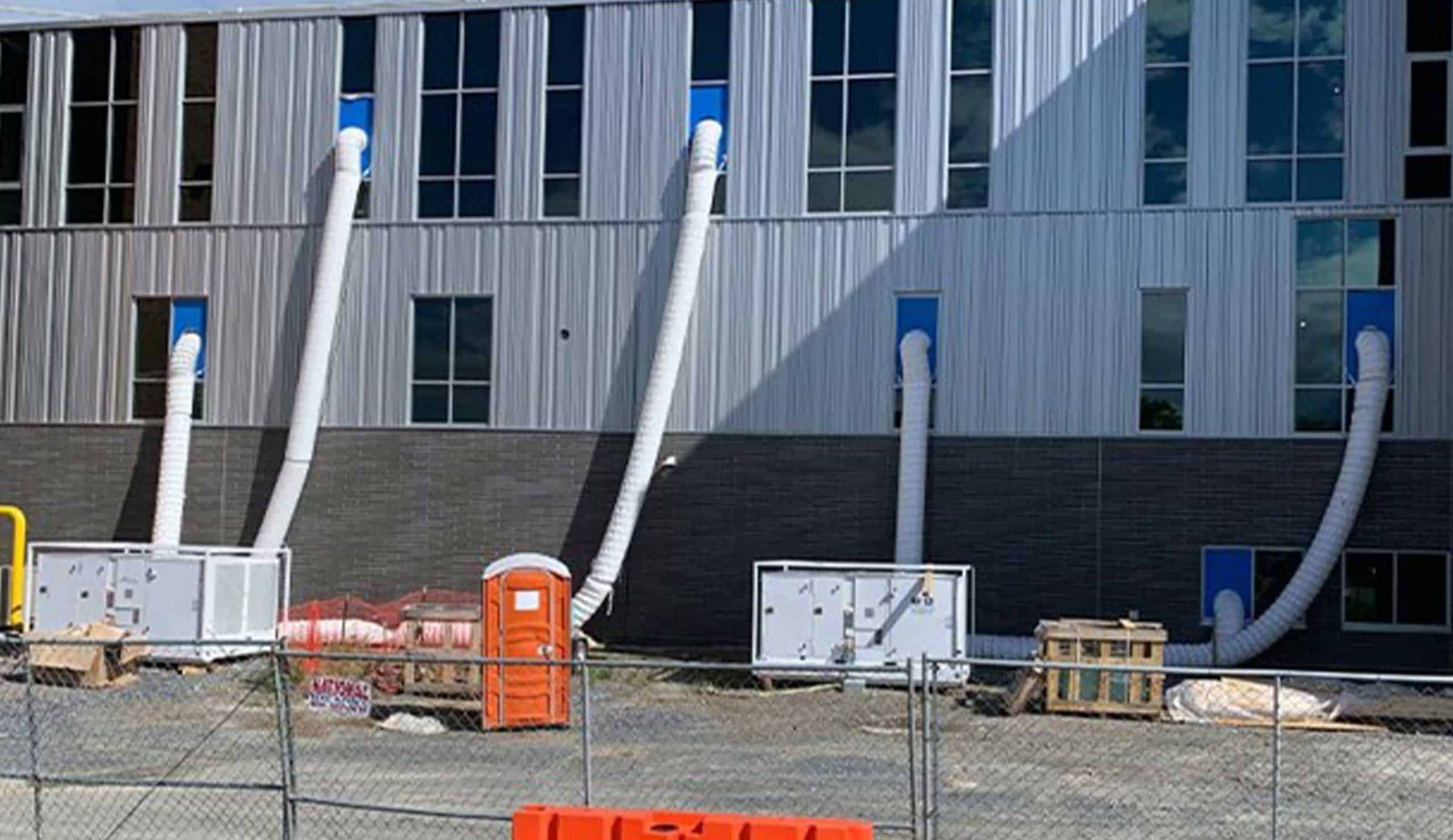
Major industrial projects run on tight schedules, fixed budgets, and interdependent sequences where a single delay in one phase compounds through every phase that follows. Environmental conditions sit at the center of most of those delays. Concrete that cannot cure in freezing temperatures, coatings that fail because humidity was not controlled, crews that slow down or stop working because heat or cold exceeded safe limits: these are not unusual outcomes. They are the predictable consequences of treating climate control as an afterthought rather than a core element of project planning.
Total climate control is the coordinated management of temperature, humidity, and airflow across every work zone and project phase that depends on stable environmental conditions. It is not a single piece of equipment or a seasonal consideration. It is an engineered approach to keeping a project on schedule regardless of the weather. At REIC Rentals, we deliver climate control solutions for major projects across North America, from the first mobilization day through final inspection, backed by 55 locations and field teams that respond when conditions change.
What Total Climate Control Actually Covers
Temperature is the most visible element, but it is not the only one. Humidity control prevents condensation from damaging electrical systems, causes steel components to corrode, and ruins stored materials in enclosed environments. Airflow and ventilation maintain safe conditions in confined spaces, dilute airborne contaminants, and support consistent drying and curing across large work zones. Managing all three in coordination is what separates a climate control plan that holds up through a demanding project from one that solves one problem while creating another.
The environments where this matters most are also the hardest to control. Remote oil and gas sites, underground mining operations, pipeline rights-of-way, modular fabrication yards, and large industrial facilities all present unique combinations of temperature range, humidity exposure, and ventilation constraints. A solution designed for a controlled warehouse environment does not directly translate to a winter turnaround at a northern refinery or a summer coating project in a humid Gulf Coast facility. The equipment and the plan must be designed for the actual deployment conditions.
The Operational Cost of Uncontrolled Environments
Every hour lost to weather-driven delays costs labor, equipment time, and schedule margin that cannot be easily recovered. In regions across North America where freezing temperatures arrive in October and persist through April, construction, coating, and curing processes face a window of risk that spans most of the operating year. Concrete that freezes before it reaches design strength requires removal and replacement. Coatings applied outside humidity specifications fail inspection and must be reapplied. Either outcome costs far more than the climate control equipment that would have prevented it.
Heat exposure creates a parallel risk profile in summer. Workers in environments above safe temperature thresholds slow down, make errors, and require more recovery time between tasks. Heat stress incidents trigger investigations, lost-time claims, and the crew morale impact that follows a serious safety event. Equipment operating above rated ambient temperatures degrades faster and fails sooner. In both directions, the cost of uncontrolled conditions is consistent and predictable. The cost of controlling them is a fraction of what the alternative produces.
Moisture damage in enclosed environments adds a third category. Condensation forming on electrical systems, switchgear, and instrumentation during temperature cycling is a common failure mode in enclosures that lack humidity control. Steel components stored without desiccant protection in high-humidity environments develop surface corrosion, compromising coating adhesion and inspection outcomes. These are not dramatic failures. They are slow, incremental quality problems that surface at the worst possible point in the project sequence.
Heating Solutions for Cold Weather Operations
Cold-weather construction and industrial work require heating solutions sized for the work zone, safe for the environment, and reliable under sustained low-temperature conditions. REIC Rentals carries flameless Jet Heat technology, indirect-fired heaters, electric heaters, and make-up air units across a broad capacity range. Jet Heat is exclusive to REIC Rentals and uses patented flameless technology that delivers high-volume heat without combustion exhaust, making it the right choice for enclosed spaces, hazardous areas, and applications where combustion moisture could compromise curing or coating outcomes.
Concrete curing in cold weather requires controlled temperatures that prevent freezing before the mix reaches design strength. Coating and painting operations require substrate temperatures above the dew point and within the manufacturer-specified application window. Weld preheat and post-weld heat treatment in pipeline and structural steel work require consistent, controlled heat delivery across the weld zone. Each of these applications has specific equipment requirements, and selecting the right heater type for the application is what determines whether the outcome meets spec or requires rework.
For projects operating in extreme cold, below -22 degrees Fahrenheit, standard indirect-fired units may not deliver adequate performance without supplemental insulation and heated enclosures. REIC Rentals has deployed heating solutions across oil and gas, pipeline, and mining operations in North America, where those conditions are standard across the winter operating season. We know what those deployments require, and we configure equipment accordingly.
Cooling Solutions for Summer Operations and Process Environments
Summer operations across refineries, power stations, and industrial construction sites require cooling that holds up under sustained ambient heat and continuous 24/7 shift schedules. REIC Rentals portable air conditioners, spot coolers, evaporative coolers, and high-capacity packaged cooling systems cover the full range, from targeted spot cooling in control rooms and electrical enclosures to full work-zone conditioning in tented or enclosed areas. Industrial-grade units rated for high-ambient operation perform reliably where standard commercial equipment fails under sustained load.
Process cooling for turnarounds and shutdowns at refineries, chemical plants, and power stations requires an approach different from general site cooling. Temporary chillers and cooling towers reduce system and equipment temperatures during peak operations and directly support the mechanical scope of the outage. Configuring these systems into the turnaround plan before the outage begins, rather than responding to cooling failures after the shutdown window has opened, is the difference between controlled execution and reactive problem-solving under pressure.
Humidity Control and Drying for Coating, Curing, and Storage Applications
Humidity control is frequently the most technically demanding element of a total climate control plan because the consequences of getting it wrong are often invisible until an inspection failure or material failure reveals them. Industrial dehumidifiers using desiccant and refrigerant technology maintain relative humidity within the tight windows required for industrial coating, concrete curing, and long-term equipment storage. Desiccant units perform reliably in cold environments where refrigerant-based dehumidifiers lose efficiency, making them the right choice for winter coating projects and cold-climate enclosure protection.
Coating and painting projects on steel structures, pipelines, and industrial equipment are among the most humidity-sensitive applications in industrial work. Surface condensation during application causes adhesion failure. High ambient humidity during cure extends dry times and affects film integrity. Controlling both the substrate temperature and the ambient humidity within the application shelter allows coating work to proceed on schedule regardless of outdoor conditions, particularly on projects in coastal or high-humidity regions where waiting for natural conditions is not a viable strategy.
Ventilation for Safety and Environmental Compliance
Airflow and ventilation are safety requirements in confined space work, coating applications, and environments where airborne contaminants accumulate. Explosion-proof fans and high-capacity ventilation systems provide continuous safe airflow in classified hazardous areas, enclosed fabrication spaces, and underground work environments. Custom ducting routes conditioned air to specific work zones, maintaining consistent temperature and air quality across areas that natural ventilation cannot reach.
Regulatory requirements for confined space entry, coating application, and welding in enclosed environments specify minimum air exchange rates and contaminant thresholds that must be maintained throughout the work activity. Undersized or improperly configured ventilation systems create compliance gaps that halt work and generate documentation requirements that consume time the project cannot spare. Sizing and positioning ventilation systems correctly from the start of the work scope is substantially less costly than the alternative.
Climate Control Across Key Industries and Project Types
The applications for total climate control span every major industrial sector. Oil and gas infrastructure projects require pipeline coating protection, weld shelter heating, and humidity control for instrumentation storage. Petrochemical and refinery turnarounds demand integrated heating, cooling, and dehumidification across multiple simultaneous work scopes operating under fixed outage windows. Mining expansion projects require heating and cooling systems that perform effectively in both underground and surface environments across extreme seasonal temperature ranges.
Power station outages and upgrades require dry, controlled environments for turbine work, electrical installations, and the handling of critical equipment. Civil infrastructure and construction projects depend on heating for cold-weather concrete and coating work, and cooling to maintain crew productivity through summer builds. Modular fabrication and pre-fab yards need stable conditions for adhesive cure, equipment assembly, and material storage across extended production runs. In each of these environments, climate control is not a support function. It is a direct enabler of schedule performance and quality outcomes.
Building the Climate Control Plan Into the Project from the Start
The most common climate control failure mode on major projects is not equipment failure. It is late planning. Climate control, scoped and resourced during the project planning phase, is integrated, appropriately sized, and deployed before the work sequence that depends on it begins. Climate control addressed after a delay or failure has occurred is reactive, more expensive, and often only partially effective because the damage or rework has already begun to accumulate.
Effective planning starts with a site assessment that covers work zone layout, volume and enclosure characteristics, seasonal temperature and humidity ranges, equipment heat load, crew size and shift schedule, and power availability. That information drives equipment selection, sizing, generator requirements, and layout planning. REIC Rentals works with engineering teams, safety leads, and site management through this process so the climate control plan reflects the actual conditions of the deployment rather than a generic specification applied to a specific project.
Monitoring temperature, humidity, and airflow across key zones throughout the project allows the plan to adjust as conditions change. A cold snap that drops temperatures 20 degrees below the seasonal forecast requires a different heating response than standard operating conditions. A humidity spike during a coating application window requires an immediate response from the dehumidifier to protect the work already completed. Building that responsiveness into the plan means the adjustment occurs via a phone call and equipment deployment rather than a failed inspection and a rework scope.
Climate Control Is Project Control
You cannot control the weather. You can control the environment your crews work in, the conditions your materials cure and coat in, and the temperature ranges within which your equipment operates. That control is what keeps a project on schedule when outdoor conditions deteriorate, protects quality outcomes through seasonal extremes, and keeps workers safe throughout the full duration of a demanding build or turnaround.
REIC Rentals brings the fleet depth, technical expertise, and field presence across 55 North American locations to deliver that control on projects of every scale and scope. Tell us your project type, site location, work schedule, and environmental challenges. We will build a climate control plan that supports every phase of the work, from first mobilization through final inspection.
1.888.356.1880 | in**@**ic.com | Get a Quote
Service You Trust. Equipment You Need.
