Spring turnaround season compresses months of deferred maintenance into tight execution windows where the wrong equipment decision can cost more than the equipment itself. Choosing between a scissor lift and a boom lift is not a minor logistics question. It determines whether crews access the work zone efficiently or spend shifts waiting, repositioning, or improvising access that the right machine would have made straightforward.
The principle is simple. For straight-up vertical work on level surfaces, scissor lifts are the right choice. For access requiring horizontal reach, multi-directional positioning, or navigation around structural obstacles, boom lifts are the right choice. Most turnarounds and complex construction projects need both, in proportions that depend on the specific work scope and site layout. Getting that mix right before mobilization begins is what protects the schedule. Getting it wrong compounds across every shift that follows.
REIC Rentals works with refinery, petrochemical, power station, and commercial project teams ahead of outage start dates to review job scope, walk the site, and recommend the lift mix that fits the work. We have seen what happens when the right machine is not confirmed in advance. It is a straightforward problem to prevent and a costly one to solve under execution pressure.
Why the Lift Decision Belongs in the Planning Phase
Refineries, chemical plants, and power facilities schedule major maintenance outages in spring to complete work before peak summer demand. These turnarounds compress large volumes of deferred maintenance into windows of 2 to 8 weeks, during which lost production can cost tens of thousands of dollars per hour. When the aerial lift arriving on site is the wrong type for the work scope, the crew does not just lose a lift; they lose the entire job. They lose productive shift time waiting for the right equipment while the outage clock continues running.
Incorrect lift selection creates compounding problems on high-intensity outages. Access delays emerge when crews cannot reach the work zone with the machine on hand. Congestion builds near critical equipment when multiple crews compete for the one lift type that can actually reach the work. Safety exposure increases when workers overreach from inadequate platforms or resort to ladder combinations that a proper lift would eliminate. These problems push unit restart dates and extend revenue losses in ways that dwarf the cost of a thorough pre-outage equipment review.
REIC Rentals supports planning teams months before the outage through site walks, equipment counts, and lift-mix recommendations specific to each unit or area. Getting the aerial equipment plan right before mobilization begins is as important as confirming cranes, power infrastructure, and temporary facilities.
Scissor Lifts: Vertical Access, Platform Capacity, and Indoor Performance
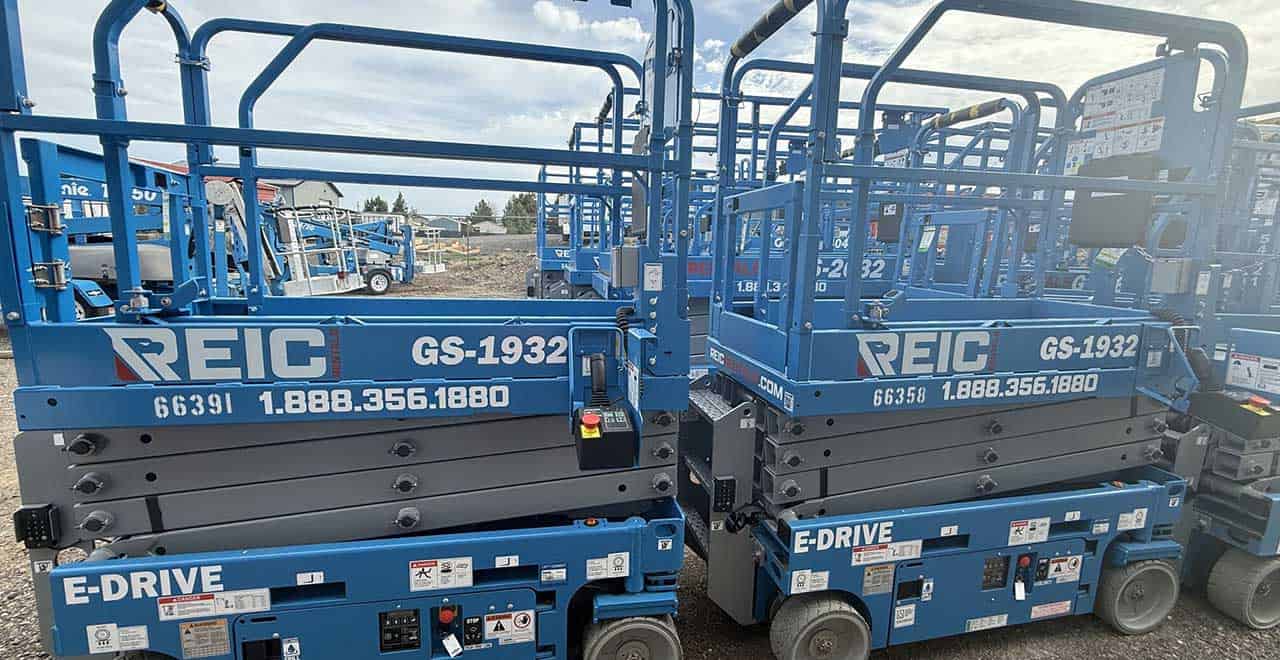
A scissor lift uses an X-pattern mechanism to raise and lower personnel vertically. The platform travels straight up and down while the base remains stationary, creating a large rectangular work surface that provides stability on level ground and supports higher payloads than most boom configurations. REIC Rentals scissor lifts range from 19 to 32 feet working height on electric models suited to interior work, up to 40 to 60 feet on rough-terrain diesel units for outdoor yard applications. Platform capacities run from 500 pounds on smaller electric models to 3,500 pounds on heavy-duty rough-terrain units, making scissor lifts the right choice when multiple trades need to share a platform or when materials need to be staged at height alongside the crew.
Scissor lifts perform best when the work is directly overhead and does not require lateral repositioning between picks. Instrumentation checks and cable tray work in control buildings, lighting and HVAC maintenance in production halls, and exchanger bay work along pipe racks, where only vertical movement is needed, are all strong applications for scissor lifts. Electric models deliver zero-emission, low-noise operation for enclosed spaces and emissions-sensitive facilities. Rough-terrain units provide the ground clearance and traction needed for outdoor work in the muddy, uneven conditions that spring turnarounds regularly produce.
The payload advantage of a scissor lift is frequently underestimated in turnaround planning. A 40-foot rough-terrain scissor supporting 1,500 to 3,500 pounds allows mechanical and instrumentation crews to work simultaneously with tools and materials staged on the platform. A spring filter house rebuild, for example, can stage duct sections and tooling on a scissor platform rather than requiring multiple trips that a narrower boom basket forces. That efficiency compounds across a high-headcount outage where the same task repeats dozens of times across multiple units.
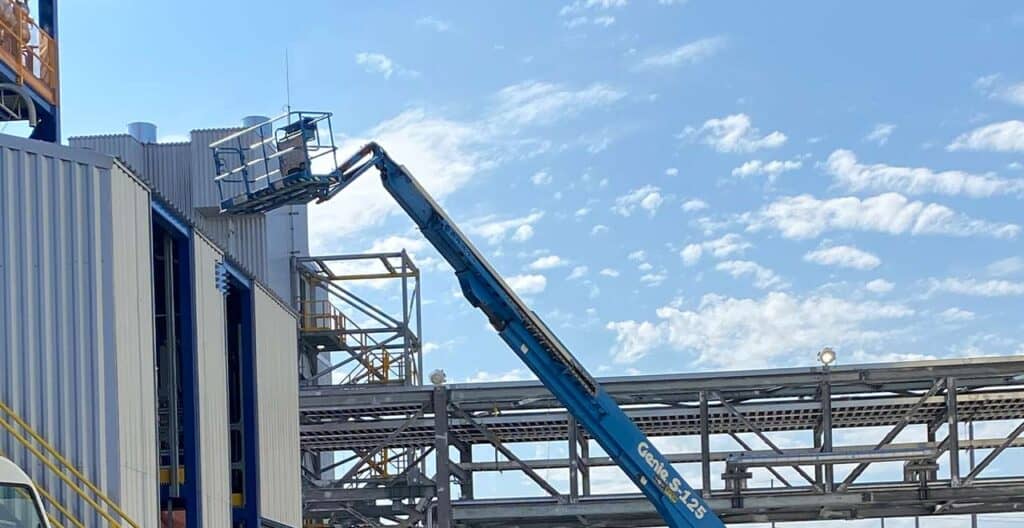
Boom Lifts: Reach, Obstacle Navigation, and Multi-Directional Access
A boom lift is an aerial work platform mounted on an extendable arm that provides both vertical and horizontal reach, allowing operators to navigate around obstacles and access work areas laterally offset from the machine’s base position. Articulating boom lifts feature multiple joints for up-and-over access around pipe racks, structural steel, and process equipment. Telescopic boom lifts use straight booms for maximum horizontal reach on open or exterior work fronts, such as tank farms and stacks. REIC Rentals commonly rents 60-, 80-, and 120-foot units for industrial turnarounds, with telescopic models reaching 150 feet and beyond for tall-structure access.
Boom lifts eliminate or significantly reduce scaffolding requirements on short-duration tasks, which matters considerably on turnarounds where scaffold erection and removal consume schedule time that the outage window cannot absorb. Scaffolding for a 100-foot structure requires days of erection time and ties up labor that could be executing the maintenance scope. An 80-foot articulating boom achieves the same access in hours and repositions to the next work location without dismantling anything. For refractory inspection and stack access, exterior column and tower work, and elevated ductwork obstructed by existing steel, the boom lift is the machine that keeps the schedule on track.
Boom lift platform capacities typically run 500 to 750 pounds, accommodating one to two workers with tools. That constraint is the trade-off for the reach and positioning flexibility the machine provides. Recognizing which tasks require reach and which require payload capacity is the core of an effective lift mix decision. REIC Rentals supplies both diesel and hybrid or electric boom lifts to meet the emissions and noise restrictions that apply on sensitive industrial sites.
The Five Factors That Drive the Right Lift Choice
Five practical factors should govern lift selection for each work package on a turnaround or construction project. REIC Rentals field representatives walk sites with planners and safety teams to apply these factors to specific work areas before the outage begins, so the decision is made with full site context rather than under mobilization pressure.
Access Pattern
Access pattern is the first and most important factor. If the work is concentrated directly above the floor or slab, overhead piping runs, cable trays, lighting fixtures, and scissor lift positions are set once, and crews complete the task without repositioning. When crews must navigate around structural steel, conveyors, or process lines to reach the work zone, the articulating boom creates safer, faster access. A distillation unit outage where operators need to reach valves positioned behind structural platforms is a clear boom lift application: the articulating machine positions the basket directly at the valve without the unsafe reaching required by a scissor-plus-ladder combination.
Required Working Height
Required working height determines the machine class. Platform height and working height differ, so plan accordingly: a 40-foot scissor lift typically offers approximately 46 feet of working height. Up to 40 feet, either a scissor or a small boom works, depending on the obstacles. From 40 to 60 feet, large rough-terrain scissors or mid-range booms are needed. Above 60 feet, boom lifts in telescopic or articulating configuration become the practical choice. A 90-foot flare line inspection requires a 120-plus-foot boom lift to reach the work safely, avoiding temporary scaffold erection that would consume days of schedule time. REIC Rentals cross-checks height requirements against plant draw
Capacity, Crew Size, and Tools
Crew size and payload requirements favor scissor lifts when multiple trades need to share a platform or when materials must travel with the crew. Boom lift platforms support 500 to 750 pounds and one to two workers with minimal tools. Scissor lifts handle 1,000 to 3,500 pounds, depending on the model. Tasks involving mechanical and insulation crews working simultaneously, or electrical and instrumentation working together with cable reels and components staged on the platform, belong on a scissor lift. Planners should list personnel, tools, and material loads for each task and match them to capacity specifications before confirming equipment.
Ground Conditions, Environment, and Location
Ground conditions and site environment determine which machine configuration can safely operate. Indoor settings with smooth concrete and strict emissions limits call for electric scissor lifts or compact electric booms. Outdoor refinery and plant areas with uneven, muddy, or compacted gravel ground require rough-terrain scissor lifts or four-wheel-drive booms with outriggers. Scissor lifts tolerate only 2.5 degrees of tilt before tip-over risk increases, while boom lifts with outriggers tolerate up to 5 degrees. Ground condition assessment before lift selection is a safety requirement, not a preference. Spring rain, thaw, and mud affect both stability and traction on machines specified for dry ground conditions. This is one of the most commonly overlooked variables in spring turnaround lift planning.
Budget, Schedule, and Turnaround Strategy
Schedule and budget consequences complete the decision framework. Boom lifts carry higher daily rental rates than similarly sized scissor lifts, but the relevant comparison is not lift cost against lift cost. It is lift cost against scaffolding cost, erection time, and the schedule risk of losing days to temporary access structures on critical path tasks. A strategically deployed boom lift on a complex access task often produces a net schedule and cost advantage that justifies the rate differential. REIC Rentals proposes blended fleets, more scissor lifts for repetitive, vertical work, and strategic boom placements for critical path access, to hit both budget and completion targets without applying the same equipment to every work package.
Safety, Training, and Compliance During High-Intensity Outages
Spring turnarounds concentrate workers and equipment in ways that increase aerial lift incident risk when planning and training are inadequate. Both scissor and boom lifts require formal operator training and documented familiarization per OSHA regulations. Selecting the wrong lift type compounds the risk: crews overreaching from a scissor lift when a boom is required, or operating a boom on terrain it was not specified for, are the behavioral patterns that emerge when equipment decisions are made without sufficient planning time.
Pre-use inspections, fall protection policies, and spotters for congested areas are the operational controls that protect crews when the work pace is highest. Safety zones, travel paths, and staging areas for aerial lifts must be mapped in the site logistics plan before the outage begins. REIC Rentals supports this process by delivering equipment with current inspection and maintenance records, advising on operator training for specific models, and reviewing site logistics alongside lift selection so the safety planning reflects how the machines will actually be used across the outage.
Because most outages are scheduled in March through June, equipment and training coordination should begin well before the mobilization date. The availability of specific lift configurations narrows as the turnaround season peaks, and operators arriving on site unfamiliar with the model they are assigned to create safety exposure that early planning prevents.
Building the Right Lift Fleet for Spring Execution
REIC Rentals carries electric and rough-terrain scissor lifts from low-level access through 40-plus-foot working heights, and articulating and telescopic boom lifts from compact indoor units through 135-foot models for tall structures. The fleet is maintained and delivered ready for the shift cycles and performance demands of industrial turnaround work. Rental periods align with outage windows, with extensions available when schedules shift, and on-call service technicians respond when an issue arises mid-outage rather than leaving the site team to manage a downed machine without support.
Aerial lifts are one component of a broader spring readiness package. REIC Rentals supplies the complementary equipment that turnarounds and construction projects need alongside aerial access: generators and temporary power, light towers, telehandlers and material-handling equipment, and climate-control systems for enclosed work areas. Coordinating this equipment through a single rental partner simplifies logistics and ensures the full equipment plan arrives on the same schedule as the crews depending on it.
Tell us your outage dates, work scope, site layout, and access constraints. REIC Rentals will review the job, recommend the right scissor and boom lift mix for each phase, and confirm availability before peak season demand narrows your options. The right lift choice, confirmed before mobilization begins, is one of the most direct levers available to keep a turnaround on schedule and keep your crews working safely through the full outage window.
1.888.356.1880 | in**@**ic.com | Get a Quote
Service You Trust. Equipment You Need.