
Mold can begin colonizing damp porous materials within 24 to 48 hours under warm, humid conditions. In a warehouse or distribution center, that clock starts the moment water enters the building, and the scale of the problem grows with every hour the response is delayed.
Roof breaches, burst pipes, and flood surges can put standing water across hundreds of thousands of square feet. Palletized inventory, racking systems, floor coatings, and concrete slabs are all at risk simultaneously. The facilities that recover fastest are not the ones with the most floor space or the most equipment. They are the ones who responded quickly, sequenced the work correctly, and had the right combination of equipment on site from the first hours of the event.
REIC Rentals supports warehousing and distribution center operators with pumps, drying and dehumidification equipment, industrial fans, and heating equipment for water intrusion response. This article covers the full response sequence, from the first hours through final moisture validation, and explains how to protect the assets that keep warehouse operations profitable.
Rapid Response: The First Two to Six Hours
The first hours after water intrusion determine whether a facility faces a contained incident or a prolonged shutdown. The response sequence in this window is not about drying. It is about stopping the spread and protecting the highest-value assets.
Stop the source first. Drying equipment deployed before the water source is controlled is working against a continuous incoming load, preventing conditions from improving. Interim containment at a roof breach during an active rain event, valve closure for a burst supply line, and door sealing at a flooded dock are all prerequisites for effective drying.
Once the source is controlled, remove standing water with pumps before deploying drying equipment. Moving bulk water out of the facility mechanically is significantly faster than evaporation, and standing water that remains in the space while dehumidifiers run continues to add moisture load that prevents the environment from responding.
While water removal is underway, move moisture-sensitive inventory, electronics, packaged foods, and pharmaceuticals away from wet areas. Document affected zones with dated photographs and marked floor plans. That documentation serves both insurance purposes and equipment planning for the drying phase.
Understanding Why Large-Footprint Facilities Are Different
Water intrusion in a warehouse or distribution center is fundamentally different from that in a smaller commercial space. The volume of the affected area is larger, the inventory at risk is more diverse, and the drying requirements of the building materials and coatings lead to a longer recovery timeline than most facility teams anticipate.
Water travels further from its entry point in open-plan facilities with high ceilings. It follows expansion joints and rack rows, moving hundreds of feet from the breach before accumulating. Concrete slabs absorb moisture that persists as hidden vapor beneath epoxy and urethane floor coatings long after the surface appears dry. Steel racking components exposed to sustained moisture begin corroding at connection points and base plates, often in ways not visible from the aisle level without close inspection.
Cardboard packaging is particularly deceptive. Packaging that appears dry on the outside may be holding trapped moisture in inner layers that will continue to off-gas humidity into the conditioned space and provide a substrate for mold growth after the immediate response is complete. Zoning the facility based on moisture readings and material type, rather than on the visible water line, produces a drying plan that addresses the full scope of the event.
The Three Core Drying Principles at Warehouse Scale
Three principles drive effective drying in large-footprint facilities. Getting all three right simultaneously is what produces fast, complete drying. Getting one wrong undermines the other two.
Air movement lifts residual moisture from wet materials and surfaces, creating a boundary-layer replacement that allows evaporation to continue at the surface rather than stalling once the immediate surface moisture is gone. Without adequate air movement, dehumidifiers pull from the air mass around them while wet surfaces remain wet.
Dehumidification extracts the moisture that air movement carries off wet surfaces into the air stream. Without dehumidification, aggressive air movement simply moves humid air around the building without reducing the total moisture load. The two work together, not independently.
Temperature management increases evaporation rates on cool concrete slabs and in cold-climate facilities, where ambient temperature slows the drying process. Pairing heating equipment with air movement and dehumidification significantly accelerates drying on concrete that would otherwise take weeks to reach specification under air movement and dehumidification alone.
Pumps and Extraction: Before Dehumidifiers Come On
High-volume pumps address standing water accumulation in low areas, dock recesses, and anywhere water has pooled to a depth. Submersible units handle dock flooding and low-spot accumulation. Walk-behind extractors reach water trapped under conveyor lines, along rack bases, and in textured safety-surface areas where pumps cannot effectively reach.
The sequencing matters: pumps first, then air movers and dehumidifiers. Running drying equipment in a space with significant standing water is inefficient. The standing water continues to contribute moisture to the air at a rate that overwhelms the dehumidification capacity sized for residual moisture in materials rather than open water.
REIC Rentals supplies matched pump and extraction equipment, along with drying equipment, so the full response can be coordinated from a single call. Our teams have seen the sequencing error play out often enough that we address it proactively rather than letting facilities discover it mid-event.
Air Movement in High-Bay Spaces
Industrial fans and air movers create directional airflow that enables dehumidification to work across a large footprint. Low-profile units along rack aisles push air under pallets and across damp concrete slabs. Axial fans drive air along long travel paths, such as pick tunnels and conveyor lanes.
High-bay warehouse spaces create a specific challenge: heat stratification concentrates warmer air near the ceiling while cool air sits at floor level, slowing evaporation where it matters most. Fans mounted on mezzanines or directed downward from ceiling height disrupt that stratification and bring drier air from the upper zone down to the wet floor surfaces, where drying needs to happen.
Dead zones behind columns, in corners, and under mezzanines require specific attention because they do not receive adequate airflow from equipment positioned for general coverage. Our teams map airflow paths before placing equipment to ensure coverage reaches every affected zone rather than leaving pockets that stay wet after the rest of the facility has cleared.
Dehumidification: Choosing the Right Equipment Type
The choice between refrigerant-based and desiccant dehumidifiers depends on the ambient conditions in the affected facility.
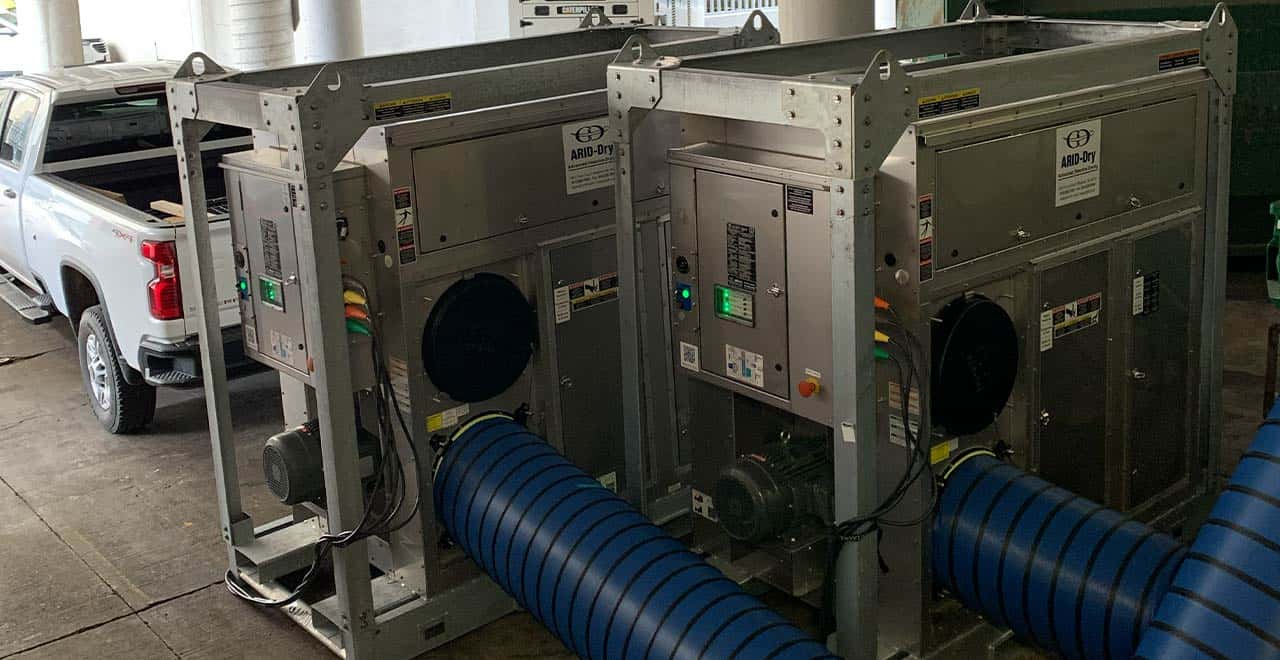
Refrigerant dehumidifiers perform effectively in warm, humid conditions and suit most summer water intrusion events in ambient warehouse spaces. They are the standard choice for general moisture control during the active drying phase in facilities with moderate or warm ambient temperatures.
Desiccant dehumidifiers perform at lower temperatures and achieve lower dew points than refrigerant systems. They are the appropriate choice for cold-climate facilities, cold-storage adjacent zones where ambient temperatures are lower than standard warehouse conditions, and for applications where the final humidity target is more demanding than refrigerant equipment can achieve. In a facility where the affected zone is cooled by proximity to refrigerated areas, desiccant equipment may be the right choice even during a summer event.
REIC Rentals provides both equipment types, sized to the actual cubic volume of the affected zone and the moisture load of the materials involved, rather than applying a standard unit count regardless of the event’s scale. Request a quote to discuss your facility’s specific conditions.
Monitoring: Confirming Drying Progress Rather Than Assuming It
Large losses must be measured, not estimated, to confirm when the structure and contents have reached acceptable moisture levels. Surface appearance is not a reliable indicator. Concrete that looks dry can carry moisture vapor emission rates that will cause adhesive failure in floor coatings applied too soon. Racking that appears intact after a water event may have corrosion developing at base plate anchor points that is not visible without close inspection.
Pin-type moisture meters confirm conditions in drywall office partitions, wood blocking, and wall cavities. Pinless meters read concrete slabs and sealed floor coatings without penetrating the surface. Infrared cameras detect hidden moisture behind walls and under floors that visual inspection cannot identify. Data loggers tracking ambient temperature and humidity over several days confirm that conditions are improving across the entire affected zone, not only near monitoring points.
REIC Rentals teams help set target moisture readings, interpret data as drying progresses, and adjust equipment placement and run times to avoid both under-drying and over-drying. The goal is confirmation, not estimation.
Floor Coatings, Racking, and Inventory: What Needs Specific Attention
Epoxy and urethane floor coatings require concrete to reach specific moisture vapor emission rates before reapplication following a water event. Coatings applied over concrete that has not reached specification will fail at the adhesion layer, requiring a second removal-and-reapplication cycle that compounds the cost and timeline of the original event. Drying to specification means monitoring until the concrete actually meets the coating’s requirements, not until the surface looks dry.
Racking systems in affected zones should be included in the drying plan rather than treated as structural elements separate from the moisture remediation. Directing airflow across racking surfaces, monitoring conditions within racking zones rather than only at aisle perimeters, and scheduling post-event racking inspection and load verification as a defined step in the recovery sequence are all components that protect both the racking investment and the facility’s operational safety after it returns to service.
Inventory triage follows the water category. Grossly contaminated water events require immediate assessment and disposal decisions on the affected product. For events involving clean or lightly contaminated water, isolate questionable pallets for inspection before returning them to storage. Check the inner layers of cardboard and shrink wrap for trapped moisture that surface assessment would miss.
Scenario: Roof Failure in an Active Distribution Center
Consider a distribution center where a roof membrane section fails during a heavy rain event, allowing water to enter across a significant portion of an active picking and staging area. Standing water accumulates in low spots, lower racking levels are wet, and the epoxy floor coating shows moisture intrusion at the surface.
The response begins with interim containment at the roof breach. Pumps address standing water in the lowest areas of the zone. Once standing water is removed and the source is controlled, dehumidifiers and air movers are deployed across the full affected footprint. Inventory on lower racking levels is assessed, relocated where possible, and documented for insurance purposes where it cannot be moved.
Humidity monitoring by zone tracks progress toward the moisture vapor emission rate required for floor coating reapplication. Racking in the affected zone is included in the drying plan and documented for post-event structural inspection. With equipment correctly sized and sequenced from the start, the affected zone reaches specification within days rather than weeks. Operations return in a defined sequence: picking aisles first as racking inspection clears them, staging and full operation as floor coating work completes.
That outcome depends on having the right combination of equipment on site from the first hours and on sequencing the work correctly. REIC Rentals supports that from the first call.
Pre-Incident Planning: Before Water Is on the Floor
The warehouses and distribution centers that recover fastest from water intrusion events share one characteristic: they had thought through the response before the event forced them to. Equipment sources were confirmed. Access was documented. Decision authority was assigned. Insurance contacts were current.
Practical preparedness before the next rain season means identifying the lowest areas of the facility where water accumulates during heavy rain, confirming pump and extraction equipment sources and lead times, documenting electrical capacity and connection points for drying equipment, assigning decision authority for initiating an emergency equipment deployment, and establishing a pre-arranged relationship with REIC Rentals before an event requires one. None of those steps takes significant time under normal conditions. All of them take significantly longer under emergency conditions when the answers are needed immediately.
REIC Rentals supports pre-incident planning for warehousing and distribution facilities through site assessments that document facility layout, vulnerable zones, and power infrastructure. Find a location near you to connect with the team in your area, or request a quote to start the conversation now, before standing water is the reason you called.
1.888.356.1880 | in**@**ic.com | reic.com
Service You Trust. Equipment You Need.
