
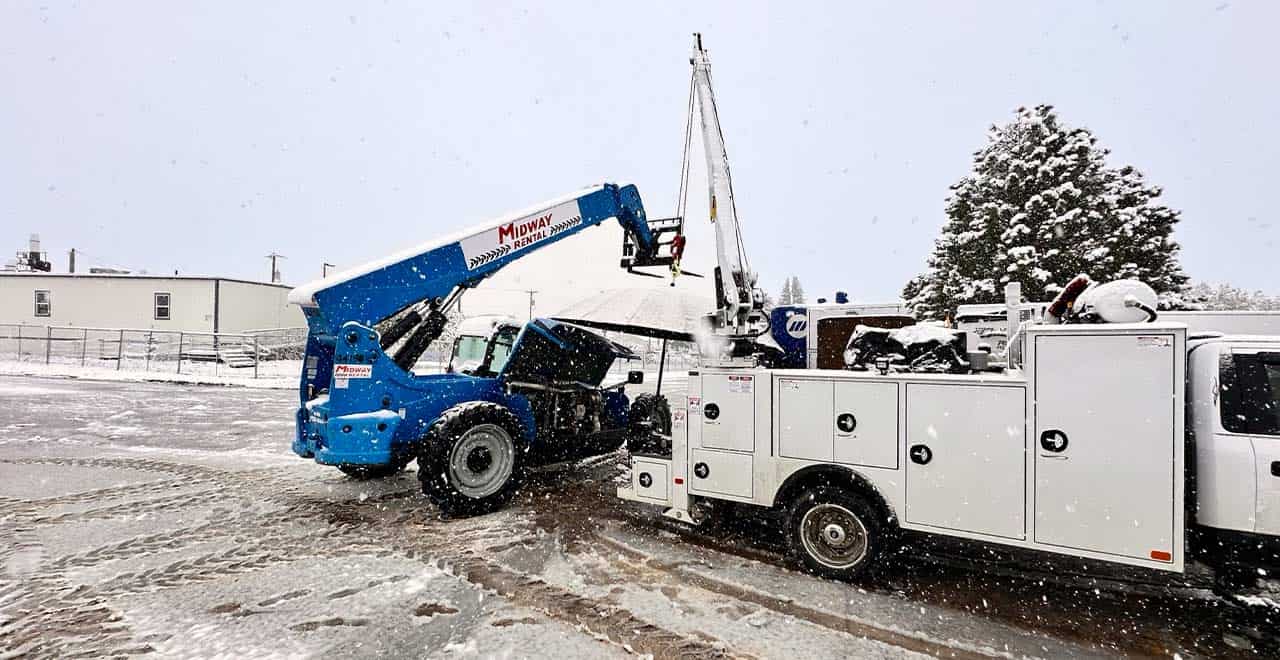
Maximizing Efficiency and Uptime on Commercial Construction Job Sites
Commercial construction projects are built on momentum. Every day on site involves multiple trades, heavy materials, tight access points, and constant coordination. When equipment, labor, or logistics slow down, productivity drops—and schedules become harder to protect.
That’s why telehandlers have become one of the most valuable machines on industrial and commercial job sites. With the lifting power of a forklift and the reach of a boom, telehandlers provide unmatched versatility for material handling, staging, and support across every phase of construction.
At REIC Rentals, we help contractors keep projects moving with dependable equipment rentals backed by knowledgeable teams and service focused on uptime. Telehandlers are a prime example of how the right machine can dramatically improve efficiency, reduce labor strain, and support safer job site operations.
This article explores how telehandlers increase industrial productivity and why they are essential tools for modern commercial construction.
What Is a Telehandler?
A telehandler, or telescopic handler, is a lifting machine equipped with a boom that extends forward and upward. Unlike a standard forklift, a telehandler can reach elevated work zones and place materials at height with precision.
Telehandlers are widely used on commercial job sites because they combine:
- Heavy lifting capacity
- Extended reach
- Rough-terrain mobility
- Attachment versatility
From steel erection to interior staging, telehandlers support tasks that would otherwise require multiple pieces of equipment.
Why Productivity Depends on Material Handling
Industrial and commercial construction is a logistics-driven environment. Crews rely on timely access to materials, tools, and components. Delays often occur when:
- Materials cannot be staged efficiently
- Crews spend time manually moving loads
- Equipment access is limited
- Trades compete for lifting resources
- Site layouts change as construction progresses
Telehandlers solve many of these challenges by streamlining movement across the job site.
The result is more productive crews, fewer bottlenecks, and faster execution.
Key Ways Telehandlers Increase Industrial Productivity
Telehandlers are not just lifting machines—they are productivity multipliers. Their flexibility makes them indispensable across commercial construction environments.
1. Faster Material Placement at Height
Commercial builds often require materials to be delivered directly to elevated work areas, including:
- Structural steel zones
- Upper-level framing areas
- Rooftop mechanical staging
- Multi-story interior buildouts
Telehandlers allow operators to lift and position loads quickly without relying solely on cranes or manual carrying.
By reducing handling steps, crews spend more time building and less time waiting.
2. Reduced Labor Demands and Physical Strain
Material movement is one of the most labor-intensive parts of construction. Without proper equipment, workers may be forced to:
- Carry heavy loads long distances
- Reposition pallets manually
- Perform repetitive lifting tasks
Telehandlers reduce unnecessary physical strain by efficiently and safely handling heavy loads. This improves worker endurance, lowers injury risk, and keeps crews focused on skilled work.
3. Versatility Across Multiple JobSite Tasks
One of the biggest advantages of telehandlers is that they can perform many roles, depending on the attachments and job site needs.
Common telehandler applications include:
- Fork handling of pallets and materials
- Lifting HVAC equipment into position
- Moving concrete forms and rebar bundles
- Supporting masonry and scaffold staging
- Handling lumber and framing packages
Instead of renting multiple machines, contractors can rely on one adaptable solution.
4. Improved Efficiency in Tight or Rough Terrain Conditions
Industrial and commercial job sites are rarely smooth or predictable. Telehandlers are designed for challenging environments, including:
- Unfinished grading
- Muddy or uneven ground
- Congested staging areas
- Confined access points
Their rough-terrain capability allows them to operate where traditional forklifts cannot, keeping materials moving even in difficult conditions.
5. Enhanced Support for Industrial-Scale Projects
Large industrial construction projects—such as refineries, storage facilities, and infrastructure builds—require constant equipment support. Telehandlers help maintain productivity by enabling:
- Rapid staging of components
- Transport of heavy materials across wide sites
- Reliable lifting without crane scheduling conflicts
- On-demand access for multiple trades
When downtime is costly, telehandlers provide consistent lifting availability throughout the day.
6. Better Coordination Between Trades
Commercial construction involves many overlapping crews. When one trade is delayed waiting for materials, others are impacted as well.
Telehandlers improve coordination by:
- Delivering materials directly to the point of use
- Reducing congestion at laydown areas
- Allowing faster turnover between phases
- Supporting multiple work zones simultaneously
This helps contractors maintain workflow continuity and protect schedules.
7. Increased Safety Through Controlled Handling
Productivity and safety go hand in hand. Telehandlers improve job site safety by reducing manual lifting and improving load stability when operated correctly.
Safety benefits include:
- Fewer workers exposed to heavy lifting hazards
- Better control of materials at height
- Reduced risk of dropped loads when properly secured
- Improved visibility compared to improvised handling methods
Telehandlers must always be operated by trained personnel and within their rated capacities, but when used correctly, they contribute to a safer, more efficient job site.
Telehandlers in Commercial Construction Applications
Telehandlers are especially valuable in commercial environments where schedules are compressed and access is limited.
Common commercial uses include:
- Office and retail development material staging
- Warehouse construction support
- Data center equipment placement
- Hospital renovation logistics
- Multi-family housing framing and delivery
- Government facility modernization
Whether the project is vertical, industrial, or tenant-occupied, telehandlers provide reliable handling power.
Choosing the Right Telehandler for the Job
Not all telehandlers are the same. Selecting the right unit depends on factors such as:
- Required lift height
- Load capacity needs
- Site terrain conditions
- Attachment requirements
- Space constraints and maneuverability
A properly matched telehandler improves productivity, while an undersized or oversized unit can create inefficiencies.
That’s why working with experienced rental professionals is critical for equipment planning.
Best Practices for Maximizing Telehandler Productivity
To get the most value from a telehandler rental, contractors should:
- Plan staging zones and travel paths early
- Ensure operators are trained and authorized
- Use the right attachment for each task
- Conduct daily inspections before operation
- Avoid overloading or improper boom extension
- Coordinate telehandler availability across trades
With the right planning, telehandlers become one of the most impactful tools on site.
Building Momentum with the Right Equipment Partner
Commercial construction success depends on uptime, efficiency, and reliable job site support. Telehandlers play a central role in keeping industrial projects productive by improving material handling, reducing labor strain, and supporting multiple trades across complex environments.
REIC Rentals delivers dependable equipment solutions backed by responsive service and teams who understand the realities of demanding commercial job sites. Whether you need a telehandler for a single phase or ongoing support for a large-scale industrial build, the right equipment strategy helps protect schedules and maintain momentum. Contact our team to ensure your project has the support and equipment it needs to perform at every stage.
Service You Trust. Equipment You Need.
