
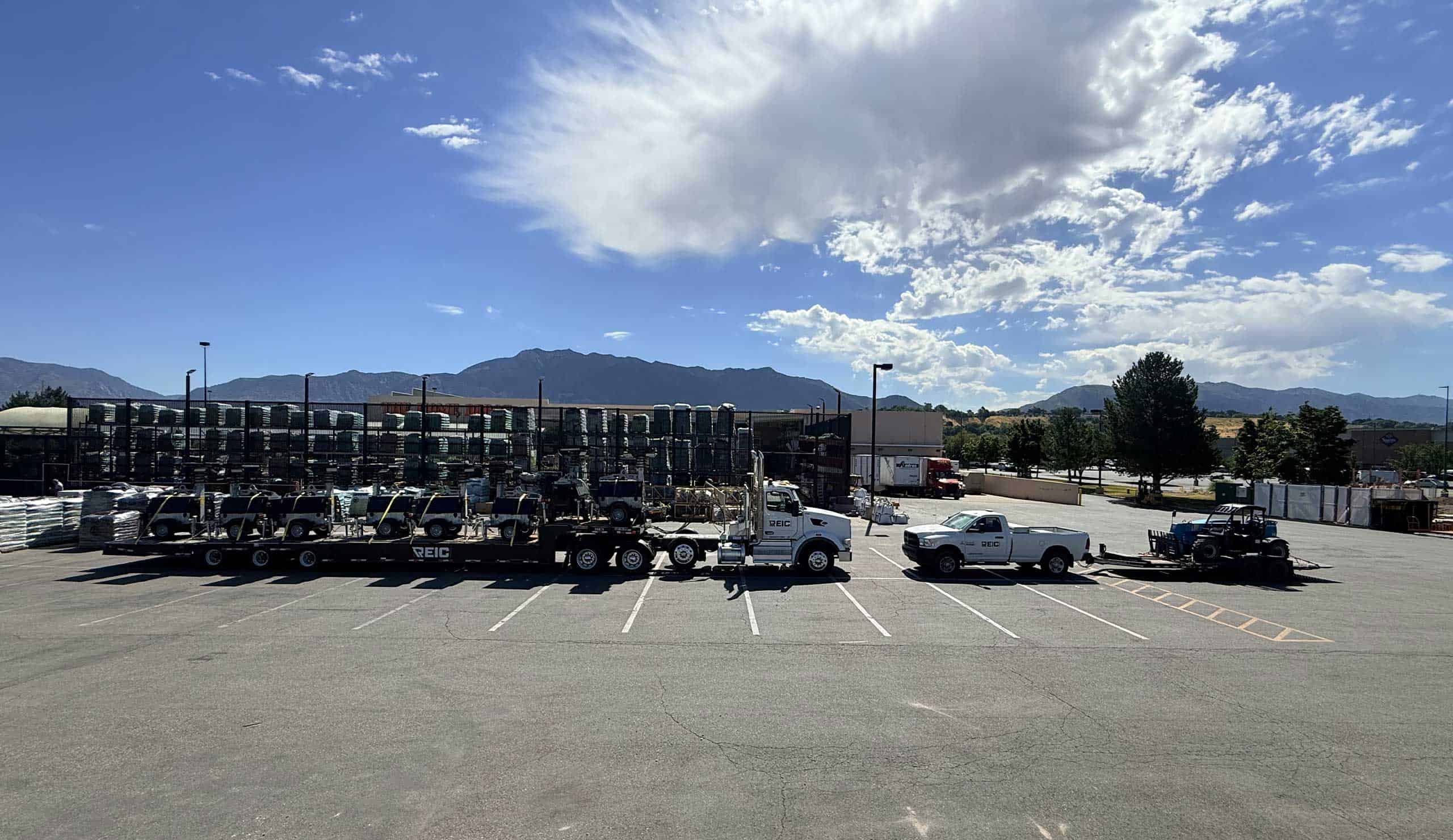
It is 2 a.m. on a Saturday at a remote oil and gas processing facility. A compressor failure has halted production. The repair crew is hours away. Parts are not in local inventory. The generators, temporary power distribution, and supplemental climate control needed to bridge the gap are the only things standing between a managed response and a multi-day production shutdown. And none of it is on site.
This is not a hypothetical. Our teams have responded to versions of this scenario across the Northern Plains, Mountain West, and Western Canada. The difference between facilities that recover in hours and those that absorb days of downtime is not luck. It is whether a pre-arranged rental partnership was in place before the event occurred.
For industrial facilities in oil and gas, petrochemical, mining, and remote continuous operations, unplanned equipment failures carry financial consequences that are disproportionate to the cost of the failed equipment itself. A compressor failure that halts production at a petrochemical facility carries an hourly cost that dwarfs the rental expense of the temporary equipment that could have bridged the gap. The investment in a pre-arranged rental partnership is not a contingency budget line. It is a direct operational cost control measure.
REIC Rentals serves industrial facilities across oil and gas, petrochemical and refinery, mining, and pipelines and storage tanks operations with temporary generators, cooling, heating, compressors, and pumps. This article covers what a pre-arranged partnership actually provides and why facilities with one consistently outperform those without when failures occur.
What a Pre-Arranged Partnership Actually Provides
A pre-arranged emergency equipment partnership is a set of decisions made in advance that eliminates the planning work that would otherwise happen during the emergency itself.
Those decisions include which equipment categories would be needed in each failure scenario, how equipment connects to the facility’s existing infrastructure, where staging areas are located, what access vendor teams need for after-hours entry, who has authority to initiate a deployment, and what the escalation sequence is when that person is unavailable.
Each of those decisions takes minutes to make under normal conditions. Under emergency conditions, they can each take hours. The pre-incident site assessment that REIC Rentals conducts produces exactly that documentation: power connection points, staging areas, access routes, equipment specifications for each critical zone, and the contact structure that allows after-hours deployment to initiate without delays at the gate.
When the first call comes after a failure event, the logistics begin immediately because the planning was done weeks or months earlier. Explore REIC Rentals Expert Solutions for integrated planning support for complex industrial facilities.
The Cost Equation: Partnership vs Reactive Procurement
The financial case for a pre-arranged partnership in industrial operations is straightforward but rarely quantified explicitly until after a significant failure event demonstrates it.
The cost of a pre-arranged partnership is the time invested in the site assessment, the agreement terms that establish pricing and response commitments, and, in some cases, the reservation of specific equipment staged at or near the facility.
The cost of reactive procurement during an active failure event includes:
- Lead time before equipment arrives during production downtime.
- Premium pricing when equipment availability is constrained during a regional event.
- Time spent identifying and qualifying a vendor under time pressure.
- Access delays when a new vendor arrives at a site they have never navigated.
- Extended production loss while all of the above are resolved.
At an oil and gas or petrochemical facility where hourly production value is significant, the difference between a two-hour deployment and a six-hour deployment can exceed the full annual cost of a pre-arranged partnership. That calculation makes the investment case simple.
Remote and Continuous Operations: Where Partnership Value Is Highest
The facilities where a pre-arranged partnership delivers the highest return combine remote location, continuous operation, and high production value per hour. Oil and gas compression and processing facilities on remote sites, petrochemical and refinery operations where shutdowns carry significant financial exposure, and mining operations in remote locations where logistics are complex and alternatives are limited, all represent the highest-value applications for a pre-arranged rental relationship.
Remote mining operations clearly illustrate the logistics dimension. Access roads to remote sites may have restrictions limiting when vendor vehicles can arrive. The nearest rental location may be several hours away. Equipment that is readily available in an urban market may not reach a remote mine site without advance coordination of permits, escort requirements, and road conditions. A pre-arranged partner who has navigated those logistics before is the only vendor who can actually respond at the speed the failure demands.
What to Pre-Arrange Before a Failure Occurs
The practical content of a pre-arranged partnership covers several distinct elements that together eliminate the improvisation that reactive procurement requires.
Equipment specifications for each failure scenario document what would be needed if specific critical systems failed. A generator sized to maintain control systems, communications, and critical process equipment during a grid outage. Temporary cooling capable of maintaining control room temperature within the range that process instrumentation requires. Compressor capacity to maintain pneumatic supply while the primary system is offline for maintenance.
Infrastructure documentation confirms where temporary equipment connects, where staging areas are accessible to vendor vehicles at all hours, and the specific access credentials that allow REIC Rentals delivery crews to enter the site without delays. Contact and authority documentation establishes who can initiate a deployment at any hour, with what spending authority, and what the escalation path is when the primary contact is unavailable.
Seasonal and Planned Events: Partnership Beyond Emergencies
An emergency equipment partnership that activates only during failures leaves significant value unrealized. The same site documentation, equipment specifications, and vendor relationships that support emergency response also support planned maintenance windows, seasonal capacity management, and the turnaround planning that industrial facilities execute annually or on multi-year cycles.
REIC Rentals supports planned maintenance and turnaround events with the same pre-arranged approach that applies to emergency response: equipment is specified and staged before permanent systems come offline, logistics are pre-planned so the maintenance window is spent on maintenance rather than equipment coordination, and demobilization is sequenced against the return of permanent systems. Browse the full equipment range, including generators, compressors, cooling equipment, and pumps, to understand the scope of support REIC Rentals provides.
Scenario: Compressor Failure at a Remote Processing Facility
Consider an oil and gas processing facility in a remote location where the primary compression system fails during an overnight shift on the weekend. The nearest qualified repair technician is several hours away. Parts are not in local inventory. The expected repair timeline is three to four days.
A facility with a pre-arranged partnership with REIC Rentals initiates the response within thirty minutes. The pre-existing site documentation identifies the temporary compressor specifications, staging location, power connection approach, and site access process. Equipment is mobilized from the nearest REIC Rentals location, with access credentials and staging logistics already confirmed. Temporary compression capacity is on site and commissioned within hours of the initial call.
Production continues at a reduced but operational rate throughout the repair period. The financial consequence of the failure is the cost of temporary equipment and the time to commission it, rather than the full production loss that would have occurred if the response had started from reactive procurement at the moment of failure.
That outcome does not happen by accident. It is the direct result of planning decisions made before the failure occurred, when roads were open, lead times were manageable, and decisions determining recovery speed could be made without a deadline.
Severe Weather Adds Another Layer
For facilities in the Northern Plains and Mountain West, severe weather events can simultaneously combine equipment failures with compromised access routes, grid outages, and communication disruptions. A compressor failure during a derecho that has also washed out the primary access road and taken the grid down is a materially more complex response challenge than a compressor failure under normal conditions.
Facilities that have pre-positioned equipment through REIC Rentals before storm season, or that have standing agreements allowing rapid mobilization, navigate these compound events significantly faster than those initiating procurement while conditions are already degraded. Pre-positioning is most valuable exactly when it is hardest to arrange reactively.
Building Your Emergency Equipment Partnership with REIC Rentals
The process begins with a site assessment that documents critical systems, the failure scenarios with the highest operational consequence, the equipment that would address each, and the physical and logistical constraints a deployment would need to navigate. That assessment produces the documentation that allows rapid response when an event occurs.
REIC Rentals maintains a comprehensive network of locations across North America, with local teams who understand the operational environments and logistics constraints of the industrial markets they serve. The combination of national fleet depth and local market knowledge enables REIC Rentals to respond at the speed industrial emergency response requires. Request a quote to begin the site assessment and partnership conversation before the next equipment failure decides the timeline for you.
1.888.356.1880 | in**@**ic.com | reic.com
Service You Trust. Equipment You Need.
