
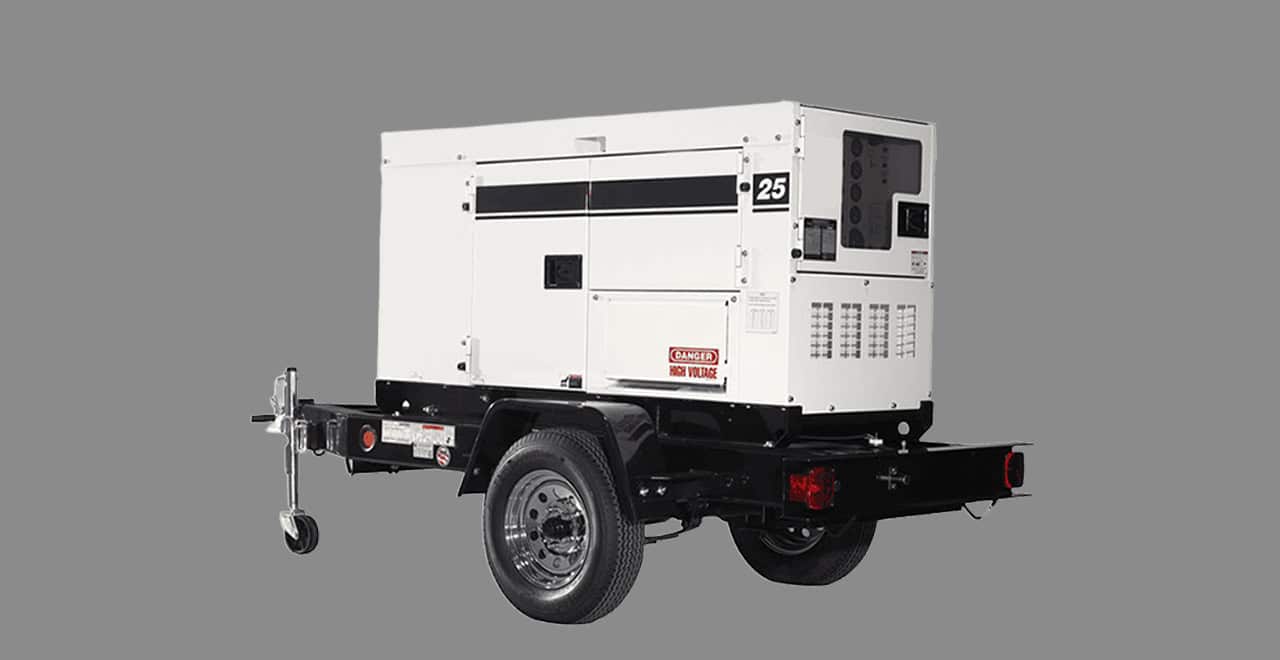
Generator sizing and rental planning for active projects are not back-office tasks. It is a core element of project management that determines whether crews stay productive, budgets hold, and a construction project can adapt as conditions change on site.
Power decisions affect every phase of a project. An undersized generator trips under combined loads, halts work, and forces crews to stagger tool use. An oversized unit wastes fuel, increases maintenance frequency, and may create compliance issues in urban environments where noise and emissions limits apply. The difference between right-sized power and wrong-sized power shows up in lost production hours and budget overruns that were entirely preventable.
REIC Rentals specializes in temporary power solutions for active construction sites, industrial turnarounds, and large-scale events. Our generator fleet is supported by application specialists who review load schedules and site conditions before making any recommendations. The goal is to give project managers, site superintendents, and procurement leads a practical framework for sizing generators correctly and planning rentals so power is never the reason a project falls behind.
Core Principles of Generator Sizing for Active Jobsites
Accurate generator sizing starts with understanding the difference between running load and starting load. Running load represents the continuous power draw of equipment in operation. Starting load, sometimes called surge or inrush current, can be significantly higher because electric motors require extra power to initiate. A pump might run steadily at a moderate load but demand two to three times that on startup. Compressors, welders, concrete saws, and HVAC units all exhibit similar behavior.
Typical load categories on an active project include construction tools, such as air compressors and welders, which both carry significant surge loads at startup. Temporary HVAC equipment for curing enclosures or occupied areas can add a significant load, with compressors spiking on startup. Office trailers, safety systems, and site communications add a smaller but consistent draw that must be accounted for in the total load calculation.
Consider an example for a concrete pour on a commercial project. Running loads might include pumps, mixers, cooling or heating equipment, and site lighting. The highest surge event, typically a pump or compressor starting under load, determines the true peak demand the generator must handle without tripping. Applying a safety margin above that peak and targeting generator operation in the 70-80 percent load range produces the most fuel-efficient, reliable outcome. REIC Rentals’ application specialists walk sites or review detailed load schedules to build accurate load profiles rather than estimating from nameplate data alone. For complex jobs, the team also accounts for power factor, three-phase versus single-phase distribution, and potential harmonics when sensitive electronics, such as variable-frequency drives, are involved.
Aligning Generator Sizing with Project Productivity
Generator sizing directly connects to measurable productivity throughout the life of a project. When power is unreliable, everything slows down. When power is stable and correctly scaled, crews work without interruption and equipment performs as it was designed to.
Undersized units cause nuisance trips, staggered tool use, and unplanned downtime. A generator that cannot handle the combined starting load of compactors, concrete saws, and site lighting during a peak work window forces the crew to manually sequence tool use, which compounds into significant lost time over a multi-week phase. Right-sizing eliminates those interruptions entirely and keeps the job moving at the pace the schedule requires.
Oversizing also affects productivity, though less obviously. A generator running at a fraction of its rated capacity consumes more fuel per useful kilowatt-hour, requires more frequent refueling, and may struggle to meet noise or emissions limits in dense urban environments. Neither outcome supports the project. The goal is a generator that runs efficiently within its productive range, not one selected to cover every conceivable worst-case scenario at the expense of daily operating cost.
REIC Rentals addresses complex load profiles by staging multiple generators rather than a single oversized unit. Two appropriately sized generators allow one to run at optimal load during normal operations, while the second covers demand peaks or future scope expansion. This approach keeps each unit within its efficient operating range and provides redundancy to protect against a single-point failure during a critical phase of work. Browse the power and lighting inventory to see available configurations.
Cost Control: Fuel, Rental, and Total Operating Expense
Generator selection is a cost-control decision, not just an equipment line item. On multi-month builds and industrial shutdowns, the difference between a well-sized rental and an oversized one compounds over time in ways that do not show up clearly in the base rental rate comparison but are visible in total project cost at closeout.
Total operating cost for temporary power includes the rental rate, fuel consumption, transport, setup, distribution equipment, and any on-site support services. Each variable compounds over a long project. Fuel is typically the largest controllable expense in temporary power, and it responds directly to how well the generator is sized relative to actual load. A unit running at its efficient operating point consumes meaningfully less fuel per hour than one running light or one that is undersized and cycling under stress.
Modern construction generators deliver better fuel efficiency than older equipment through improved fuel injection and load management systems. Right-sizing with current-generation equipment is one of the most direct ways to control fuel costs over a project’s timeline. REIC Rentals advises on run schedules, such as shedding non-essential loads during low-activity periods, to achieve meaningful daily fuel savings without affecting production. Load sharing between paralleled generators keeps each unit within its efficient range and spreads operating hours evenly, reducing maintenance intervals.
Flexible rental terms align with real construction cash flows. REIC Rentals offers month-to-month extensions, project-specific pricing, and packages that include distribution panels, cabling, and accessories, in addition to the generator itself. For projects that require temporary power for a defined window, renting avoids the fixed costs of ownership, including capital outlay, maintenance programs, and storage.
Planning Generator Rentals Across Project Phases
Power needs change as projects move through phases. A static power plan fails to account for those shifts and either leaves money on the table through over-rental or creates gaps in coverage when load requirements increase unexpectedly during a peak phase.
Early site setup typically requires modest power for office trailers, site lighting, and basic tool use. As the project moves into the structural and heavy-lifting phases, load requirements increase substantially to support welding operations, lifting equipment, and mechanical systems. When work shifts indoors for mechanical, electrical, and plumbing rough-in and interior finishing, noise and emissions requirements often tighten because of proximity to occupied adjacent spaces. Commissioning phases require reliable, clean power for testing and verification of installed systems before utility tie-in.
REIC Rentals creates phased rental plans where generator capacity, distribution equipment, and cabling are mapped to project milestones rather than held constant throughout. Consider a multi-phase commercial build that starts with a compact towable generator for site mobilization, scales up to a larger unit or parallel configuration during structural work with elevated welding and hoisting loads, then transitions to quieter units suited for urban permit requirements during interior trades. Each changeover is planned around the schedule so transitions occur during low-activity windows and critical path work is never interrupted by a power gap.
When paired with REIC Rentals Expert Solutions, phased power planning integrates with the broader equipment strategy across all rental categories. Delivery, staging, and service are coordinated against project milestones rather than managed as separate transactions, reducing coordination overhead and keeping the power plan current as site conditions evolve.
Matching Generator Technology to Project Scale and Environment
Different project scales and environments call for different generator configurations. The choice affects operating cost, compliance, and reliability throughout the production timeline.
Diesel generators are the standard for medium and large-scale active projects. They offer extended run times, strong fuel efficiency at continuous-duty loads, and durability under conditions typical of active construction sites. Tier 4 Final-compliant units meet current emissions standards for NOx and particulate matter, a requirement for many urban and public-sector projects. For contractors working in jurisdictions with strict air quality regulations, specifying compliant equipment at the planning stage avoids permit complications that would otherwise stop work.
Smaller portable generators are suitable for remote punch list work, small crews, or short-duration tasks where load requirements are modest and temporary. For projects that may scale significantly in scope, REIC Rentals helps clients evaluate the trade-off between a single large set and multiple parallel units. Paralleled configurations provide redundancy and load flexibility that a single large unit cannot match, and they allow incremental capacity addition as the project grows without a full equipment swap.
For projects requiring sound-attenuated equipment to meet urban noise limits, REIC Rentals provides enclosed generator configurations designed for operation in noise-sensitive environments. The power and lighting accessories available alongside generators include distribution panels and cabling configured for each project’s specific layout. Combined with site lighting for night work and compressors for pneumatic tools, REIC Rentals can provide the full scope of temporary power and air from a single partner.
REIC Rentals’ Process: From Load Assessment to On-Site Support
The process begins with a scope discussion. REIC Rentals’ team reviews project schedules, load lists, and site conditions before making any recommendations. A typical load list covers the major electrical draws by category: pumping equipment, lifting and hoisting systems, temporary climate control, lighting, welding, and site services. This level of detail enables sizing that accounts for both running and surge requirements across each project phase, rather than just the peak demand in isolation.
Load assessment translates equipment lists into a phased power plan that captures running and surge requirements by phase. Recommendations specify generator models, distribution equipment, cabling, and accessories that balance rental expense against fuel consumption and the flexibility to scale. Installation includes startup testing to confirm the generator performs as specified under actual site conditions before crews depend on it.
Ongoing support includes scheduled maintenance, emergency response, and proactive communication if load profiles change mid-project. REIC Rentals is a lifecycle partner, not a delivery service. When site conditions change, the rental plan adapts. When a phase closes ahead of schedule, equipment is promptly returned. When the scope expands, additional capacity is staged without disrupting active work.
What to Have Ready Before Talking to REIC Rentals
A productive first conversation with REIC Rentals starts with a few key inputs. Planned project dates and phases help the team map equipment needs to the actual timeline rather than building a generic plan. Site location and access constraints matter for delivery logistics, noise requirements, and any local permit conditions that affect equipment selection.
A rough list of known electrical loads, even in approximate terms, gives the team enough to develop an accurate starting recommendation. Knowing the major draws by category, such as pumping, climate control, lighting, and welding, is more useful than a single total number because it allows the load profile to be built correctly with surge factors applied to each equipment type.
Utility timelines matter. If permanent power is expected by a specific project milestone, the rental plan should account for demobilization at that point rather than unnecessarily extending. Sharing anticipated scope changes upfront, such as a potential night shift addition or a second building phase, allows the plan to scale without mid-project disruptions that would otherwise require a full replanning conversation.
Keeping Projects Productive, Cost-Controlled, and Ready to Scale
Correct generator sizing and disciplined rental planning directly support productivity, cost control, and adaptability as project conditions change. These are not abstract considerations. They determine whether crews work without interruption, whether budgets hold through completion, and whether the operation can respond to opportunities or challenges without power as the constraint.
The most effective decisions happen early, before ground breaks or before a critical shutdown window begins. Last-minute power planning produces last-minute power problems. Projects that define their load requirements by phase, select equipment matched to actual demand, and partner with a rental team that stays engaged through delivery, adapt well when conditions change. Projects that treat power as an afterthought do not.
REIC Rentals brings deep experience with active projects, a generator fleet suited to a range of project scales, phased rental strategies, and full lifecycle support from planning through demobilization. Explore the generator inventory, review the full power and lighting range, or request a quote to start the planning conversation today.
1.888.356.1880 | in**@**ic.com | Get a Quote
Service You Trust. Equipment You Need.
