
An airport construction closure window opens at 11 p.m. and closes at 5 a.m. Crews have six hours to complete work on an active taxiway before aircraft operations resume. The temperature is minus 12. The concrete pour scheduled for that window needs controlled conditions to cure correctly. There is no option to reschedule. The right heating equipment has to be on site, operational, and producing the required conditions from the first minute of the window.
Airport and aviation construction combines the time pressure of fixed closure windows, the safety sensitivity of occupied terminal adjacency, the emissions and noise restrictions of airside environments, and the material quality requirements of infrastructure that will carry aircraft loads for decades. The heating solution for each phase of that work needs to reflect those constraints, not just provide warmth.
REIC Rentals supports aviation construction and airport projects with temporary heating equipment matched to the operational and regulatory requirements of airside and terminal environments. Here are the five heating options our teams deploy on airport projects, along with what each is suited for.
1. Indirect-Fired Heaters
Indirect-fired heaters are the standard solution for enclosed interior construction phases in terminal buildings, gate areas, and any space adjacent to occupied passenger areas. They heat air through a heat exchanger, keeping combustion byproducts entirely separate from the air delivered to the workspace. The result is clean, dry heat that is appropriate for occupied buildings and for any application where air quality matters.
For terminal renovation and gate area construction, indirect-fired heaters positioned outside the building with insulated ducting distribute heat to interior work zones, keep fuel and combustion equipment away from occupied passenger areas, and deliver consistent heat to the construction zone. Our teams regularly deploy indirect-fired heaters on terminal renovation projects where the proximity to active passenger operations makes clean heat a requirement rather than a preference.
2. Jet Heat Flameless Heaters
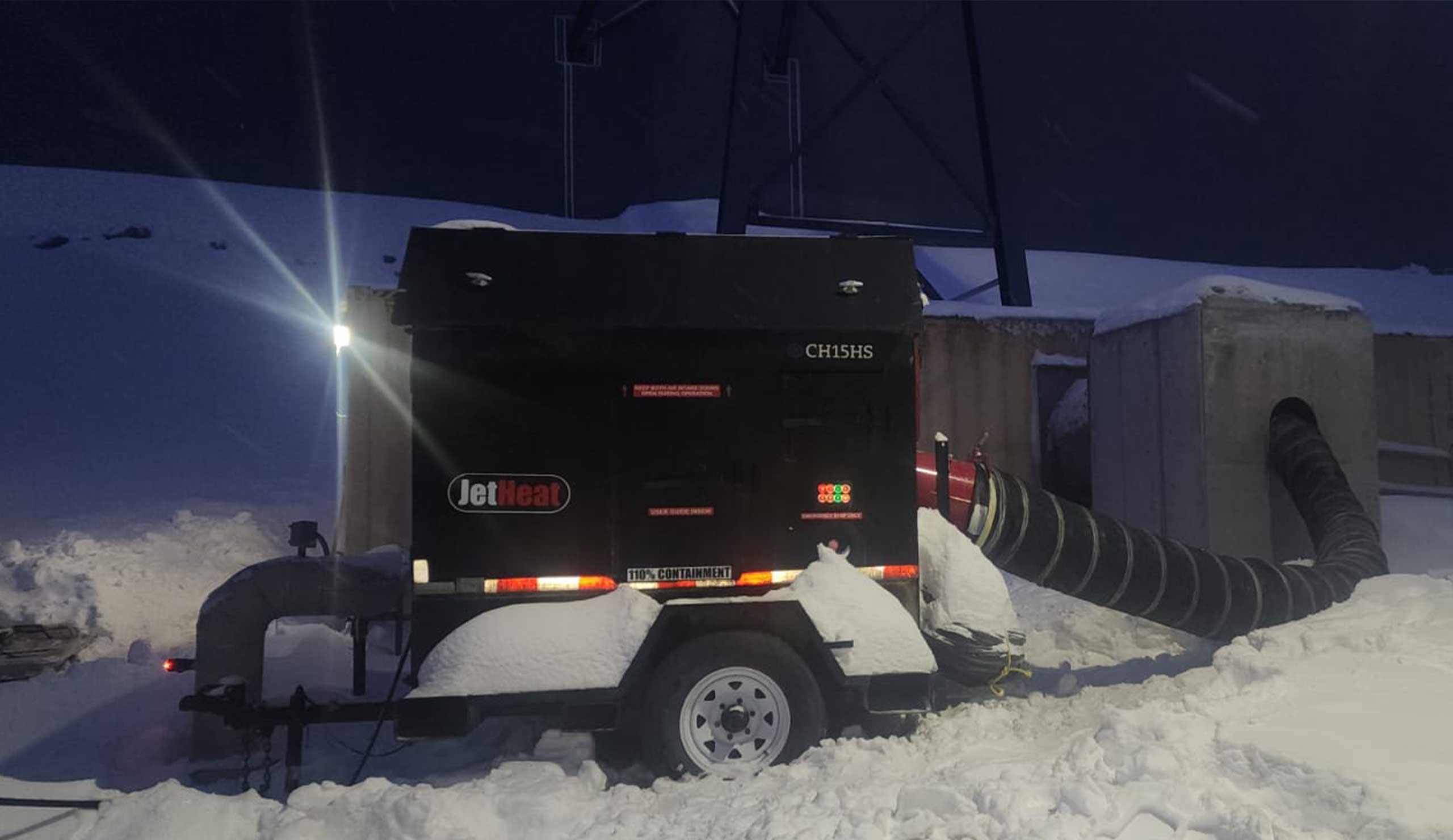
Jet Heat is REIC Rentals’ exclusive, patented flameless heating technology and the most operationally appropriate heating solution for airside construction environments. It delivers dry heat with no open flame and no combustion emissions, operating at over 97% efficiency with long-distance ducting capability that conventional heaters cannot match.
For airside work, where flammable aviation fuels make open-flame equipment inappropriate, Jet Heat is the right choice. Its flameless operation eliminates the ignition risk posed by direct-fired heaters in proximity to fueling areas, aircraft, and fuel storage infrastructure. Its long-distance ducting capability allows heat to be delivered to work zones from equipment positioned away from active aircraft operations. And its noise profile supports work in environments where noise restrictions protect both passenger experience and aircraft operations.
3. Direct-Fired Heaters
Direct-fired heaters use an open flame to heat air directly and push it into the workspace. They are highly efficient and cost-effective for outdoor or well-ventilated applications and can operate in temperatures as low as minus 30 degrees Fahrenheit.
On airport construction projects, direct-fired heaters are appropriate for remote, well-ventilated outdoor work areas away from aircraft operations, fueling infrastructure, and occupied terminal spaces. They are not appropriate for enclosed terminal spaces, airside areas where aviation fuel poses an ignition risk, or any application adjacent to occupied passenger areas where combustion byproducts would compromise air quality. Understanding those boundaries before specifying equipment is what keeps the right heater in the right location on a complex airport site.
4. Electric Heaters
Electric heaters produce clean, dry heat with no combustion byproducts and no emissions. They are quiet, carry no fire or explosion risk, and are the right choice for small, enclosed areas within terminal buildings where electrical supply is available and the heating requirement is localized.
For noise-sensitive terminal environments where passenger operations are active nearby and for spaces where any emissions are unacceptable, electric heaters provide the cleanest possible heating solution for small, well-defined areas. The trade-off is cost: electric heaters carry higher operating costs per BTU than fuel-fired alternatives and depend on an electrical supply that may not be readily available at all locations on a large airport site. Where those conditions are met, they are a practical and appropriate choice.
5. Make-Up Air Units
Make-up air units supply conditioned, tempered air to replace air exhausted from a building or enclosure, maintaining positive pressure and indoor air quality while controlling temperature. On airport construction projects, they serve two distinct roles.
In terminal renovation, make-up air units complement other heating systems to prevent the negative pressure conditions that arise when construction exhaust systems remove air without a balanced supply. Those negative-pressure conditions draw unconditioned air through gaps in temporary construction barriers, compromising both temperature control and the dust containment that protects occupied passenger areas.
During concrete work, make-up air units provide balanced ventilation, allowing indirect-fired or flameless heating equipment to maintain the curing enclosure conditions a pour requires without creating pressure differentials that compromise enclosure integrity. Our teams configure make-up air units alongside primary heating systems on airport concrete work to ensure the full environmental system performs as intended within the available closure window.
Matching the Equipment to the Application
Every airport project involves multiple distinct work environments: terminal interiors, airside pavement and structural work, remote utility corridors, and transitional areas between occupied and under-construction zones. Each environment has distinct heating requirements, regulatory constraints, and fuel and power logistics.
One challenge our teams commonly help airport construction project managers solve is equipment specified for the general airport construction category, rather than for the specific application, arriving on site and being unsuitable for the zone where it was intended to operate. Consulting with REIC Rentals before equipment is specified, with a clear description of each work zone’s conditions and constraints, is how airport projects get the right heating solution for each phase, rather than an approximation that creates problems during a closure window.
Request a quote or find a location near you to discuss your airport project’s heating requirements and identify the right equipment combination before cold weather arrives.
1.888.356.1880 | in**@**ic.com | reic.com
Service You Trust. Equipment You Need.
