
Roberts Field in Redmond, Oregon, shut down its main runway for three weeks in 2015 to complete a reconstruction project. Crews worked 24 hours a day to hit the reopening date. In the words of the airport director at the time, the project rated a ten out of ten for complexity. Finishing on time required that every piece of equipment was exactly where it needed to be, exactly when it was needed. That is aviation construction.
Airport and infrastructure projects are scheduled for fixed dates. FAA closure windows, airline schedules, and passenger demand dictate when work can happen. A runway that was promised to reopen at 6 a.m. reopens at 6 a.m. Equipment gaps do not produce schedule extensions. They result in missed milestones, compressed phases, and downstream costs that compound across every subsequent trade.
Rental equipment is how contractors close that gap. Not as a cost alternative to ownership, but as a schedule-protection strategy that ensures the right machine is available at the right phase, without the logistics constraints imposed by owned fleet management on a large, time-pressured project.
REIC Rentals supports large infrastructure and aviation construction projects with aerials and lifts, material handling equipment, power and lighting, climate control, and general tools. This article covers how rental equipment strategy supports schedule protection on complex, multi-trade infrastructure projects, with the Redmond Municipal Airport expansion as a reference point.
The Redmond Airport Expansion
The $180 million expansion of Redmond Municipal Airport, Roberts Field, is one of the largest infrastructure projects in Central Oregon. It is adding over 80,000 square feet of terminal space and receiving more than $8 million in FAA Airport Improvement Program grants. Multiple contractors are working simultaneously across electrical, mechanical, fire protection, and general construction scopes in an active airport environment.
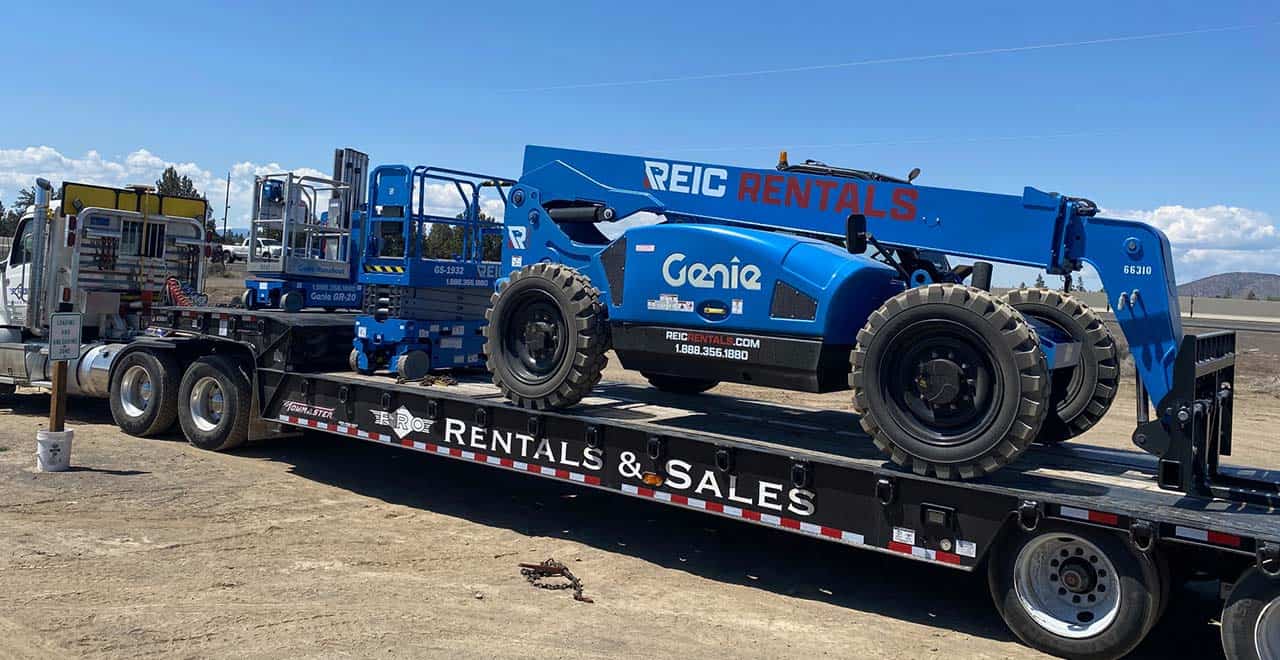
REIC Rentals began engaging with contractors on the project before equipment demand peaked. EC Electric, Southland Mechanical, Cochran Electric, Costco Fire Protection, and Skanska have all worked with us on this project. Equipment ranges from scissor lifts and forklifts to additional aerial equipment supporting electrical, mechanical, and fire protection work across active areas of the site simultaneously.
At any given time, 25 to 40 scissor lifts are on site. Additional forklifts and aerials serve multiple active trades in parallel. That level of simultaneous fleet deployment requires a rental partner with the fleet depth to sustain the commitment across months of intensive use, not just fulfill the initial order.
Why Equipment Gaps Hit Aviation Construction Harder
A single-trade project absorbs an equipment gap differently from a multi-trade project. When one crew is waiting for a lift, one crew is idle. On a multi-trade project with overlapping work fronts, a lift unavailable to one trade may block access to another. The idle time does not stay contained. It propagates through the coordination dependencies that connect parallel work streams.
Aviation construction adds constraints that most commercial projects do not face. Secure perimeters, access badging, and escort requirements mean that a delivery arriving at the wrong time or without pre-cleared credentials can be turned away at the gate. Night closures lasting eight hours or more leave no room to resolve equipment logistics that should have been managed in advance.
Consider a runway overlay sequence. Milling and trucks must be staged and running before the closure window opens. Pavers and compactors take over mid-window. Striping and lighting crews need to be operational by early morning. The runway reopens at 6 a.m. with no exceptions. A single piece of equipment arriving late breaks the chain and threatens the commitment to reopen.
Engaging Early: Before Equipment Demand Peaks
One of the most consistent observations our teams make on large infrastructure projects is that the contractors who engage their rental partner early outperform those who initiate the conversation when demand is already at its peak.
By the time a large aviation project reaches its most intensive phases, rental inventory that was readily available during preconstruction may be partially committed elsewhere in the region. Lead times that were days become weeks. The equipment configuration needed for a specific phase may not be available in the standard stock of a partner engaged under time pressure.
On the Redmond Airport expansion, REIC Rentals’ engagement before the project peaked allowed us to understand the sequencing, anticipate which equipment categories would be needed across different phases, and position fleet resources accordingly. As needs expanded, we were already embedded in the project’s operational rhythm rather than being introduced as a new relationship under deadline pressure.
Fleet Depth Matters More Than Initial Availability
Fleet depth is the rental partner characteristic that matters most on a large infrastructure project and is the least visible during the initial equipment conversation. A vendor who can supply the first scissor lift may not be able to supply the thirty-fifth when the project reaches full intensity. A vendor without backup units cannot respond when service is needed on an active airfield at 2 a.m.
Maintaining 25 to 40 scissor lifts on an active airport construction site over months of intensive use requires a partner whose fleet can sustain that commitment, whose maintenance practices keep units job-ready, and whose local presence allows replacement equipment to reach the site quickly when a unit needs service. That is not a transaction. It is a relationship built on fleet depth and operational reliability.
Matching Equipment to Each Phase
Different phases of airport and infrastructure construction require different equipment. Earthwork and site preparation call for excavators, dozers, and compaction equipment. Vertical construction and systems work require boom lifts and scissor lifts configured to the access constraints of the specific work zone. Material staging requires forklifts and reach-out equipment. Interior phases and commissioning benefit from climate control and power and lighting to support work that cannot stop when the sun goes down.
Owning every type of equipment required across an 18-month airport program would be both expensive and inefficient. Specialized machines needed for a few weeks incur carrying costs across the months they sit between uses. Rental allows contractors to access exactly the right equipment for each phase, return it when the phase is complete, and scale back up for the next phase without the overhead of fleet ownership.
Logistics Planning for Secure Sites
Airports present logistics challenges that most construction sites do not. Secure perimeters, badging requirements, escort procedures, and limited access points can turn a straightforward equipment delivery into a multi-hour delay if not planned carefully. A missing permit or incorrect credential can result in delivery vehicles being turned away at the gate, wasting an entire closure window and creating schedule pressure that cascades through every trade scheduled behind it.
A rental partner experienced in aviation work plans deliveries and pickups around TSA and airport authority requirements, with equipment staged inside the security fence before closure windows open, rather than arriving during them. REIC Rentals coordinates access logistics as part of the project engagement, not as an afterthought when the delivery truck is already at the gate.
Planning Your Next Infrastructure Project With REIC Rentals
For aviation and large infrastructure construction, a rental equipment strategy is most effective when built into the project plan at preconstruction, rather than sourced reactively as each phase begins. Equipment availability, rental terms that align with actual phase durations, and the service response commitment that protects critical-path work all affect the schedule before the first machine arrives on site.
REIC Rentals engages with contractors and project teams during preconstruction for large infrastructure projects to understand phasing, trade sequencing, and the equipment categories required throughout the project. Request a quote or explore the full range of equipment to begin the conversation for your next schedule-critical aviation or infrastructure project.
1.888.356.1880 | in**@**ic.com | reic.com
Service You Trust. Equipment You Need.
