
A concrete slab that cures with inadequate moisture control can fail a coating adhesion test six weeks after placement, blocking floor finishing trades, delaying racking installation, and pushing a move-in date by a month or more. At a 400,000-square-foot distribution center, that delay can cost more than the entire dehumidification program that would have prevented it.
Moisture control during concrete curing is one of the highest-leverage decisions made on a large commercial or industrial slab project. It determines whether the floor meets its design strength, accepts coatings on schedule, and withstands years of forklift traffic. When it fails, the consequences cascade across every trade that follows the concrete crew.
REIC Rentals supports high-performance commercial and industrial slab projects with dehumidification and drying equipment, heating, and HVAC accessories that maintain the conditions concrete requires from placement through coating readiness. This article covers the core principles of moisture control on large warehouse and distribution center slabs.
Curing vs Drying: Two Different Problems
Curing and drying are related but distinct. Hydration, the chemical reaction between water and cement compounds, is what builds concrete strength over time. Adequate moisture during the first 7 to 28 days allows hydration to proceed fully. Cutting that process short, by allowing the surface to dry too quickly, reduces ultimate compressive strength.
Drying is the subsequent process of reducing free water content and vapor emissions so that coatings and adhesives can bond. Most floor systems require moisture vapor emission rates at or below 3 to 5 pounds per 1,000 square feet per 24 hours, per ASTM F1869, or internal relative humidity at or below 75 percent per ASTM F2170. These targets are independent of whether the concrete has reached its design strength.
A slab can be strong enough to strip forms while still carrying vapor emission rates that violate coating manufacturer requirements. Managing both the curing and subsequent drying phases produces a floor ready for finishes on the intended schedule.
Why Large-Footprint Slabs Are a Different Problem
Large industrial slabs, ranging from 200,000 to one million square feet or more, generate more heat of hydration than small pours. Internal moisture gradients are steeper: drier at the surface, wetter below. ACI drying research shows that a slab with a water-cement ratio of 0.40, drying from one side, can take 46 days or more to reach acceptable emission rates under average conditions. At a water-cement ratio of 0.50, that extends significantly.
Large placements also mean long stretches of exposed concrete surface before curing materials or coverings arrive, amplifying the risk of moisture loss during the initial critical hours. In hot, dry, or windy conditions common at inland logistics sites, plastic shrinkage cracking can form on exposed surfaces before the slab sets, weakening the surface paste and creating pathways for moisture intrusion and subsequent dusting under forklift traffic.
Regional climate changes the strategy. Humid coastal markets slow drying and delay coatings. Dry inland sites accelerate surface moisture loss during curing. REIC Rentals reviews regional climate conditions and slab specifications before recommending dehumidification and drying equipment rather than applying a standard approach regardless of location.
Moisture Control Methods for Large Industrial Slabs
No single method covers every need in a large warehouse or distribution center placement. Large industrial applications require a combination of curing methods matched to slab zones, finish requirements, and construction sequencing.
Wet curing through continuous water application, sprinklers, or fogging is effective for exterior aprons or limited interior zones but becomes impractical across large interior areas due to water logistics and slip hazards for other trades.
Membrane-forming curing compounds limit evaporation when wet curing is impractical. A curing compound is sprayed as soon as the bleeding water disappears, per the coverage rates in ASTM C309. Timing and film thickness determine effectiveness. Where epoxy or urethane coatings are planned, dissipating curing compounds compatible with future finishes are specified and confirmed with the coating manufacturer before full application.
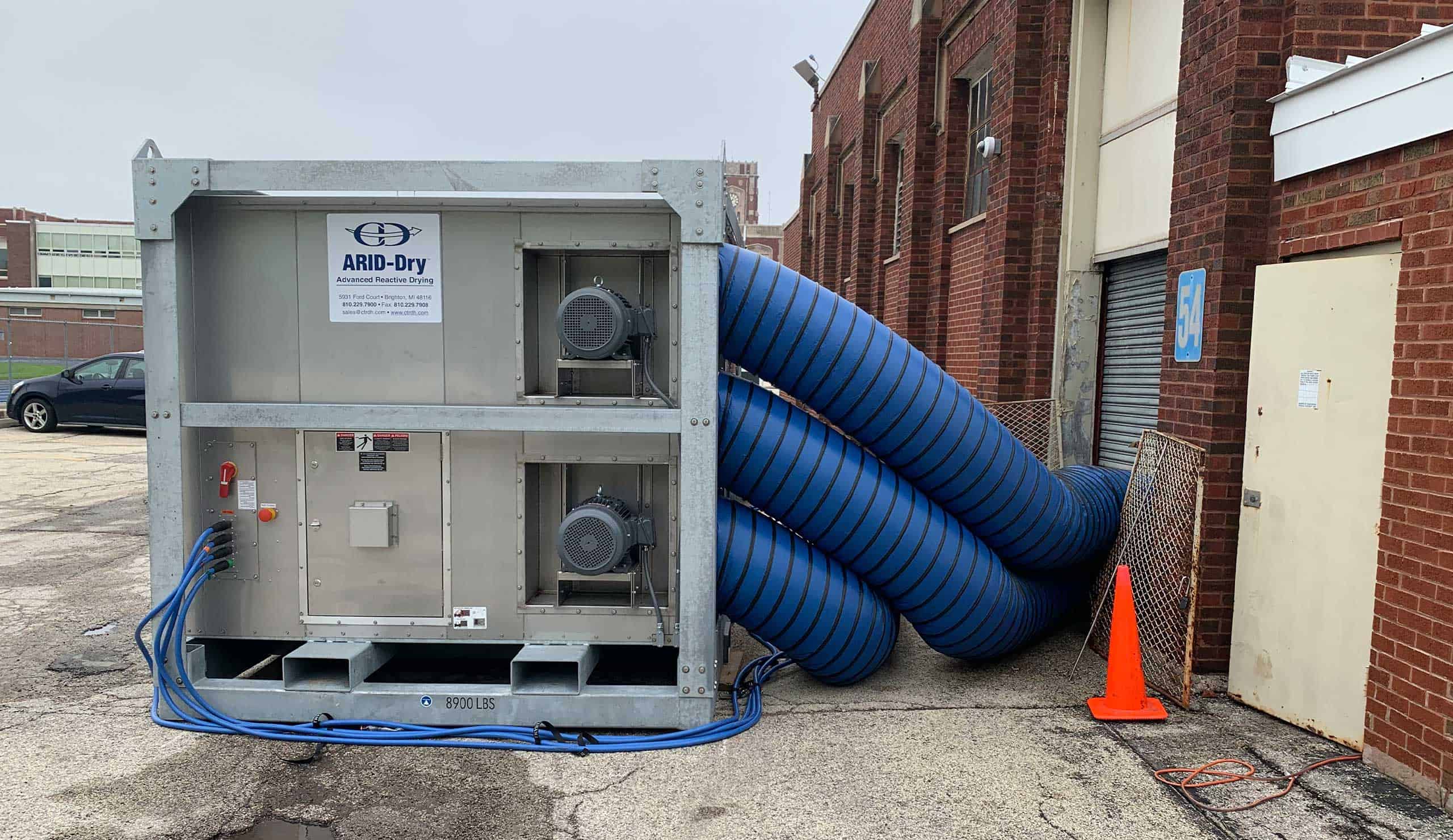
Where mechanical drying is needed to bring slabs into coating compliance on schedule, REIC Rentals’ drying equipment accelerates moisture removal from both the slab surface and the surrounding air. The combination of dehumidification and air movement is more effective than either approach alone because removing moisture from the air reduces the vapor pressure differential that slows moisture release from the slab.
Environmental Factors That Change the Approach
Surface evaporation rate depends on four variables: air temperature, concrete surface temperature, relative humidity, and wind speed. When the ACI evaporation nomograph indicates elevated evaporation risk, precautions, including windbreaks, evaporation retarders, fogging, and accelerated finishing, are warranted. Above the critical threshold, protective measures are required before plastic shrinkage cracking becomes a significant risk.
In cold and damp conditions common at warehouse projects in the Mountain West and Pacific Northwest, slow hydration delays control joint cutting and requires heated enclosures to maintain adequate curing temperatures. REIC Rentals’ heating equipment, including indirect-fired heaters and the exclusive Jet Heat flameless system, provides the dry, clean heat that concrete curing enclosures require without introducing combustion moisture that would counteract the drying effort.
Below-Slab Moisture: The Source That Slips Through
Moisture entering a slab from below is often the source that pushes emission rates above coating manufacturer limits months after the surface appears dry. Under-slab vapor barrier practice for commercial construction now specifies 10 to 15 mil plastic sheeting or engineered membranes complying with ASTM E1745 Class A, with permeance ratings at or below 0.1 perm.
Without an adequate vapor barrier, even slabs with excellent surface curing push moisture upward under finished floor systems. A properly sealed vapor barrier reduces moisture vapor rising through the slab and protects adhesives and coatings from blistering, even in facilities where the concrete above it was placed and cured correctly.
Concrete mix design connects directly to moisture control. Low water-cement ratios (0.40 to 0.50 for most industrial slabs) reduce porosity. Chemical admixtures, such as water reducers and shrinkage reducers, lower the internal moisture content. REIC Rentals coordinates with design teams and coating manufacturers early to align slab thickness, vapor barrier class, and mix composition with the intended floor system and project schedule.
From Curing to Floor Readiness: Testing and Schedules
Slab curing history sets the real schedule for when finishes go down. Two tests are standard on industrial slabs: calcium chloride (ASTM F1869) measures moisture vapor emission rate, and in-situ relative humidity probes (ASTM F2170) measure internal humidity at 40 percent slab depth. Most coating manufacturers require results below both thresholds before application.
Schedule pressure is real on distribution center and manufacturing facility projects. Rushing flooring and coating installation over slabs that have not reached moisture specification leads to blistering, debonding, and warranty disputes. Replacing a failed coating system on a large slab can exceed half a million dollars in materials and labor alone.
REIC Rentals integrates curing method planning, joint layouts, and moisture testing schedules into the overall project timeline, so realistic dates for floor finishing and racking installation are built in from the start, rather than discovered after a failed moisture test. Request a quote or find a location near you to discuss your project’s slab moisture management requirements.
1.888.356.1880 | in**@**ic.com | reic.com
Service You Trust. Equipment You Need.
