
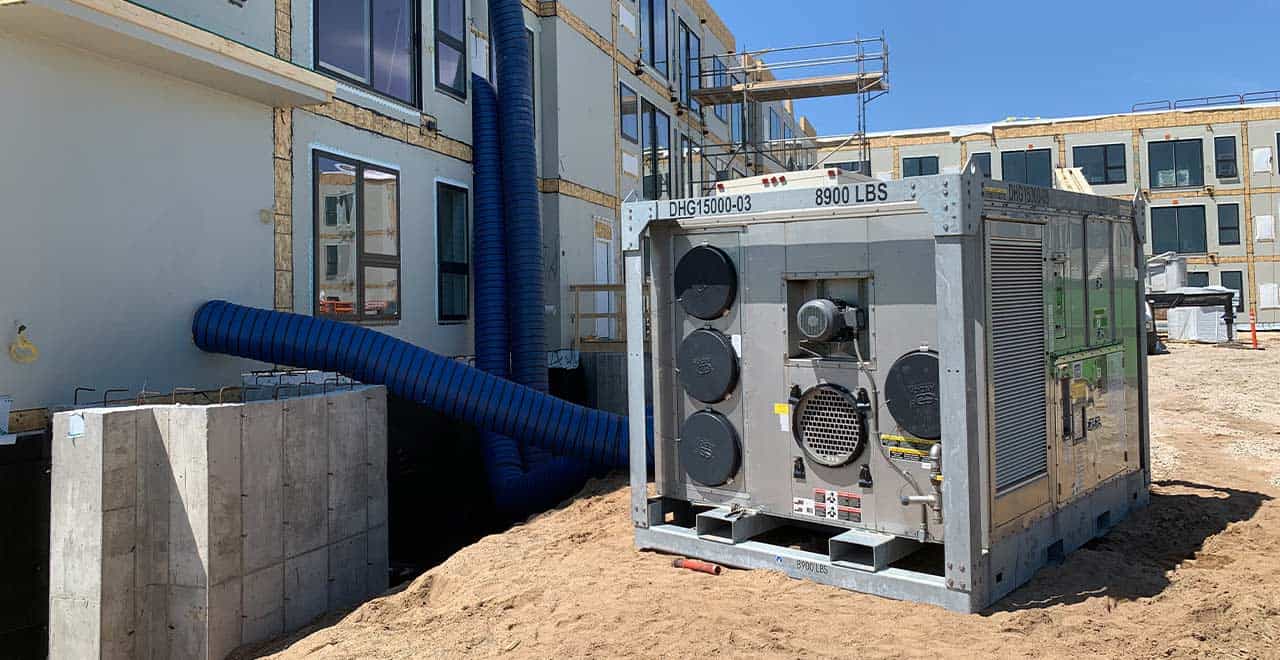
Excess moisture on active construction projects rarely announces itself as a single event. It accumulates through ordinary pathways, wood absorbing weeks of exposure before the envelope is sealed, concrete releasing more water vapor than ambient conditions can carry away, and interior trades adding humidity into spaces without adequate ventilation or mechanical conditioning. By the time the damage is visible, the schedule has already slipped, and the cost is already distributed across overtime labor, material replacement, failed inspections, and compressed trade sequencing.
The financial impact is significant and consistent across project types and markets. Cost overruns attributable to moisture mismanagement appear on projects large and small, and they share a common characteristic: the conditions that caused them were predictable, and the interventions that would have prevented them were available. The gap between the project that finishes on schedule and the one that absorbs weeks of moisture-related delay is almost always a planning gap, not an equipment gap.
REIC Rentals provides temporary dehumidification, drying, and climate control solutions for active construction projects. Our team partners with general contractors, developers, and owners from preconstruction planning through final inspections, delivering equipment and planning support that keeps moisture from derailing project timelines and budgets.
How Moisture Enters Construction Projects
Moisture does not need a dramatic failure to infiltrate a construction site. It enters through pathways that are easy to overlook until the cumulative effect becomes a problem.
Weather exposure is the most obvious source. Rain on exposed slabs and framing, snowmelt on foundations and decks, and sustained high ambient humidity all introduce moisture into materials that are expected to stay dry. The duration of exposure matters as much as the intensity of any single event. Materials that absorb moisture over several weeks of a wet spring carry a significantly higher moisture load into the finishing phase than materials that experienced a single heavy rain.
Concrete is a major source of internal moisture that is often underestimated. A typical concrete mix contains substantially more water than the hydration chemistry requires, and that excess water must evaporate before finishes can be applied. Under average ambient conditions without mechanical drying, natural evaporation from a concrete slab is slow enough that the gap between placement and finish-ready conditions can extend by weeks or months beyond what the original schedule assumed. In an enclosed space without dehumidification, moisture vapor accumulates in the air and redeposits on adjacent surfaces rather than escaping.
Interior trades add humidity that many teams do not adequately account for. Painting, drywall mudding, and flooring adhesive application all release moisture into the air during application and cure. When those operations occur in enclosed or semi-enclosed spaces without operating ventilation or mechanical conditioning, relative humidity rises and drying rates for all materials in the space slow simultaneously. The compounding effect delays every subsequent trade.
Below-grade elements, including basements, elevator pits, and parking decks, are subject to groundwater and hydrostatic pressure that continues regardless of above-grade weather conditions. Roof assemblies before the building is dried in, exterior walls awaiting weather-resistive barrier installation, and interior partitions with gypsum and insulation exposed to unconditioned air are all high-risk zones that require active moisture management rather than passive reliance on conditions improving.
The Financial Impact of Uncontrolled Moisture
The cost of moisture damage on construction projects is distributed across budget categories in ways that make it difficult to isolate as a single line item, but impossible to ignore at project closeout. Schedule delays, rework, failed inspections, and contractual consequences all trace back to the same root cause.
Schedule delays due to moisture hit hardest at the transition between rough construction and the finishing trades. Concrete slabs that have not reached the moisture vapor emission levels required by flooring manufacturers force installers to wait or remobilize. Wood framing with elevated moisture content delays the installation of insulation and drywall. Each day of idle crews and parked equipment is a cost the original budget did not anticipate, and the compounding effect across multiple affected trades is larger than any single delay in isolation.
Rework is a direct financial loss. Tearing out mold-damaged or moisture-compromised drywall, replacing warped subflooring, discarding saturated insulation, and addressing delaminated finishes all consume labor and materials that produce zero forward project progress. The work performed represents pure cost with no schedule advancement. When rework occurs in areas that subsequent trades have already worked around or above, the disruption extends beyond the rework scope itself.
Failed inspections formalize the schedule impact of moisture mismanagement. When inspectors find visible mold on framing, wet fireproofing on structural steel, or failed moisture readings on a slab that is scheduled for floor covering, work stops across the affected area until conditions are remediated and re-inspected. The re-inspection fees, documentation requirements, and trade sequencing disruption that follow a failed inspection compound the original delay in ways that are difficult to recover from without schedule compression or overtime.
Contractual consequences close the loop. Missed milestones trigger liquidated damages on contracts that specified delivery dates based on a schedule that did not account for weeks of moisture-related delay. Owner disputes that trace back to moisture mismanagement during construction create legal exposure that extends well beyond the construction period. The money lost to moisture damage is real and measurable, even when it is spread across enough categories to make the connection between cause and cost less obvious than it would be if it appeared as a single repair invoice.
Mold: From Construction Moisture to Occupancy Risk
Mold requires moisture, an organic food source, and temperatures above approximately 60 degrees Fahrenheit to grow. Active construction sites provide all three. Wood framing, paper-faced drywall, ceiling tile, carpet backing, and similar materials are all organic substrates that support mold growth when they remain wet for long enough. The threshold is shorter than most teams expect. Mold can begin colonizing wet organic materials within 48 hours under favorable conditions.
Once established, mold spreads through spore dispersal. Spores become airborne through air movement and HVAC operation, colonize additional surfaces, and establish in wall cavities and concealed spaces where they are not visible during standard inspection. By the time mold is visible on a surface during a field walk, it has typically been present in the assembly for longer than the surface evidence suggests.
The health effects of mold exposure are well documented. Construction workers with repeated exposure to damp, enclosed spaces, including mechanical rooms, below-grade areas, and poorly ventilated corridors, experience respiratory irritation, allergic reactions, and sinus symptoms that increase sick days and can lead to workers’ compensation claims. Post-occupancy, mold linked to construction moisture conditions creates liability that extends years beyond project completion, when building occupants experience health effects in spaces that appeared acceptable at handover.
Remediation after mold is established is significantly more expensive than prevention during construction. Materials that must be removed, the containment required to prevent spore spread during removal, the replacement installation, and the re-inspection all add cost and time that proactive moisture management would have avoided entirely. The prevention cost is a fraction of the remediation cost. The schedule impact of prevention is minimal. The schedule impact of remediation is not.
Inspection Milestones Where Moisture Causes Failures
Moisture mismanagement leads to inspection failures at multiple stages of a construction project, and each failure triggers a cascade of additional costs and delays that extend beyond the failed inspection.
Structural framing inspections flag wet or mold-affected lumber, raising concerns about dimensional stability and moisture content before insulation and gypsum board are installed over it. Insulation inspections reveal saturated cavity insulation that fails thermal performance requirements and that may already be supporting mold growth in the cavity. Fireproofing inspections of structural steel require the fireproofing to be dry before acceptance, so wet fireproofing requires additional drying time before the inspection can proceed.
Concrete slab moisture testing before finish flooring installation is a specific inspection trigger that moisture management directly addresses. Most flooring manufacturers require slab relative humidity to be within defined thresholds before installation and tie warranty coverage to documentation of that testing. A slab that tests above the required threshold on the planned installation date requires additional drying time, re-testing, and rescheduling of the flooring trade. The downstream schedule impact of a failed slab test is greater than the test result alone suggests, because it forces re-sequencing of all trades that depend on flooring being in place before they can proceed.
Occupancy inspections that reveal mold, elevated relative humidity, or moisture-compromised assemblies in spaces that were believed to be complete represent the most disruptive failure mode because they occur after trades have finished and the building is considered ready for handover. Remediation at that stage requires working in finished spaces, protecting completed work during repairs, and managing the schedule and the contractual implications of a delayed handover.
REIC Rentals supports the inspection process by providing run-time records, environmental data logs, and site documentation that demonstrate to building officials, owners, and inspectors that moisture was actively managed throughout the project. That documentation is both a professional standard and a practical defense against claims that moisture conditions during construction caused post-occupancy problems.
How REIC Rentals Controls Moisture on Active Projects
REIC Rentals’ drying equipment addresses the moisture sources and risk zones associated with active construction. Equipment selection is matched to the conditions the project actually presents rather than applied as a standard configuration regardless of climate, enclosure stage, or material requirements.
Refrigerant-based dehumidifiers perform effectively in warm, humid conditions, removing moisture from the air efficiently at temperatures above the range at which refrigerant systems lose effectiveness. They are well suited to warm-season interior phases, including drywall finishing, painting, and flooring installation in enclosed spaces where ambient conditions are favorable for refrigerant operation.
Desiccant dehumidifiers perform well at low temperatures, making them the appropriate choice for cold-weather construction in the Pacific Northwest, the Rocky Mountain region, and Canada, where refrigerant equipment loses efficiency. Desiccant systems achieve lower dew points than refrigerant systems, which matters for applications such as concrete curing in cold conditions and coatings work, where dew point control relative to surface temperature is a specification requirement.
Air movers increase airflow over wet surfaces, replacing the moist boundary layer with drier air from the conditioned space and accelerating evaporation. The combination of dehumidification and air movement produces faster drying than either approach alone because removing moisture from the air reduces the vapor pressure differential that slows moisture release from wet materials.
Indirect-fired heating equipment accelerates drying in cold-weather construction without introducing combustion moisture that would counteract the dehumidification effort. Dry, warm air combined with mechanical dehumidification creates controlled conditions for winter concrete curing, drywall installation, and coatings work that would otherwise be limited by ambient temperature and humidity.
Moisture meters, relative humidity probes, and data loggers provide the monitoring and documentation that verify conditions are within specification throughout the active phase. REIC Rentals supports monitoring planning alongside equipment selection, so the data that protects the project is collected systematically rather than assembled reactively when a problem is suspected.
Scenario: Slab Drying on a Commercial Interior Fit-Out
Consider a commercial office fit-out where concrete is poured in late spring and the building is enclosed several weeks later. Ambient conditions during the summer months keep relative humidity in the enclosed space elevated, and natural drying is insufficient to bring slab moisture vapor emission rates within the thresholds the flooring manufacturer requires before installation can proceed.
In that scenario, desiccant or refrigerant dehumidification equipment sized to the floor plate volume and the slab moisture load would be deployed at enclosure. Air movers accelerate evaporation across the slab surface. Relative humidity is monitored by zone using data loggers that provide continuous records of conditions throughout the drying period. Slab testing per ASTM F2170 confirms that conditions have reached specification before flooring installation begins.
The flooring trade arrives on schedule. The manufacturer’s installation requirements are met, the warranty is intact, and the trades that follow proceed without the re-sequencing that a failed slab test would have forced. The cost of the drying equipment rental is a fraction of the cost of a single failed test result and the schedule compression that follows it.
That outcome depends on the plan being in place at enclosure, not initiated after the first test result reveals a problem. When REIC Rentals is engaged during preconstruction, the equipment and monitoring protocol are ready from day one of the enclosed phase rather than assembled reactively under schedule pressure.
Best Practices for Moisture Management on Active Projects
Effective moisture management on a construction project is an operations discipline built into the project from preconstruction, not a reactive response deployed after damage becomes visible.
Beginning dehumidification at enclosure, rather than when moisture problems are already affecting materials or trades, yields significantly better results at a lower total cost. The moisture load that accumulates during weeks of unmanaged conditions after enclosure is a multiple of what dehumidification would have required if deployed at the right time. Early deployment also produces the documentation record that protects the project at inspection and at handover.
Containment is the prerequisite for effective dehumidification. Sealing major openings, isolating zones with temporary barriers, and preventing continuous infiltration of humid outdoor air are what allows dehumidification equipment to drive conditions toward the target rather than maintaining them against a continuous incoming moisture load. A dehumidifier deployed in a space with uncontrolled openings to the exterior cannot achieve the conditions a sealed space would reach with the same equipment.
Trade coordination regarding moisture conditions prevents the installation of finishes on substrates that have not reached the moisture conditions those materials require. Flooring installers, drywall crews, painters, and millwork installers all work within manufacturer-specified environmental requirements. Communicating drying goals and monitoring data to each trade ensures they understand the conditions they are working within and that moisture testing is treated as a critical path activity rather than a formality completed after installation decisions have already been made.
Moisture logs, relative humidity records, equipment run-time data, and material testing documentation together constitute the evidence that the project was managed responsibly. REIC Rentals provides that documentation as part of the engagement rather than leaving it to the site team to compile independently.
Applications Across Construction Project Types
Moisture management requirements vary by project type, climate, and the specific materials and phases that carry the highest risk. Commercial office and retail fit-outs require moisture control through flooring, drywall, and finishes phases to protect tenant improvements and meet handover specifications. Hospitals and healthcare construction require moisture management that protects both materials and indoor air quality in environments where mold contamination carries regulatory as well as operational consequences.
Warehousing and distribution center construction involves large slab areas that require controlled drying before floor coating and sealing systems can be applied. Coating and curing projects, including industrial floor systems, tank linings, and structural coatings, require dew point control throughout preparation, application, and cure periods that REIC Rentals’ integrated drying and heating solutions are specifically designed to support. Dehumidification and restoration following water intrusion during construction requires rapid moisture removal to prevent secondary damage and mold establishment in materials that are already compromised.
Planning Moisture Control with REIC Rentals
The most effective moisture management plans are developed at preconstruction, when the project schedule, enclosure sequence, and critical installation windows are known. Engaging REIC Rentals at that stage produces a drying and climate-control plan integrated into the project schedule, rather than deployed reactively when moisture conditions are already affecting trades.
The planning process covers the enclosure sequence and the phases where moisture risk is highest, the climate conditions expected during those phases at the project location, equipment sizing and placement recommendations suited to the actual volume and geometry of the spaces being managed, and a monitoring protocol that produces the documentation the project requires at inspection and handover.
Request a quote or find a location near you to begin the moisture control conversation for your next project before the schedule depends on it.
Protecting the Schedule, the Budget, and What Has Already Been Built
Excess moisture does not announce itself as a single line item. It distributes its cost across delays, rework, failed inspections, and post-occupancy claims in ways that make the connection between cause and consequence harder to trace than a straightforward repair invoice. The total is real and measurable. It is simply spread across enough budget categories that it is easy to underestimate until the project closes and the full picture becomes visible.
Proactive moisture management, backed by correctly specified and deployed temporary climate control from REIC Rentals, converts an unpredictable risk into a planned, managed line item. Explore the full range of drying equipment, heating equipment, and HVAC accessories, or request a quote to build a moisture management plan that protects the project from day one.
1.888.356.1880 | in**@**ic.com | reic.com
Service You Trust. Equipment You Need.
