
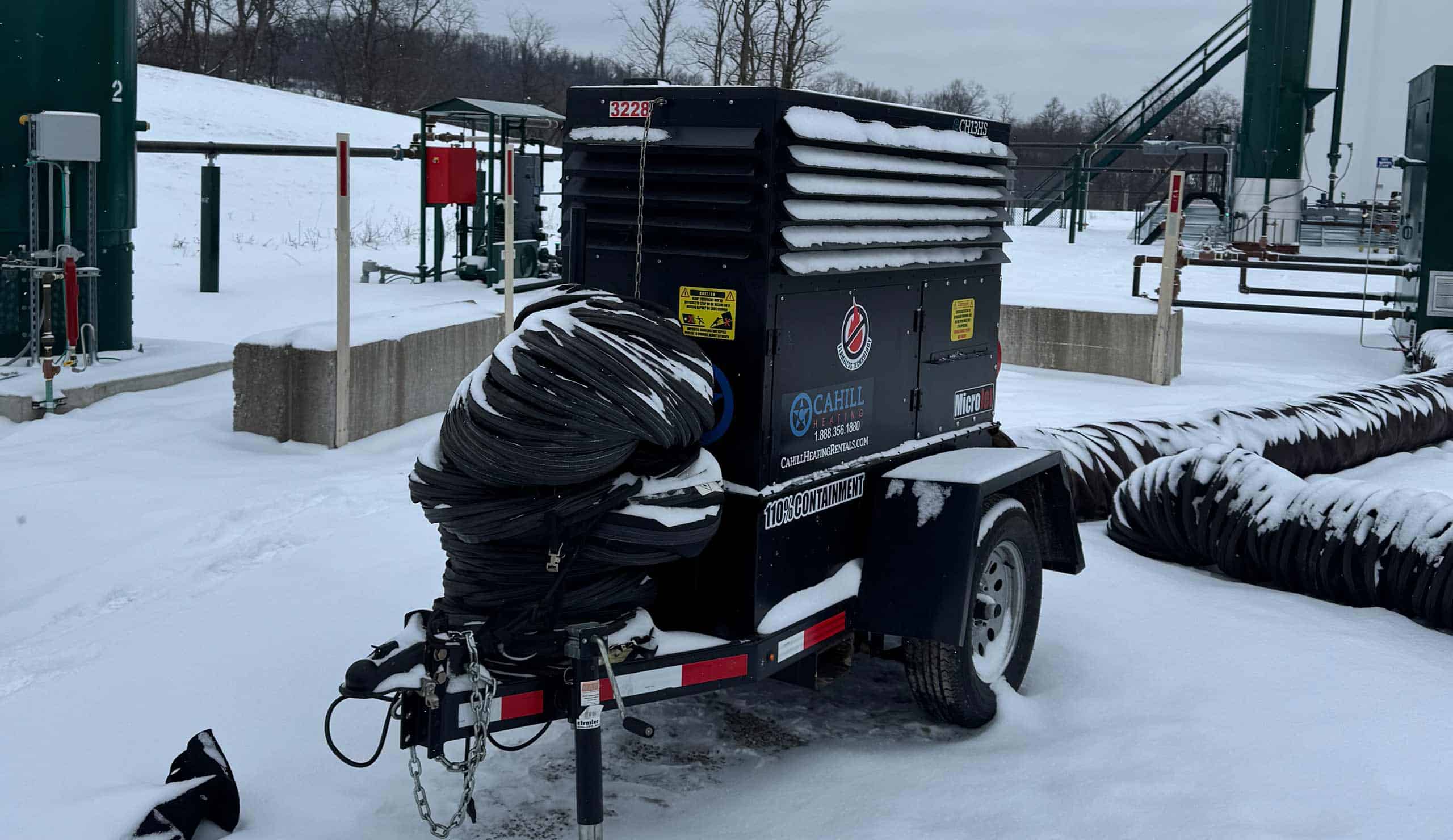
In northern British Columbia and the Northwest Territories, sub-zero overnight temperatures arrive by late September. Snow accumulation has been recorded as early as late August near Yellowknife. For construction projects building processing plants, crusher foundations, camp facilities, and tailings infrastructure at mining and resource extraction sites, this compressed timeline changes the entire approach to cold weather planning. The question is not whether to rent heaters. It is how much lead time there is before the window to do it effectively closes.
Mining and resource extraction construction in Western Canada presents a version of the cold-weather heating challenge that southern construction markets do not face. The season arrives earlier, lasts longer, and imposes logistics constraints that make reactive procurement exponentially more difficult than pre-season planning. Access roads that can carry heavy equipment in September may be weight-restricted or impassable by November. Rental equipment inventory that is available in August is committed across multiple active sites by October. And the consequences of inadequate heating on a copper concentrator foundation pour or a mill building interior fit-out, are measured in months of schedule slippage, not days.
REIC Rentals maintains a regional presence in Alberta and British Columbia, including a location in Fort St. John, to support construction across Western Canada for the mining, oil sands, and critical minerals sectors. This article covers why the timing of heater rental decisions matters so much on these projects and what the planning process looks like for sites where the first snowfall is not in December.
Why the Timing Window Is Tighter Than It Appears
The compressed nature of the Western Canada fall construction window is the central planning challenge for mining and resource extraction projects. By the time visible snowpack arrives, the window for mobilizing heavy equipment and managing fuel logistics has already narrowed significantly.
Ground temperatures and nighttime lows drop below freezing weeks before continuous snow cover begins. Freeze-thaw cycles that begin in September degrade road surfaces and introduce daily uncertainty into equipment and fuel delivery logistics. Access roads serving remote mine sites may have weight restrictions that tighten progressively through October and November before winter roads or closures formalize the constraint that ground conditions have already been imposing for weeks.
The lead time required for major project heater mobilization is four to eight weeks before the historical first-snow date for the specific site. For a project near 60 degrees North latitude, that means mid-September mobilization at the latest. Projects that treat cold-weather planning as an October activity are already behind schedule by the time they begin.
Competing demand across the region tightens rental equipment availability as the season approaches. Mining, oil sands, and infrastructure projects across Alberta and British Columbia all compete for the same rental heater inventory. Rental equipment that is readily available in September is committed across the region by November. The facilities that engage REIC Rentals in early fall have more options, better logistics, and lower total response costs than those that make the first call after temperatures have already dropped and access conditions have already changed.
Protecting Concrete Curing in Cold Weather
Cold-weather concrete curing is the most schedule-critical heating application at mining and resource-extraction construction sites. Mill foundations, crusher building pads, retaining walls, pump house slabs, and the heavy foundations that process plant equipment sits on all require sustained temperature control through curing periods that cold weather extends significantly.
Cold-weather concreting protocols activate when ambient temperatures approach freezing or when frost is forecast within 24 hours of placement. Below freezing, hydration slows dramatically. Early-age concrete that freezes before it has reached sufficient strength suffers irreversible damage: it cannot be heated back to its design strength after a freeze event.
For Western Canada mining projects, REIC Rentals designs heater setups to maintain slab and ambient temperatures within target ranges throughout the full curing protection period, typically seven days or longer for the heavy elements common in mine infrastructure. That coverage requires planning equipment types, quantities, and fuel logistics before the pour season arrives, rather than sourcing heaters after the first cold event has already demonstrated the need.
Indirect-fired heaters are the appropriate choice for enclosed curing enclosures where combustion byproducts would compromise concrete quality. Electric heaters are used in confined spaces where power is available. For large-surface-area curing applications, REIC Rentals’ heating equipment is combined with insulated blankets and temperature-monitoring sensors to provide the continuous documentation required by inspectors and quality control programs.
Worker Safety and Regulatory Compliance in Extreme Cold
Open-pit and plant construction sites in Western Canada regularly experience sustained extreme cold and wind chill conditions throughout the cold season. At those temperatures, cold stress risk is not a general concern. It is an immediate operational and regulatory reality.
Canadian occupational health regulations require employers to address thermal stress through monitoring, engineering controls, protective clothing, and access to warmed shelters. WorkSafeBC guidance triggers specific cold stress protocols, including heated shelters and more frequent rest breaks, when equivalent chill temperatures fall below defined thresholds. Similar requirements apply under Alberta’s occupational health and safety legislation.
Warming infrastructure must be operational on the first day of sub-zero weather, not staged after the first incident. Heated lunchrooms, break trailers, change rooms, and first-aid facilities that are in place and functional from the beginning of the cold season protect both the workforce and the project’s compliance standing.
Our teams regularly help mining project safety teams size and stage heaters for warming shelters and break facilities, scaled to crew size and site layout. One challenge we commonly help contractors address is the lead time gap between when safety plans require warming infrastructure to be in place and when procurement processes would normally initiate the rental process. Engaging REIC Rentals several weeks before the cold season begins is what closes that gap.
Preventing Frozen Ground, Piles, and Utility Infrastructure
Frozen ground complicates excavation, trenching, pile driving, and utility installation at large mine and processing facility construction sites. Before visible snow cover arrives, frost penetration begins to lock up shallow strata overnight, making early-morning on-site conditions unpredictable and slowing work that requires ground access.
Ground thaw and frost prevention measures that protect the schedule:
- Heat mats and insulated enclosures spread warmth evenly across work areas, preventing the daily freeze-thaw cycle from disrupting progress on active excavation and foundation zones.
- HDPE pipe fusion work in tailings pond liner systems and process water infrastructure requires ambient temperatures or supplemental heating at joints to ensure welds cure correctly.
- Pile cap concrete beds that freeze overnight do not seat correctly, creating alignment issues that require rework before structural steel can be set.
- Pre-thawing excavation areas ahead of scheduled pours eliminates the morning warm-up delay that compounds across a full work season.
- Engine block heaters on excavators, loaders, and drill rigs prevent the mechanical stress and hydraulic sluggishness that cold overnight temperatures impose on equipment that must be productive from the start of each shift.
Protecting Materials, Finishes, and Sensitive Equipment
Cold weather affects construction materials and pre-installed equipment in ways that are sometimes not visible until the damage has already occurred. Paint, coatings, grout, adhesives, and sealants in process buildings, control rooms, and MCC buildings all have minimum application temperatures defined by their manufacturers, below which adhesion fails and curing stalls.
Interior trades in mine site buildings, including drywall, paint, flooring, and instrumentation, cannot proceed in spaces below those thresholds. Early heater deployment that maintains indoor temperatures suitable for interior finishing allows those trades to work through the cold season rather than being suspended until spring warmth arrives.
Temperature-sensitive electrical equipment, including MCCs, variable frequency drives, analyzers, and PLC cabinets, stored in temporary warehousing or pre-installed in buildings awaiting permanent HVAC, is vulnerable to condensation and frost damage. Indirect-fired and electric heaters provide clean, dry heat in those spaces, protecting equipment investments that can represent significant portions of the total project cost.
REIC Rentals commonly supplies indirect-fired heaters and electric heaters for sensitive equipment storage and pre-commissioning environments on mining projects, providing clean heat without combustion byproducts in spaces where electrical equipment and instrument calibration are active.
Logistics Reality: Remote Access and Long Lead Times
The logistical challenge of delivering heaters, fuel tanks, and distribution equipment to remote mining projects in Western Canada and the Northwest Territories is the primary reason why pre-season planning produces better outcomes than reactive procurement.
Once freeze-thaw cycles begin in early fall, road restrictions multiply and transportation lead times extend. Equipment that can be mobilized in three days in August may require three weeks in November due to road conditions, weight restrictions, and competing demand on available transport. Fleet-scale heater requirements on major mine projects, potentially dozens or hundreds of units of varying types and sizes, plus supporting fuel storage and ducting equipment, require coordination weeks in advance rather than days.
REIC Rentals maintains regional inventory in Alberta and British Columbia, with locations including Anzac, Calgary, Fort McMurray, Red Deer, Fort St. John, and Kitimat, allowing heater fleets to be staged closer to project sites and redeployed from completed projects to active ones within the region. Fuel delivery must be coordinated in parallel with equipment mobilization: remote mines that rely on diesel deliveries via seasonal or gravel roads face dramatically compressed logistics windows once cold weather arrives, and fuel supply gaps during sustained freeze events are as disruptive as equipment shortfalls.
Choosing the Right Heating Technology for Mining Applications
Mining and resource extraction facilities use a combination of heating technologies based on the specific area, occupancy conditions, ventilation requirements, and any emission or flame restrictions that apply to the space.
Direct-fired heaters suit large, well-ventilated structural shells, laydown tents, and open steel structures where ventilation is adequate and workers are not continuously present. They provide efficient raw space heating, with combustion byproducts dissipating quickly.
Indirect-fired heaters produce clean, dry air appropriate for enclosed work areas with crews present, electrical rooms, and spaces where combustion byproducts could pose safety or quality risks. They are the standard choice for interior fit-out phases in processing buildings and control rooms.
REIC Rentals’ exclusive Jet Heat flameless system is appropriate for hazardous environments and confined spaces where open flame is not permitted, and for applications requiring long-distance heat distribution, where the unit must be positioned away from the work zone it serves. Its flameless operation eliminates the ignition risk posed by direct-fired equipment in hydrocarbon-adjacent environments, which are common at oil sands and natural gas processing sites.
Electric heaters suit control rooms, instrumentation areas, and locations where fuel is restricted, and electrical capacity is available. They deliver zero emissions at the point of use but depend on an adequate electrical supply, whether from the grid, hydro, or on-site generation.
Risk Management and Schedule Protection
Pre-snowfall heater rental functions as schedule insurance on major capital projects in Western Canada’s mining sector. The connections between heating adequacy and schedule performance are direct and measurable.
Missing a late-fall concrete window for a mill foundation or a primary crusher base can delay that element until spring. That single delay cascades through structural, mechanical, and piping contractors who cannot begin their work until the foundation is complete and accepted. On a copper concentrator or critical minerals processing facility, that kind of schedule slippage represents meaningful production value lost before the first day of commercial output.
Interior work in process buildings and control rooms cannot proceed without heat. If paint, coatings, and finishes cannot be applied in cold spaces, the gap between structural completion and commissioning readiness widens in ways that directly affect the project’s commercial operation date. Across sectors, including gold, copper, iron ore, and critical minerals processing, projects that stage heaters before the cold season consistently remain on schedule through the winter months.
Talk to a REIC Rentals project specialist in late summer or early fall to build your heating plan and lock in equipment capacity before the first snowfall. Find a location near you to connect with the regional team, or request a quote to start your cold-weather planning before the logistics window closes.
1.888.356.1880 | in**@**ic.com | reic.com
Service You Trust. Equipment You Need.
