
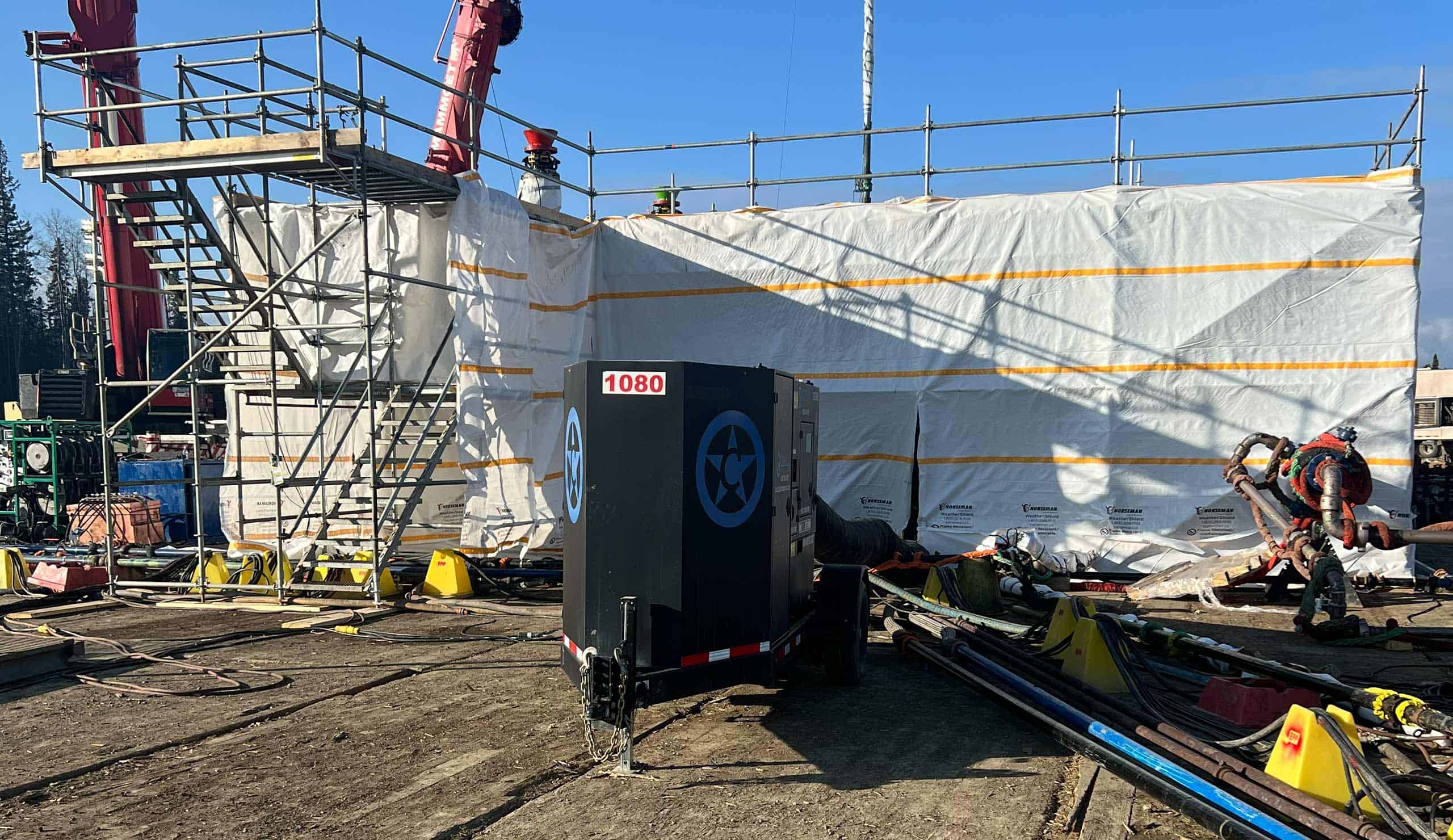
At a compressor station built in western North Dakota in January, cold weather is not a seasonal inconvenience. It is the primary operating condition. Crews are working on steel structures, handling precision instrumentation, and completing mechanical installations where cold-induced errors carry consequences that a commercial renovation site would never encounter. The heating strategy for that site is not optional. It is as much a part of the project plan as scaffolding or equipment access.
Industrial and oil and gas construction projects face a version of the cold-weather challenge that general commercial construction does not. The environments are more hazardous. The equipment requirements are more specific, particularly regarding open-flame restrictions near classified areas. And the schedule pressure is often higher because facility outages and production downtime drive the construction window.
REIC Rentals serves oil and gas and industrial construction projects with indirect-fired heaters and the exclusive Jet Heat flameless system for hazardous environments. Here are the core reasons rental heating belongs in every industrial and oil and gas construction plan.
Timely Completion of Projects in Demanding Environments
Cold weather slows industrial construction through mechanisms that compound over the course of a project schedule. Crews produce less per hour in cold conditions. Mechanical installations that require precise fastener torquing take longer when hand dexterity is reduced. Inspection hold points that require specific ambient conditions for coatings and sealants extend phase durations. And equipment startup procedures that require stable temperatures in control rooms and instrumentation areas cannot be rushed.
Rental heaters that maintain adequate working conditions throughout the shift eliminate the productivity reduction caused by cold exposure. On an industrial project with a fixed commissioning date or a defined shutdown window, those recovered productivity hours are not a convenience. They are schedule protection.
Our teams regularly support project managers on oil and gas and industrial sites who underestimated the combined effect of cold conditions on both crew performance and material application requirements. Engaging REIC Rentals during preconstruction to plan the heating strategy for each phase produces a plan that is ready when conditions demand it, rather than assembled reactively when the first cold snap arrives.
Worker Safety in Hazardous Industrial Environments
Worker safety on industrial and oil and gas construction sites involves risks that general commercial projects do not share. Cold stress impairs the judgment and dexterity required for industrial safety-critical work. In environments where equipment is moving, pressurized systems are being worked on, and heights and confined spaces are involved, that impairment creates incident risk before the worker or supervisor recognizes what is happening.
Industrial and oil and gas sites impose a specific safety constraint on heating equipment: open flames are prohibited in and around classified areas where flammable gases or vapors may be present. A direct-fired heater appropriate for a commercial renovation is not appropriate for a compressor station, a tank battery, or a refinery turnaround scope.
REIC Rentals’ exclusive Jet Heat flameless technology operates without an open flame or combustion emissions, making it the appropriate heating solution for hazardous industrial environments where standard open-flame heaters cannot be used. Our teams regularly deploy Jet Heat at oil and gas construction sites where classified area boundaries and hot work permit requirements require flameless operation.
Protecting Tools and Construction Materials
Industrial construction involves materials and equipment with minimum temperature requirements that cold weather violates without active intervention. Coatings on process piping and structural steel are among the most consequential. When applied below their specified minimum temperature, coatings fail at the adhesion layer rather than at the surface, so the failure mode is not a visible imperfection that gets caught during inspection. It is a bond failure that appears weeks or months later, requiring full strip and reapplication of work that passed visual review at the time. Adhesives and sealants used in mechanical and electrical installations carry the same risk: when applied in cold conditions, they cure with reduced bond strength that the specification did not anticipate, and that the installation record does not reflect.
Temperature-sensitive instrumentation and electrical equipment staged in partially conditioned spaces before installation faces condensation and freeze risk that can damage components before they are ever energized. Pre-installed control systems in MCC buildings and control rooms awaiting permanent HVAC require heating to prevent condensation that can damage electronics and void manufacturer warranties before the facility has produced a single unit of output.
Rental heaters that maintain adequate conditions in these storage and pre-installation spaces protect equipment investments, which in some cases represent a significant fraction of the total project cost.
Ventilation and Air Quality in Industrial Work Zones
Industrial construction zones require active ventilation management for reasons that go beyond comfort heating. Welding, cutting, coating application, and chemical use all generate fumes and contaminants that require controlled exhaust to maintain safe breathing conditions for workers. A rental heater that delivers warm air into a work zone must be paired with adequate ventilation planning to ensure that heated air movement does not recirculate contaminants, rather than exhausting them.
Indirect-fired heaters that deliver clean air into the work zone and exhaust combustion products separately eliminate the combustion byproduct contribution from the heating system itself. Jet Heat flameless equipment eliminates any contribution from combustion byproducts entirely. Both approaches allow ventilation planning to focus on contaminants generated by the actual work rather than on the combined effects of work activity and combustion from the heating equipment.
The Flexibility Advantage of Rental Over Ownership
Industrial and oil and gas construction projects have heating needs that vary significantly by phase, by location, and by the specific classified area boundaries and hazardous conditions at each site. Owning a fixed heating inventory forces every site and every phase to work with what is available. Renting matches the equipment to the actual phase requirement: direct-fired units for open-air and well-ventilated outdoor applications, indirect-fired units for enclosed work areas with crews present, and Jet Heat flameless systems for classified and hazardous environments where open flame cannot be used.
Rental also eliminates the service risk associated with ownership at remote industrial sites. When a unit develops a problem at a compressor station several hours from the nearest service center, the project team cannot absorb the repair timeline. REIC Rentals responds to equipment issues so the project team can focus on the construction work rather than managing a heating equipment failure on top of it.
Contact REIC Rentals to discuss the heating requirements of your next oil and gas or industrial construction project. Request a quote or find a location near you to connect with the team supporting industrial construction in your area.
1.888.356.1880 | in**@**ic.com | reic.com
Service You Trust. Equipment You Need.
