
Enclosed construction environments trap heat, dust, fumes, and moisture in ways that open-air jobsites never experience. Without planned ventilation, air quality degrades rapidly, conditions become unsafe, and work slows or stops entirely. The projects that manage these conditions effectively treat ventilation as a planned system from the start, not a problem to solve after something goes wrong.
Interior fit-outs in high-rise towers, data center builds under phased commissioning, hospital renovations with active patient care nearby, and warehouse retrofits with temporary enclosures all create environments where air exchange cannot be left to chance. Summer conditions amplify every problem. Heat accumulates in sealed spaces. Dust, VOCs from adhesives and coatings, and welding fumes concentrate when there is no forced air exchange. The combination creates conditions that are simultaneously a safety risk, a compliance exposure, and a productivity problem.
REIC Rentals provides ventilation and climate control solutions for enclosed construction environments, including cooling equipment, heating, drying equipment, and HVAC accessories, including ducting and distribution components. This article covers how to approach ventilation planning for enclosed construction spaces, the principles that govern airflow through those spaces, and how the right equipment selection keeps crews safe, compliant, and productive.
Why Enclosed Construction Environments Are Different
An open-air jobsite exchanges air continuously with the surrounding environment. An enclosed construction space does not. Temporary walls, poly sheeting, scaffolding wraps, and sealed floor plates all create boundaries that trap whatever is generated inside: heat from equipment and solar gain, dust from cutting and demolition, fumes from adhesives, coatings, and welding, and moisture from concrete curing and weather intrusion.
The accumulation is progressive. A single shift in a poorly ventilated enclosed space can push conditions to levels that would not be acceptable in any occupied building. Temperature rises as equipment runs and solar gain builds with no pathway out. Particulates concentrate as cutting and grinding operations proceed without exhaust. Humidity climbs as concrete releases moisture vapor into a sealed volume. Each of these problems compounds the others, and the combined effect on crew performance and safety is significantly worse than the sum of the individual factors.
Ventilation planning for enclosed construction is not simply about adding fans. It requires understanding how air pressure relationships work within the space, where contaminants are being generated, where they need to be exhausted, and how clean air will be introduced to replace what is removed. Getting those fundamentals right is what determines whether the ventilation system actually works as intended.
Air Pressure, Airflow Direction, and Contamination Control
Pressure differentials between zones are the mechanism that controls where contaminants go. When a space is held at positive pressure, clean supply air pushes outward through any opening, preventing contaminated air from migrating inward. When a space is held at negative pressure, air is drawn inward from surrounding zones, containing contaminants within the targeted area and exhausting them through a controlled pathway.
Positive pressure ventilation is the right approach when the goal is to protect a clean zone from contamination originating nearby. Occupied offices adjacent to demolition areas, finished spaces being protected from dust during active construction, and completed areas awaiting final inspection are all candidates for positive pressure. Supply air introduced at a rate that exceeds exhaust creates the outward pressure differential that keeps dust and fumes from migrating in.
Negative pressure ventilation is the right approach when the goal is to contain contamination within a defined zone. Concrete-cutting areas, grinding bays, chemical-application zones, and any area where hazardous materials are disturbed should be maintained at negative pressure relative to surrounding spaces. Air is drawn into the zone and exhausted through filtered outlets, ensuring that contaminants move in a controlled direction rather than drifting into adjacent occupied or completed areas.
Temporary barriers created by construction phasing can disrupt these pressure relationships in ways that are not always obvious. A door cycle, an improperly sealed partition, or an exhaust fan that is pulling against the intended pressure direction can reverse the carefully established airflow and send dust into a corridor that was supposed to be protected. Pressure relationships need to be verified and maintained throughout the active phase, not just established at setup.
Mechanical Ventilation: The Primary Strategy for Enclosed Jobs
Natural ventilation, which relies on wind, thermal buoyancy, and open building envelope elements, supplements mechanical systems but rarely provides adequate control on its own for enclosed construction environments. Security requirements often prevent overnight operation with open pathways. Outdoor air quality is variable and can be worse than indoor air quality. And during hot, still summer conditions, there may be no meaningful natural airflow driving exchange.
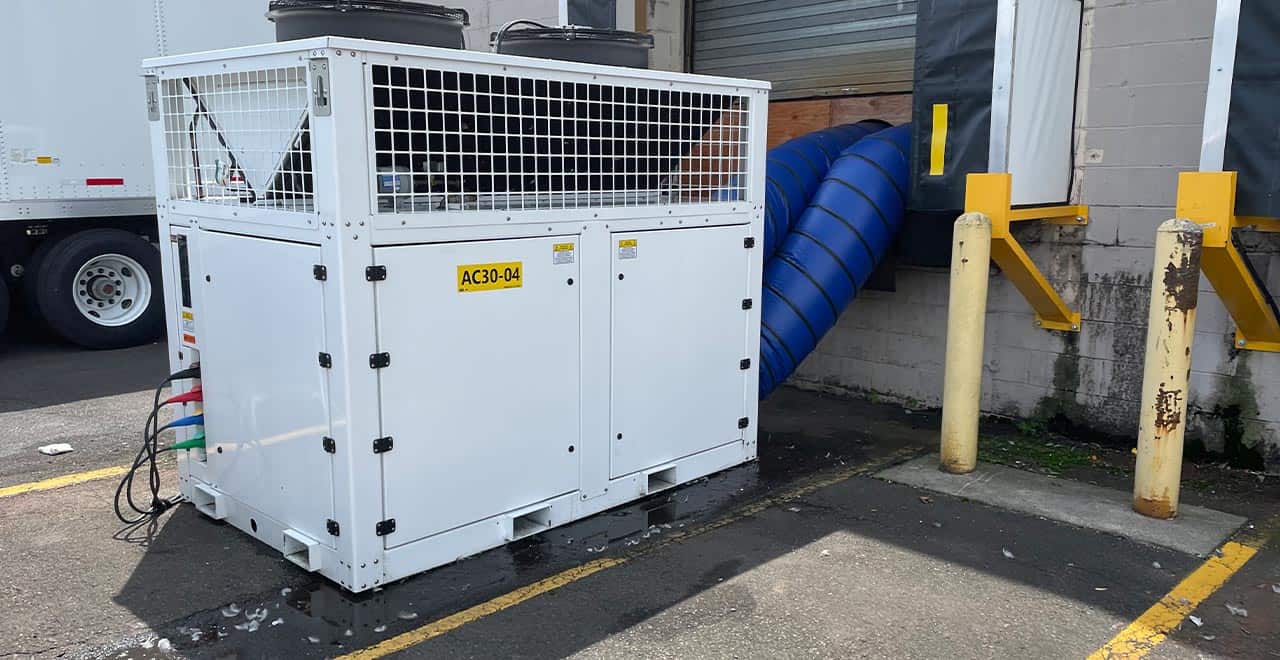
Mechanical ventilation uses fans and blowers to move air in a controlled direction at a specified volume. It provides predictable airflow regardless of outdoor conditions, allows pressure differentials to be established and maintained, and can be combined with filtration to remove particulates from the air stream before it reaches crews or adjacent areas. REIC Rentals provides cooling equipment, including industrial fans and portable air conditioners, that form the core of mechanical ventilation strategies on active construction sites, alongside HVAC accessories, including ducting that routes conditioned or exhausted air to where it needs to go.
Equipment selection for mechanical ventilation depends on the space volume, the heat and contaminant loads generated, and the pressure relationships to be maintained. A large, open warehouse floor with high ceilings has very different requirements than a sealed interior floor plate in a high-rise building. Undersized equipment results in inadequate air exchange rates and fails to achieve the pressure differentials required for contamination control. Oversized equipment may create excessive pressure differentials that cause problems at openings and transitions between zones. Sizing to actual conditions is what makes mechanical ventilation work as intended.
Ducting routes supply and exhaust air to specific locations rather than relying on open-volume distribution, which is essential in complex floor plate geometries where air movement without ducting would create dead zones with inadequate exchange. HVAC accessories, including flexible and rigid duct components, extend the reach of central equipment to the specific zones where air quality control is required. REIC Rentals advises on duct layout as part of the planning process, because a poorly designed distribution system defeats correctly sized equipment.
Heat Management in Enclosed Summer Environments
Heat accumulation in enclosed construction spaces during summer is one of the most consistent threats to crew safety and productivity. Solar gain through scaffolding wraps and translucent enclosures, heat output from active equipment and power tools, and the body heat of the crew all contribute to a total heat load that mechanical ventilation must overcome to maintain conditions that allow sustained work.
Portable cooling equipment introduces conditioned air into the enclosed space to offset the heat load from all sources. Industrial fans increase air movement across the work zone, improving the effectiveness of the body’s natural cooling mechanism even when active refrigerant cooling alone does not bring the ambient temperature down to comfortable levels. Evaporative coolers reduce temperatures in arid climates with lower power requirements than refrigerant systems, though their effectiveness decreases as humidity rises.
The combination of equipment types that achieves adequate conditions depends on the space, the heat load, and the ambient climate. A sealed high-rise interior in a hot, humid summer environment requires refrigerant-based cooling with adequate capacity to meet the heat load and sufficient air exchange to remove the heat generated rather than just redistributing it. A covered but partially open warehouse in an arid climate may achieve acceptable conditions with evaporative coolers and directional fans at significantly lower cost. REIC Rentals reviews the specific conditions before making recommendations so the equipment deployed is suited to what the site actually requires.
Recovery zones where crews can step away from intense work and return to manageable conditions significantly reduce heat-stress risk on summer sites. Positioning cooling equipment to create accessible relief areas rather than evenly distributing cooling capacity across the entire space can be a more effective use of available equipment when the work area is too large to cool uniformly. REIC Rentals factors placement into every equipment recommendation, because where a unit sits determines how much of its rated capacity actually reaches the people and processes that need it.
Moisture and Humidity Control in Enclosed Buildings
High humidity in sealed construction zones creates cascading problems that go beyond crew discomfort. Concrete releases substantial moisture vapor as it cures. Temporary weather enclosures can trap rain intrusion or condensation. Without controlled air exchange and dehumidification, relative humidity rises to levels that delay material installation, compromise coating adhesion and cure, accelerate corrosion of steel elements, and enable mold growth in new drywall and insulation. REIC Rentals’ drying equipment addresses these conditions directly, removing moisture from the air to reduce humidity to levels required by material specifications and manufacturer guidelines.
Dehumidification works in combination with ventilation and heating, not as a standalone solution. Bringing conditioned, dry air into a space and exhausting humid air out is the mechanism that removes moisture from the enclosed volume. A dehumidifier running in a sealed space with no air exchange will eventually saturate. Pairing drying equipment with adequate air movement is what sustains acceptable humidity levels throughout an active phase rather than temporarily reducing them.
The humidity targets that matter are set by the materials being installed and the coatings being applied, not by a general comfort standard. Concrete moisture vapor emissions must be below the threshold specified for the flooring adhesive system being used. Coatings require relative humidity within the manufacturer-specified range during application and cure. Drywall and insulation must stay below the threshold that enables mold colonization. REIC Rentals reviews these requirements as part of the planning conversation, so the drying and ventilation plan is built around what the materials actually need.
Ventilation for Specific Hazards: Dust, Fumes, and Chemical Applications
Specific construction activities create concentrated hazardous conditions that require targeted ventilation responses rather than general air exchange. Concrete cutting and grinding generate silica dust at concentrations that exceed exposure limits rapidly without local exhaust. Welding produces fumes that require capture velocity at the source to prevent accumulation in the breathing zone. Chemical applications, including epoxy coatings, adhesives, and spray paints, introduce VOCs that require adequate ventilation to prevent dangerous concentrations.
Local exhaust ventilation, which captures contaminants at or near the point of generation rather than diluting them across the full space, is the appropriate strategy for these operations. This means positioning exhaust equipment close to the work and ensuring the airflow velocity at the capture point is sufficient to draw the contaminant into the exhaust stream before it disperses into the general space. General dilution ventilation can supplement local exhaust but should not be relied upon as the primary control for operations that generate high concentrations of hazardous contaminants.
Negative-pressure containment zones isolate dust- and fume-generating operations from adjacent areas where other trades are working or where completed work or occupied spaces need protection. Establishing a negative pressure zone requires that exhaust exceeds supply in the targeted area, that the perimeter is adequately sealed to prevent uncontrolled air infiltration, and that the exhaust pathway routes contaminated air out of the building rather than into an adjacent zone. REIC Rentals advises on the equipment and layout needed to achieve functional containment for specific operations rather than providing generic guidance.
Scenario: Multi-Zone Ventilation on an Enclosed Hospital Renovation
Consider a hospital renovation project where active construction is underway on a floor directly above occupied patient care areas. Dust migration from demolition and cutting operations is unacceptable under any circumstances. The construction zone must be maintained at negative pressure relative to the occupied floor below and the adjacent occupied corridors, with all exhaust routed through filtered pathways to the exterior.
At the same time, the construction crew working in the negative pressure zone needs an adequate supply of fresh air to maintain safe working conditions, manage heat accumulation from summer ambient temperatures and equipment operation, and limit the concentration of fumes from chemical applications. Supply air is introduced at a rate slightly below exhaust to maintain the negative pressure differential while still providing adequate fresh air exchange for the crew.
Managing both requirements simultaneously, negative pressure for contamination control and adequate fresh air for crew safety, requires ventilation equipment that is correctly sized and positioned, ducted to maintain the pressure relationships at every opening and transition point, and monitored to verify that conditions remain within the intended parameters throughout the active phase. REIC Rentals supports this kind of coordinated ventilation planning by reviewing the specific project requirements before recommending equipment, rather than delivering a standard package and leaving commissioning to the site team.
Ventilation Across Different Project Types and Sectors
The ventilation requirements of enclosed construction vary significantly by facility type, and the approach must reflect those differences. Hospitals and healthcare renovations require negative pressure containment with filtered exhaust to protect patients and immunocompromised occupants from particulate infiltration. Data centers under construction require clean, filtered supply air and dust control before permanent HVAC commissioning to protect sensitive equipment from particulate accumulation during fit-out. Commercial office and retail build-outs with occupied tenant floors require quiet, low-odor ventilation systems and strict dust containment to protect adjacent tenants throughout construction.
Industrial projects, including petrochemical and refinery shutdowns, power station maintenance outages, and oil and gas facility work, create enclosed environments with concentrated fume and chemical exposure risks that require ventilation specifically designed to address those hazards. Warehousing and distribution center retrofits with large, enclosed floor areas require high-volume air-movement equipment to achieve adequate exchange rates across spaces that would require impractical numbers of small units without the right equipment specification.
Power Planning for Temporary Ventilation Systems
Mechanical ventilation equipment requires reliable power. Running multiple fans, cooling units, and drying equipment simultaneously across a large enclosed site adds up to a power load that must be planned for rather than discovered on delivery day. When the site’s power infrastructure cannot support the ventilation load, temporary generators provide the required supply. Coordinating ventilation and power requirements through a single planning conversation with REIC Rentals ensures both systems are sized to work together. Distribution panels and cabling route power from the generator to ventilation equipment across large floor plates, eliminating the constraints of running everything from a single supply point.
Planning Ventilation with REIC Rentals
Effective ventilation planning for enclosed construction starts before mobilization, not after conditions have already degraded. The inputs that drive equipment selection are available during preconstruction: the dimensions of the enclosed space, the activities that will generate heat and contaminants, the pressure relationships that must be maintained, the available power infrastructure, and the ambient conditions expected during the active phase. Engaging REIC Rentals at that stage yields a ventilation plan built into the project rather than assembled reactively.
The planning process includes a site or plan review, a load assessment covering heat, moisture, and contaminant generation by phase, equipment recommendations covering type, quantity, placement, and distribution, and logistics coordination for delivery aligned to project milestones. Ongoing support during active phases includes adjustments as conditions change and rapid response when scope shifts require a different equipment configuration. Request a quote or find a location near you to start the ventilation planning conversation for your next enclosed construction project.
Ventilation as a Project Management Priority
Ventilation in enclosed construction environments is not a background consideration. It directly determines whether crews can work safely and productively, whether materials are installed in accordance with the specifications, and whether adjacent occupants and completed areas are protected from contaminants generated by active construction. Getting it right requires planning, correct equipment selection, and a partner who understands what the specific project environment actually demands.
REIC Rentals delivers equipment, planning support, and on-site service to keep enclosed construction environments safe, compliant, and productive at every project phase. Explore the full cooling, heating, and drying ranges alongside HVAC accessories, or request a quote to build a ventilation plan that is ready before work begins.
1.888.356.1880 | in**@**ic.com | reic.com
Service You Trust. Equipment You Need.
