
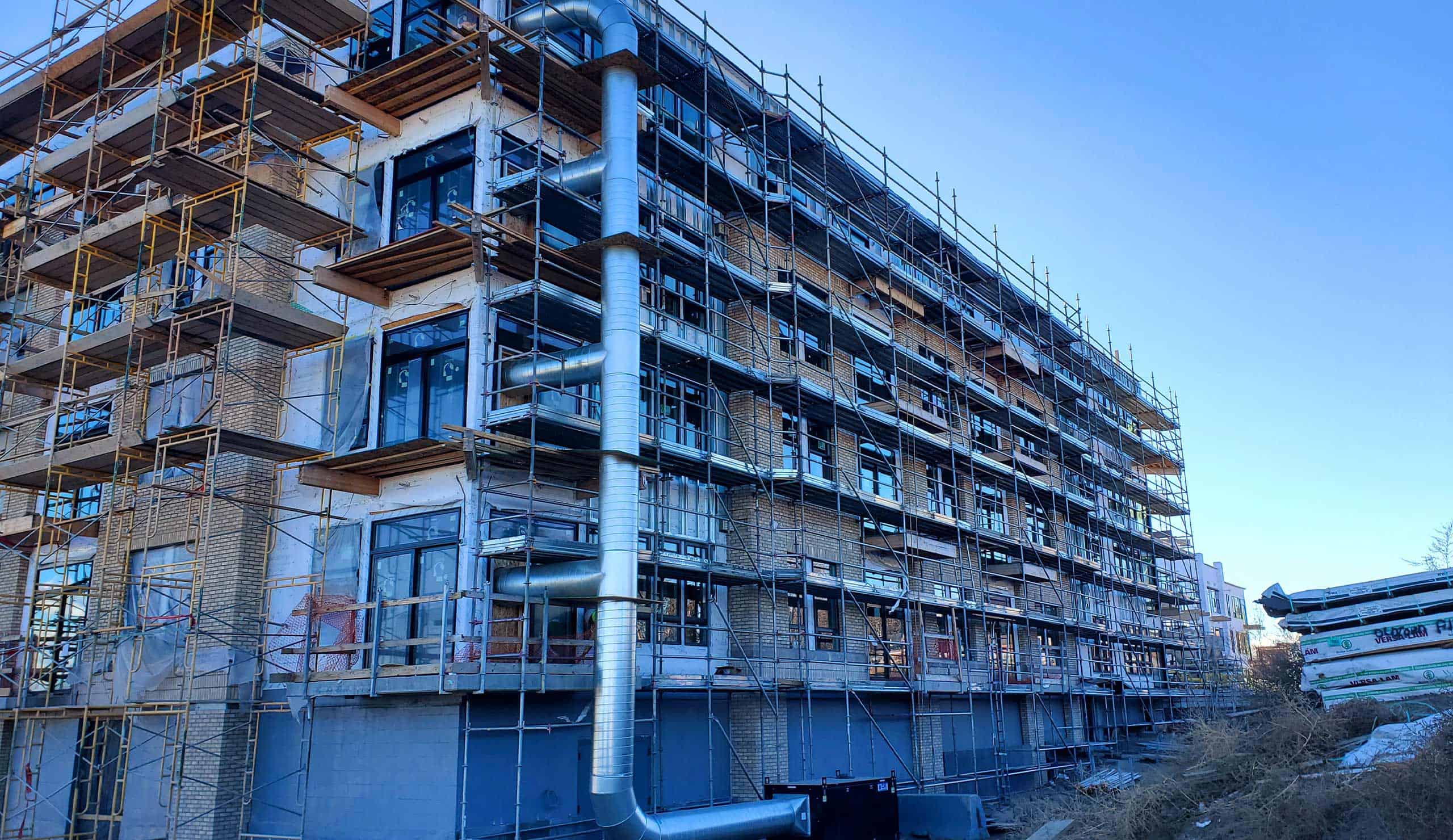
A single burst pipe on a fifth-floor fire sprinkler riser in an unheated multifamily building during a cold overnight creates a cascade that no general contractor wants to manage mid-project. Water migrates down through drywall, flooring, and ceiling assemblies across multiple floors below. Rework scope is measured in units, not rooms. The schedule impact is measured in weeks, not days. And the cost of remediation consistently exceeds the entire temporary heating budget that would have prevented it.
Frozen-pipe events at multifamily and mixed-use construction sites are not random occurrences. They occur in predictable locations and under predictable conditions when specific protective measures are absent. Understanding where pipes freeze, what conditions cause the freeze event, and which combination of design decisions and temporary heating prevents it is what separates projects that get through winter without incidents from those that incur significant remediation costs before occupancy.
REIC Rentals provides temporary heating equipment, dehumidification, and generators for multifamily and mixed-use construction through every winter phase. This article covers where pipe freezing happens on active construction sites, what prevents it, and how to respond when a freeze event occurs despite protective measures.
Where and When Pipe Freezing Happens on Construction Sites
Pipes freeze when standing water or partially filled lines reach 20 degrees Fahrenheit or below, forming ice that generates enough pressure to split walls, fittings, and joints. The risk window runs from November through March on most cold-climate projects, but the specific locations where freezing occurs follow consistent patterns that proactive planning can address.
High-risk locations on multifamily construction sites:
- Pipes running through exterior walls with inadequate insulation, particularly on north-facing exposures.
- End-of-line units on upper floors, where water in branch lines is static and loses heat faster than units with active flow.
- Stair and elevator cores that function as wind shafts before glazing is complete.
- Mechanical rooms in parking podiums and rooftop locations where ambient temperatures drop faster than on occupied floors.
- Unheated crawl spaces and attic spaces where service connections run without insulation.
- Fire sprinkler risers charged early for testing in partially enclosed structures where the shell is complete, but permanent heat is not yet operational.
The construction-specific vulnerability that causes the most expensive freeze events is the partially enclosed structure: the building shell is up, sheathing and roofing are complete, but glazing, insulation, and permanent heating are not yet in place. These structures effectively retain cold air while providing no meaningful thermal resistance around the installed and sometimes charged piping systems.
Mixed-use zoning creates a specific exposure on ground-floor commercial spaces with large storefront openings that lag the residential floors in enclosure. Domestic water supply lines serving upper residential floors often run through or adjacent to these unenclosed commercial spaces, creating freeze risk for residential plumbing even when the residential floors above are adequately heated.
Design and Mechanical Protection Strategies
Effective pipe freeze protection on multifamily construction sites starts with routing and installation decisions made during design and preconstruction. The most reliable protection is to not allow vulnerable pipe runs in the first place.
Route water supply lines and fire protection risers through interior chases rather than exterior wall cavities, where layout permits. Interior routing eliminates the direct exposure to cold exterior wall conditions that produce most residential pipe freeze events. Where exterior wall routing is unavoidable, specify continuous closed-cell foam insulation in the wall cavity around the pipe rather than standard batt insulation with gaps at framing members.
Pipe insulation on exposed runs in parking levels, mechanical penthouses, and service connections is a basic protective measure that prevents freeze events at a fraction of the cost of remediation after a burst pipe. Closed-cell foam and rubber tubular insulation provide durable protection on exposed runs. Self-regulating heat cable on domestic lines and fire-suppression branches in parking garages adds active protection to runs that insulation alone cannot protect during the most severe cold events.
Sealing penetrations through exterior assemblies at slab edges and balcony transitions eliminates the air infiltration pathways that create cold pockets around pipe runs in otherwise protected locations. A well-insulated pipe running through an unsealed slab penetration is exposed to the outdoor conditions in the gap around the penetration, regardless of the insulation applied to the pipe itself.
REIC Rentals reviews mechanical and temporary heat plans with the general contractor and MEP teams to identify where supplemental protection is needed before systems are charged and before permanent heating is operational. That review during preconstruction is significantly more effective than diagnosing freeze vulnerability after the first cold event has already revealed it.
Temporary Heat: The Primary Defense Before Permanent Systems Are Online
Before permanent heating systems are commissioned and operational, temporary heat is used to keep water in pipes rather than allowing it to expand into cracks and fittings. Without it, even well-insulated pipe runs in partially enclosed structures will eventually reach freezing temperatures during a sustained cold event.
Indirect-fired heaters are the appropriate choice for enclosed multifamily construction spaces where workers are present and where combustion byproducts from direct-fired equipment would compromise air quality. REIC Rentals’ indirect-fired heaters deliver clean, dry heat suited to occupied and adjacent occupied spaces, allowing drying, taping, painting, and finish work to proceed while maintaining the ambient conditions that prevent pipe freeze events in charged water systems.
Temporary heat sizing and zoning for multifamily construction should reflect the actual distribution of charged pipe runs across the building rather than treating the structure as a single uniform space. Riser rooms and mechanical chases that house the highest concentration of vulnerable piping require maintained temperatures above 40 degrees Fahrenheit regardless of what is happening in adjacent occupied floors. Increasing that threshold to 45-50 degrees Fahrenheit in riser rooms provides additional margin against temperature dips during extreme cold events, when permanent heating has not yet taken up the load.
Air distribution matters as much as heat output in large multifamily structures. Warm air delivered at one location in a long corridor does not automatically reach the far end. Temporary ducting that extends heat distribution to end-of-line units, stair cores, and mechanical spaces at building perimeters provides protection across the full structure rather than adequate conditions near the heater and inadequate conditions in the zones furthest from it.
Redundancy in temporary heating for multifamily construction is not a luxury. A single heater failure in a critical riser room during an extreme cold event can produce a freeze event within hours of the equipment going offline. Daily fuel checks, backup units staged in key locations, and automatic restart capabilities after power interruptions are operational requirements for a temporary heating system protecting charged plumbing systems during sustained cold weather.
Construction Sequencing Practices That Reduce Freeze Risk
Schedule and sequencing decisions made by the general contractor and MEP trades have as much influence on pipe freeze risk as the heating equipment deployed to protect against it.
Charge domestic water risers only after reliable heat is established and confirmed on the relevant floors. Charging pipe systems before adequate heat coverage is in place creates freeze risk from the moment water enters the lines. Coordinating the heat-first, charge-second sequence with the plumbing subcontractor eliminates the most common cause of freeze events on construction sites.
Coordinate with fire protection contractors to keep wet sprinkler systems in unheated garages and ground-floor commercial spaces dry until the structure is consistently above freezing and temporary or permanent heat covers those zones. A dry-pipe or pre-action system in those spaces is not a permanent solution. It is a sequencing tool that keeps water out of vulnerable runs until conditions permit a wet configuration without freeze risk.
Pre-holiday and pre-weekend walkthroughs are a basic site discipline that prevents the freeze events that almost always occur when the site is unoccupied, and heat systems fail without anyone noticing. Walk down exposed lines, verify heat in the riser rooms, check fuel levels, drain temporary hoses, and document the walkthrough before every extended period of unoccupied time. The projects that lose pipes over long weekends in January are almost always the projects that did not do the walkthrough before leaving Friday afternoon.
Temperature monitoring with remote sensors in riser rooms, amenity decks, and top-floor corridors provides early warning, allowing a heating failure to be addressed before it becomes a freeze event. Alerts set at 40 degrees Fahrenheit give facilities teams time to respond and restore heat before water in piping systems reaches freezing.
When a Freeze Event Occurs: Response and Remediation
Even well-managed sites experience freeze events. The response sequence determines whether a freeze event remains a limited, contained incident or becomes a multi-floor water damage event.
Warning signs that a pipe has frozen or is approaching freezing:
- Only a trickle or no flow at fixtures served by a suspect line
- Reduced water pressure in a specific zone or on a specific floor
- Ice buildup on pipe exteriors in mechanical rooms or exposed chases
- Unusually cold conditions in a riser room that was previously heated
Immediate response steps:
- Turn off the water supply to the affected section at the nearest isolation valve.
- Open the downstream faucet to relieve pressure as ice begins to melt.
- Isolate the frozen area and communicate immediately with plumbing and fire protection subcontractors.
- Document the location, ambient temperature at discovery, and all actions taken for insurance and corrective action purposes.
Restoring heat to the affected zone is the correct thawing approach for most freeze events on construction sites. Electric heating of the pipe itself, through approved electric heat tape or an electric heater positioned to warm the affected area, is appropriate for isolated sections. The general contractor should ensure that restoring heat to the zone, rather than applying heat directly to the frozen section, is the primary thawing method. Direct flame application to any pipe in a construction environment is not appropriate.
After thawing, inspect all joints and fittings in the affected section for cracking or stress from ice expansion before restoring water pressure. Pressure-test the section before returning it to service. Update the winter protection plan to include the specific location and conditions that produced the freeze event, so the corrective action addresses the actual cause.
REIC Rentals can rapidly deploy additional heating or adjust existing layouts to stabilize temperatures and prevent repeat events after a freeze. Request a quote or find a location near you to discuss a winter protection plan for your next multifamily or mixed-use project before the cold season arrives.
1.888.356.1880 | in**@**ic.com | reic.com
Service You Trust. Equipment You Need.
