
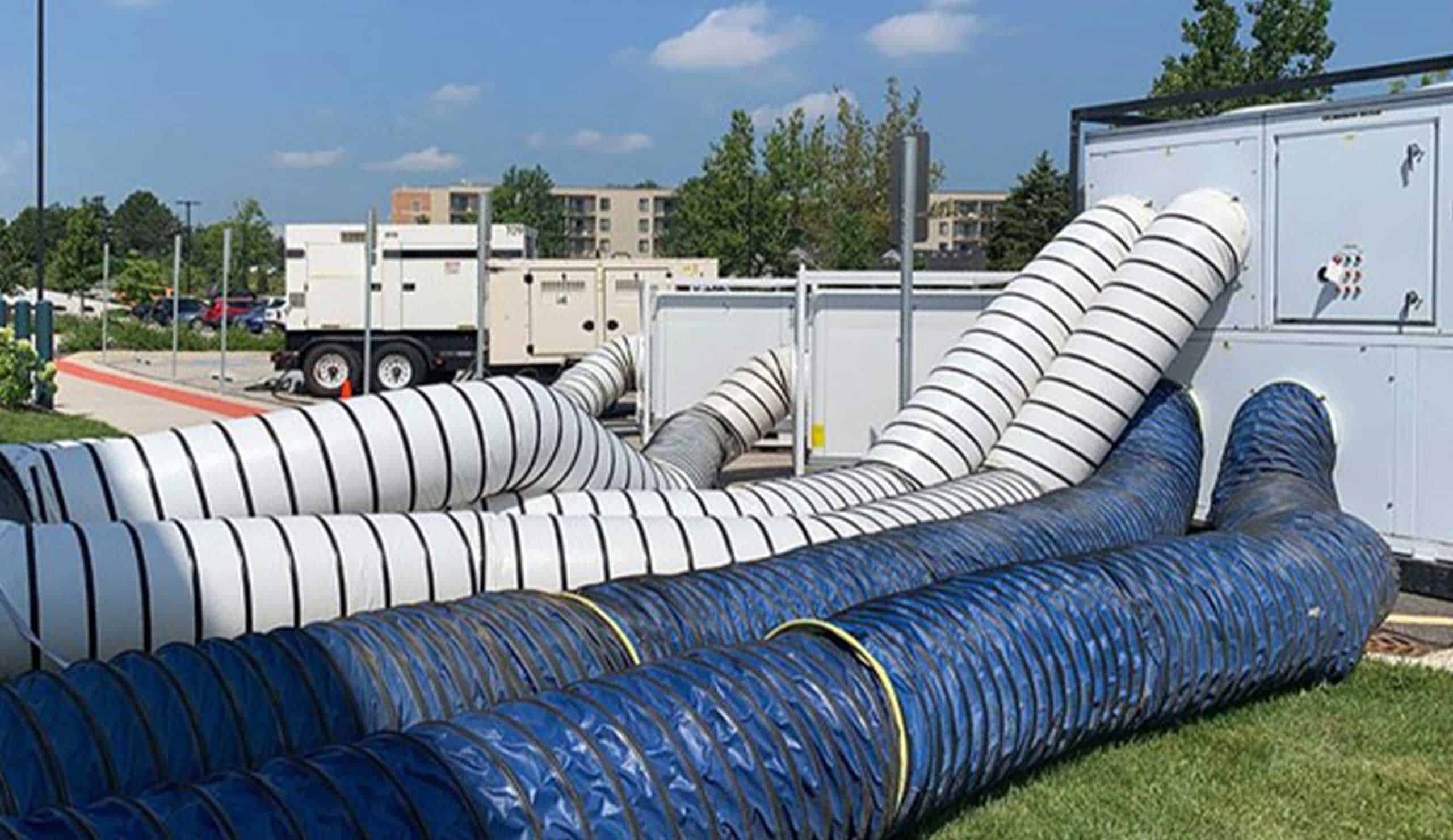
Effective cooling at remote industrial job sites is not a comfort consideration. It is a safety and operational requirement. Whether the site is an oil and gas operation in a northern basin, a mining facility in an arid region, or a construction project hours from the nearest service center, a dependable cooling system protects workers from heat stress, keeps sensitive equipment within safe operating ranges, and maintains the conditions that allow work to continue through peak summer months.
Remote locations make that harder to deliver. Extreme temperatures, limited infrastructure, restricted access to maintenance services, and long lead times for parts create conditions that standard cooling approaches are not built for. REIC Rentals works with industrial and construction teams across North America to solve these problems with equipment that is sized, configured, and supported for the realities of remote site work. This article covers the most common cooling challenges in these environments and the approaches that actually work.
Power Supply Limitations
Most remote sites run on diesel generators or off-grid power sources that deliver neither the stability nor the capacity that traditional air conditioning systems require. Voltage fluctuations damage compressors. Insufficient amperage causes units to cycle erratically or fail to reach the setpoint. When power is the constraint, the cooling system has to be selected around it, not the other way around.
Energy-efficient cooling units with variable-speed compressors draw significantly less power at partial load, which describes most real-world operating scenarios. Pairing cooling equipment with properly sized generators and distribution panels from the same rental package eliminates the mismatches that cause field problems. REIC Rentals supplies compatible generators and temporary power distribution alongside cooling equipment, so the full system arrives configured to work together. For sites with access to solar or hybrid power infrastructure, we can advise on units rated for the supply characteristics of those systems.
Extreme Weather and Temperature Ranges
Remote industrial sites often experience temperature swings that standard commercial HVAC equipment is not rated for. Desert sites push ambient temperatures well above 100 degrees Fahrenheit. In Northern operations, conditions require equipment to transition from heating to cooling within the same season, sometimes within the same week. Standard residential or light commercial units fail quickly in these environments because they are not designed for sustained operation at extreme temperatures.
Industrial-grade portable air conditioners and spot coolers in the REIC Rentals fleet are rated for high-ambient operation and built with components that withstand sustained loads. For sites in arid or high-dust environments, units with pre-filtration and sealed electrical compartments reduce the maintenance burden and extend reliable operating intervals. Supplementing mechanical cooling with shade structures or reflective insulation on enclosures reduces the heat load that the AC system needs to manage, improving both performance and equipment longevity in extreme conditions.
Limited Access to Maintenance and Repairs
When a cooling unit fails at a remote site, the gap between the problem and the fix is measured in days, not hours. Skilled HVAC technicians, spare compressors, and replacement controls are rarely available in the nearest town, which might be 4 hours away. Extended downtime in summer heat is not just a productivity problem. On sites where heat stress protocols limit work activity above certain temperatures, a cooling failure can halt operations entirely.
Renting from a provider with a national fleet depth and field service capability changes that equation. REIC Rentals operates across 55 locations in North America with teams that respond when equipment needs attention, not just when delivery is convenient. For remote deployments, we recommend configuring redundant cooling capacity so a single unit failure does not take the entire system down. Basic on-site training for maintenance staff covers filter changes, drain line checks, and early fault identification so minor issues are caught before they become mobilization events. Remote monitoring capability on select units allows our team to flag performance degradation before failure occurs.
Dust and Debris Buildup
Mining, construction, and arid-region sites generate dust levels that clog filters and coat coils faster than standard maintenance intervals account for. A unit running with 30 percent filter blockage loses cooling capacity, works harder, draws more power, and fails earlier. In high-dust environments, filter changes that might happen monthly on a standard installation need to happen weekly or more frequently, depending on conditions.
Selecting units with high-efficiency particulate filtration and accessible filter housings makes maintenance faster and more likely to occur on schedule. Protective enclosures or covers for outdoor condenser sections reduce debris ingestion at the source. REIC Rentals can advise on the right unit configuration for a site’s dust profile, and our equipment arrives with filter kits sized for the expected service interval, so maintenance teams have what they need from day one rather than sourcing parts in the field.
Transportation and Mobilization Logistics
Moving bulky cooling equipment to a remote site is a logistics challenge before it is anything else. Road access, weight limits, crane availability at the destination, and the lead time required to coordinate delivery all factor into whether the equipment arrives when the project needs it. Purchasing large, fixed systems for a temporary scope adds costs that rarely make sense when the site will be demobilized in months.
Portable and modular cooling units in the REIC Rentals fleet are designed for exactly this scenario. Spot coolers, portable air conditioners, and packaged cooling units ship on standard trailers, require no crane for installation in most configurations, and connect to existing ductwork or operate in spot-cooling mode without permanent infrastructure. Modular configurations allow capacity to scale up or down as the scope changes without replacing the entire system. Renting rather than purchasing eliminates the ownership cost on equipment that serves a defined project window.
Choosing the Right Cooling Equipment for Remote Industrial Work
The equipment decision for a remote industrial site is not the same as specifying cooling for a commercial building. Capacity, ambient rating, power requirements, maintenance accessibility, and transport configuration all need to align with the specific conditions of the deployment. Getting one of those factors wrong creates problems that are difficult to correct once the site is active and the season is running.
Portable air conditioners are used in enclosed spaces such as control rooms, offices, and crew quarters where directed cooling is required. Spot coolers provide targeted relief in open work areas, server rooms, and process equipment enclosures where ductwork is not practical. Large-capacity packaged cooling units support full building conditioning for temporary structures, modular facilities, and process environments where temperature control directly affects output quality or equipment reliability. REIC Rentals offers a range across all these categories, with units available in configurations suited to the power supply, climate, and access conditions of remote industrial work.
Plan Cooling Into the Project Before the Season Starts
Remote site cooling fails most often not because the wrong equipment was chosen, but because cooling was not planned far enough in advance. Peak summer demand puts pressure on rental fleet availability across every market. Sites that confirm equipment needs in Q1 for Q2 and Q3 deployments secure the right units at the right time. Sites that wait until temperatures are already climbing compete for what is left.
REIC Rentals works with project teams ahead of the season to assess site conditions, identify the right equipment configuration, confirm power compatibility, and schedule delivery to match mobilization dates. For multi-phase projects or operations that run through the full summer season, we support ongoing adjustments as scope and conditions change. The goal is the same on every deployment: cooling that works when the site needs it, backed by a team that responds when it does not.
Tell us your site location, work environment, crew size, and power availability. We will build a cooling plan that fits the project and holds up through the season.
1.888.356.1880 | in**@**ic.com | Get a Quote
Service You Trust. Equipment You Need.
