
Smart compact equipment selection directly affects productivity, cost control, and the ability to scale operations from residential foundations to large commercial developments. The difference between right-sized equipment and a poor match shows up in labor hours, schedule performance, and total project cost, not just on the rental invoice.
On modern construction sites, compact machines handle a wider range of tasks than they did a generation ago. Access requirements have tightened as urban infill lots grow more constrained. Schedule compression has made every productive hour more valuable. And the variety of attachments available means a single well-chosen machine can work across multiple phases of a project without requiring a swap. All of that makes the selection decision more consequential than it may appear at the quoting stage.
REIC Rentals specializes in helping contractors match compact machines to project requirements. Rather than providing a catalog and leaving contractors to figure out what fits, our team reviews project constraints, soil conditions, access limitations, and schedule requirements to recommend equipment that maximizes output per shift. This article covers three core areas where compact equipment creates measurable advantages: site preparation, material handling, and jobsite productivity. Each section addresses how the right rental strategy and machine selection tighten production schedules and protect project budgets.
Why Compact Equipment is Central to Modern Site Prep
Project timelines and budgets have compressed significantly in recent years. Labor shortages have made every productive hour more valuable. Those pressures have made compact machines essential for accessing tight urban infill lots while maintaining production rates that keep schedules intact. A machine that can pass through a standard gate, work within a few feet of an existing structure, and preserve subgrade conditions while moving meaningful yardage is not a compromise. It is often the most productive option available.
Compact dirt movers cause less site disturbance than full-size counterparts. That means less rework from rutting or over-compaction, fewer delays caused by repairing damage to finished areas, and the ability to work on sites where a larger machine would create more problems than it solves. On both small infill lots and large greenfield sites, compact equipment improves site access while operating with ground pressures that protect subgrades and surrounding work.
Specific site prep tasks where compact machines consistently outperform alternatives on constrained sites include topsoil stripping, utility trenching, foundation excavation, building pad fine grading, foundation backfilling, and loading spoils into trucks throughout the day. The production rates for each task depend on matching the machine to soil conditions, access constraints, and the compaction requirements specified for the project. The team at REIC Rentals reviews those inputs before making recommendations rather than defaulting to the most available unit.
Selecting Compact Equipment for Site Preparation Tasks
Site prep productivity depends on pairing the right machine to the specific conditions of each task. Simply getting a machine on site does not guarantee efficient production. The selection process requires evaluating dig depth, reach, ground pressure, rated operating capacity, and attachment compatibility for each phase of the work.
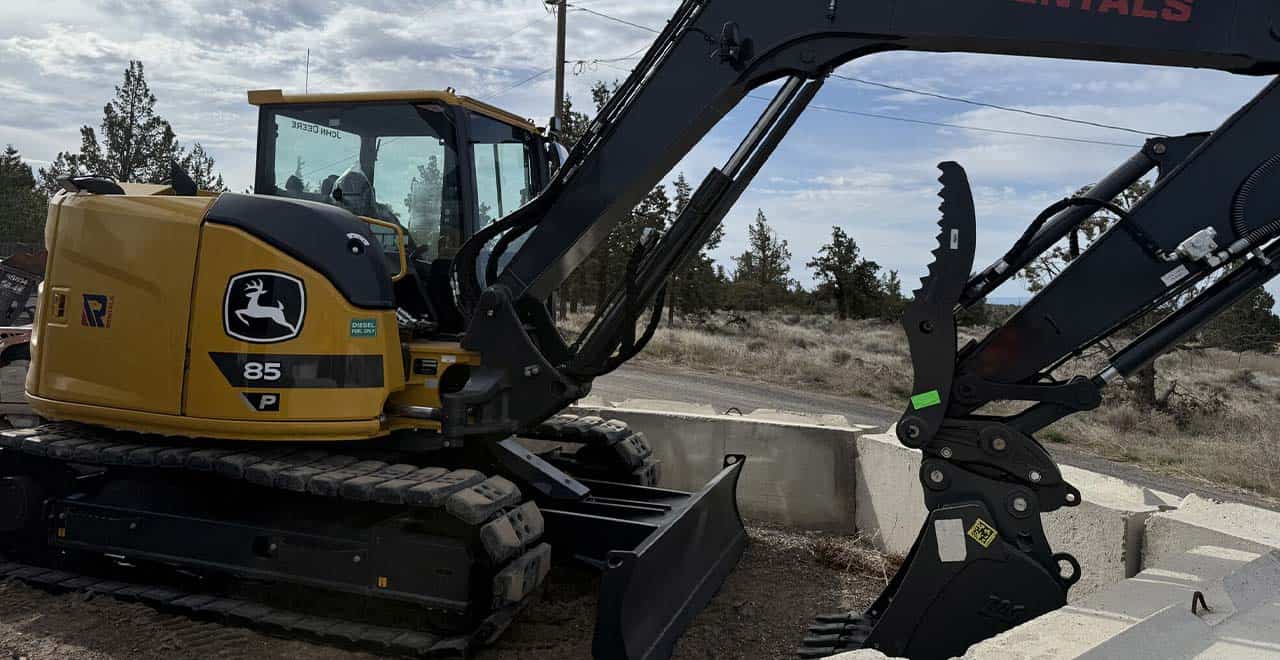
Mini excavators serve as the primary tool for trenching, foundation excavation, and utility work. Zero tailswing designs keep the counterweight within the track width during slewing, allowing operators to work in close proximity to existing structures without risking collisions. That capability is particularly valuable on infill lots and renovation sites where clearances are tight. For open areas where swing clearance is not a constraint, conventional designs offer slightly higher productivity. REIC Rentals carries compact excavators in the small-dirt category for residential and commercial utility work, alongside large-dirt equipment for heavier commercial scopes.
When selecting between wheeled and tracked machines for loading and pushing work, terrain conditions drive the decision. Wheeled units handle firm, paved surfaces efficiently. Tracked units outperform wheels in wet clay, sand, or soft soils where flotation matters, maintaining rated operating capacity in conditions that would cause a wheeled machine to sink or lose traction. Matching the undercarriage to the soil is one of the most consistent places contractors recover production hours that would otherwise be lost.
Compactors are suited to spot compaction in confined areas and granular soils that respond well to vibration, with walk-behind and ride-on options for different trench and pad configurations. Attachments expand machine versatility across phases without requiring a swap: grading buckets for finish work, trenching attachments sized to the utility being installed, and hydraulic breakers for concrete and rock removal.
REIC Rentals advises on machine width, ground pressure requirements, and noise considerations before equipment arrives on site. That consultative approach prevents mismatches that increase fuel burn and labor input when operators work on the wrong machine for the conditions.
Compact Equipment for Material Handling: Matching Capacity to the Work
Material handling is a hidden cost driver on many construction projects. Inefficient material flow consumes labor hours, damages materials through unnecessary handling, and creates schedule delays when supplies are not staged where crews need them. Compact equipment designed specifically for material handling tasks gives project teams direct control over this aspect of operations.
Compact forklifts and reachout equipment move palletized materials efficiently across active sites, staging rebar, formwork, block, and other supplies directly where workers need them without secondary handling. The productivity gains from using dedicated material-handling equipment become clear when compared with manual alternatives. A machine that places materials at the point of use eliminates the back-and-forth that accumulates into significant lost time across a multi-week phase.
The right material handling machine depends on the reach required, the weight of the loads being moved, and the surface conditions where the machine will operate. A site with firm, paved surfaces has different requirements than an active earthworks area with soft or uneven ground. Getting that match right means the machine operates at its rated capacity rather than running below it to avoid instability or surface damage.
Fork attachments available through REIC Rentals support precise material placement across a range of load widths. Grapple buckets handle debris and demolition material. Specialized material buckets increase throughput for bulk materials. Safety features on current-generation compact material handlers protect both operators and equipment, with load management systems that keep machines operating within rated capacity rather than in ranges that accelerate wear and create instability.
Avoiding overload situations protects both operators and equipment over the full rental period. Exceeding rated capacity creates stress on structural components and hydraulic systems that is not always immediately visible, but that shortens machine life and reliability across subsequent uses. REIC Rentals maintains rental units with documented maintenance histories, which keeps material handling operations moving without the downtime events that occur when equipment arrives on site in unknown condition.
Controlling Costs with the Right Rental Strategy
Cost control in compact equipment rental extends beyond finding the lowest daily rate. True savings come from maximizing utilization, reducing downtime, and avoiding mismatched equipment that creates hidden expenses across the project timeline. A well-planned rental strategy treats equipment as an input that directly affects total project cost, not just a line item to minimize at the quote stage.
Rental periods should align with actual project phases. Day rentals are suitable for short clearing or demolition tasks. Weekly rentals work for utility installations and foundation work. Monthly rentals match extended grading or earthworks phases. Planning those periods with REIC Rentals ahead of the project start minimizes idle days when machines are on rent but not turning hours, which is one of the fastest ways for the rental budget to leave a project without generating output.
Hidden costs accumulate quickly without proper equipment planning. Repeated delivery and redelivery charges add up across a multi-phase job requiring frequent equipment changes. Oversized machines consume more fuel than appropriately sized units on the same tasks. Breakdowns generate overtime labor costs and schedule delays that compound across downstream trades. REIC Rentals mitigates these risks through pre-delivery inspections, field service support, and replacement capability in key service areas. That responsiveness keeps equipment performing at full capacity when projects depend on it.
Modern equipment in the REIC Rentals fleet delivers better fuel efficiency than older machines through current engine technology, reducing operating costs while meeting emissions requirements on public projects subject to environmental mandates. The service and maintenance support provided by REIC Rentals ensures machines stay productive rather than sitting idle waiting for parts or service that is not available on short notice.
The most cost-effective approach on constrained sites is often a single versatile machine with multiple attachments rather than separate specialized units for each task. One compact tracked unit with a grading bucket, forks, and a breaker attachment handles work across several phases without multiple deliveries, separate rental agreements, or the congestion that comes from having more machines on site than the work area can productively support.
Scaling from Small Jobs to Larger Projects
Compact equipment remains relevant at every project scale, adapting to increased scope through fleet expansion and additional attachments rather than requiring a wholesale change in equipment strategy. A contractor who starts with compact machines on residential work builds familiarity with operating characteristics and attachment systems that carry forward as project sizes grow. That continuity reduces the learning curve when adding crew members or moving operators between sites.
On larger jobs, compact equipment complements full-size excavators and dozers rather than replacing them. Small dirt movers handle fine work in areas where larger machines cannot operate efficiently, including low-clearance courtyards, utility crossings requiring precision, and zones adjacent to completed work where a larger machine would cause damage. Compact machines navigate around finished installations without disrupting them, maintaining productive output in areas that would otherwise require time-consuming manual work.
REIC Rentals supports scaling through multi-unit reservations, staggered delivery scheduling that matches equipment arrival to phase requirements, and a consistent fleet across 55 locations. That standardization allows operators to move between projects or machines without extended learning curves, which matters on larger jobs where crews may be split across multiple active areas simultaneously. Regional branches coordinate with project managers and superintendents to review plans and build right-sized equipment packages for each phase.
Improving Jobsite Productivity with Attachments and Operator Support
Once core compact machines are selected, productivity gains often come from attachments and operator support that multiply output without adding equipment. The right combination of tools turns one machine into a versatile production asset capable of handling diverse tasks throughout a full workday without requiring swaps.
Key productivity attachments include grading equipment for fine pad and parking lot work, hydraulic breakers for concrete removal and rock, auger attachments for post and foundation drilling, sweeper attachments for site cleanup, and quick couplers that allow operators to swap attachments in under a minute, rather than the extended downtime required by manual swaps. Each attachment that eliminates a separate mobilization or manual labor task reduces total project cost in ways that do not show up individually in the rental invoice but that compound significantly across a multi-week phase.
Modern compact equipment incorporates technologies that improve both efficiency and the operator experience. Return-to-dig functions save cycle time on repetitive tasks by automatically returning the bucket to a set position. Ride control smooths travel across uneven sites with loaded attachments. Basic grade assistance improves finish grading speed and accuracy for operators who are not working with a dedicated grade checker. These features increase output per shift without requiring additional crew members.
Operator comfort affects production across long shifts in ways that are easy to underestimate during planning. Equipment with well-designed controls, an appropriate cab climate, and manageable noise levels allows operators to sustain full production throughout a shift rather than slowing as fatigue accumulates in the final hours. REIC Rentals provides delivery orientations for operators unfamiliar with specific models, helping production get started correctly rather than forming bad habits during an extended learning period on the first day.
For contractors ready to explore how attachments and machine selection can improve productivity on upcoming projects, contact REIC Rentals for a site review or equipment consultation. We review the specific requirements of each phase and develop a recommendation that aligns with the job’s access constraints, soil conditions, schedule, and budget.
Planning Your Next Project with REIC Rentals
Smart compact equipment selection improves site prep efficiency, streamlines material handling, tightens cost control, and scales with project growth. The productivity that matters on modern jobsites depends on matching machines to tasks, maintaining high utilization rates, and deploying attachments that multiply output per machine.
REIC Rentals operates as a partner in project planning, not simply a rental source. The team provides consultative equipment selection based on site conditions, schedule requirements, and budget constraints. Once machines arrive on site, responsive service support keeps operations running without the delays that erode margins and disrupt schedules. Browse the full dirt movers inventory, compaction equipment, and material handling options, or find a location near you to discuss upcoming work and build an equipment plan that supports your next project from clearing through final grading.
1.888.356.1880 | in**@**ic.com | Get a Quote
Service You Trust. Equipment You Need.
