
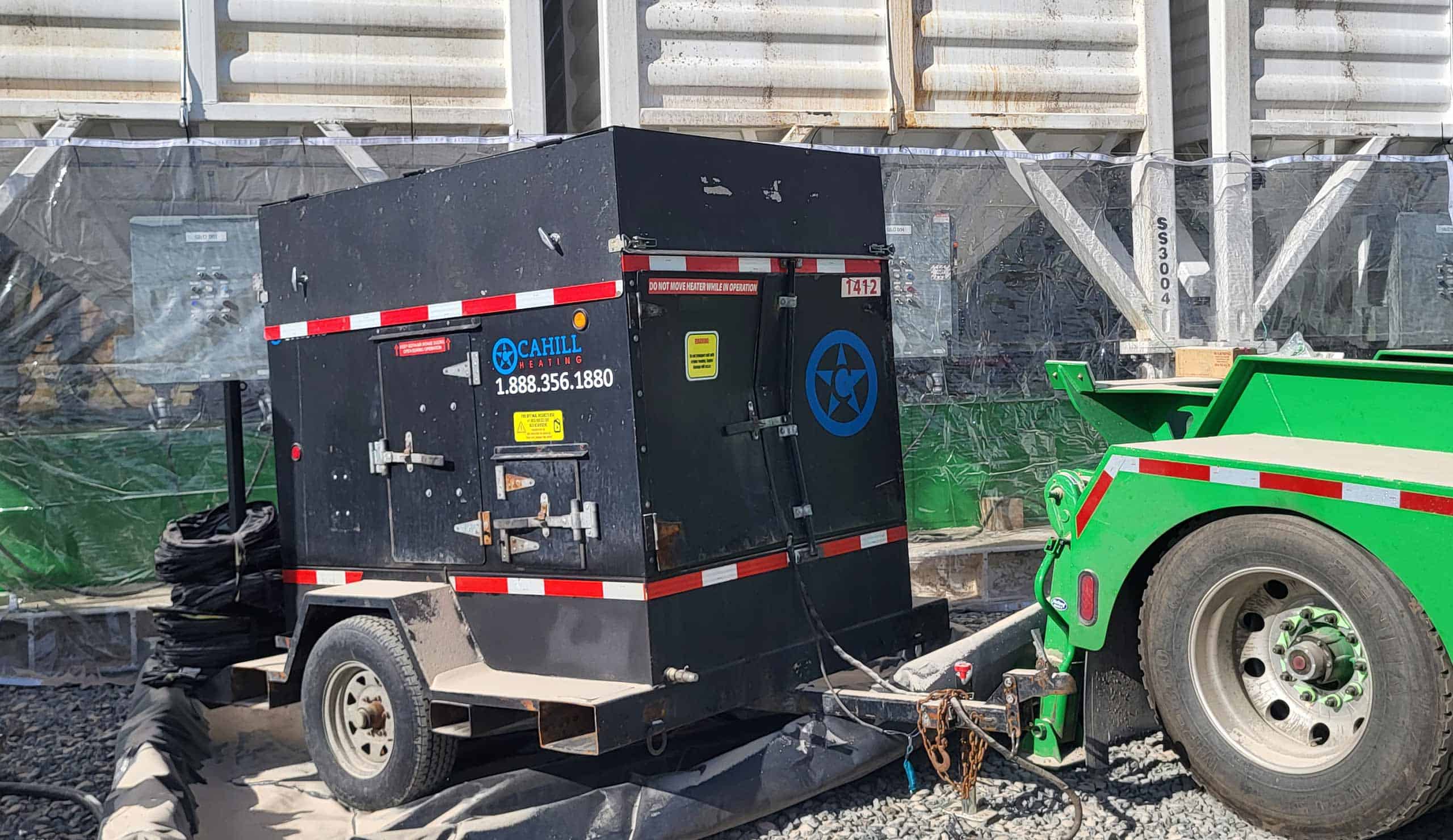
A distribution center running three shifts through a Mountain West winter is not a controlled environment. Dock doors open hundreds of times a day, flooding receiving areas with cold outdoor air. High ceilings create thermal stratification that leaves the floor level cold while warm air collects at the ceiling. And permanent HVAC systems sized for typical conditions may not recover fast enough when a cold snap pushes ambient temperatures well below design assumptions. The result is a facility that looks heated on paper and feels cold where the work is happening.
For warehouses and distribution centers, the connection between ambient temperature and operational output is concrete and measurable. Pick rates, pack rates, forklift operator efficiency, and receiving dock throughput all decline when ambient conditions drop below comfortable levels. Those declines are not marginal. They are visible in shift production numbers and error rates on any day when the temperature is not actively managed.
REIC Rentals supports warehousing and distribution centers with temporary heating equipment and HVAC accessories for seasonal peaks, planned maintenance, and emergency HVAC failures. This article covers how temporary heating directly improves productivity in warehouses and distribution centers, and what a practical deployment looks like.
The Direct Productivity Benefit of Comfortable Conditions
Employees who are warm sustain their normal work pace and accuracy across a full shift. Employees managing cold conditions slow progressively, make more errors, and disengage from the collaborative behaviors that operational performance depends on: communication with supervisors, quality checks, attention to packing accuracy, and the small course corrections that keep a shift running at plan rather than drifting below it.
The productivity difference between adequate and inadequate temperature management in a warehouse or distribution center during cold weather is not subtle. It shows up in shift production reports as reduced pieces per hour, in quality records as elevated error and rework rates, and in supervisor time as increased oversight required to maintain output standards that comfortable conditions would have maintained automatically.
Retaining experienced warehouse staff through the winter season is also affected by working conditions. Workers with options choose employers who provide adequate environmental conditions. In competitive labor markets, the working environment your facility provides during colder months affects which crews show up consistently and which ones find employment elsewhere before spring.
Temporary Heating: When It Is the Right Answer
Temporary heating in a warehouse or distribution center is the right solution in four distinct scenarios, each of which produces different financial and operational consequences without it.
When permanent heating systems are insufficient to meet peak cold demand, temporary equipment supplements existing capacity to maintain conditions required by production rates. When planned maintenance takes permanent systems offline, pre-staged temporary equipment maintains conditions throughout the maintenance window so production continues without interruption. When emergency failures cause unplanned outages, rapid deployment of temporary equipment mitigates the impacts on productivity and product safety. And when new spaces are brought into operation before permanent mechanical systems are commissioned, temporary heating provides the climate control needed to let the space function immediately.
In all four cases, the cost of temporary heating is weighed against the cost of the alternative: production loss, inventory exposure, staff safety risk, or the disruption caused by a delayed commissioning that pushes permanent heating installation into a period when the space is already needed.
Targeting Heat Where It Matters Most
Effective temporary heating in a large warehouse or distribution center is not about conditioning the full building volume. It is about targeting the zones where people are working and where operations are most affected by temperature. Portable heating equipment positioned at pick lines, packing stations, receiving docks, and active staging areas delivers temperature control where it produces the most direct productivity return.
Dock areas are consistently the most thermally challenging zone in a warehouse or distribution center. Dock doors open frequently, introducing columns of cold air directly into the operational space with each cycle. Directed heating at dock zones reduces the temperature differential between the dock and the interior and maintains conditions for dock workers operating in an environment that permanent HVAC systems treat as the most difficult to condition.
Mezzanine and upper rack levels in high-bay warehouses run significantly warmer than floor level due to heat stratification, but product stored at height and workers on mezzanine pick levels are exposed to conditions that floor-level monitoring does not accurately capture. Addressing stratification with directional air movement, alongside targeted heating, produces more uniform conditions throughout the building height rather than simply better floor-level readings.
Pairing Heating With Dehumidification
Humidity control alongside temperature management protects warehouse inventory in ways that temperature alone does not. Elevated relative humidity accelerates corrosion on metal components and racking, enables mold growth in packaging materials and stored goods, and compromises the integrity of moisture-sensitive products, including electronics, pharmaceuticals, and food items. REIC Rentals’ drying equipment provides dehumidification alongside heating, so both temperature and humidity are maintained within the ranges required by product specifications and facility standards.
Loading dock areas are the primary source of humidity in most warehouses during cold weather. Repeated door openings introduce humid outdoor air into the conditioned space, raising relative humidity and increasing the moisture load the building’s permanent systems must manage. Addressing dock area ventilation and dehumidification alongside heating produces better results than treating temperature and humidity as separate problems with separate solutions.
Contact REIC Rentals to discuss temporary climate control for your warehouse or distribution center. Request a quote or find a location near you to connect with the team supporting warehousing and distribution operations.
1.888.356.1880 | in**@**ic.com | reic.com
Service You Trust. Equipment You Need.
