
A loading dock door opens 200 times a day in a busy distribution center. Every opening floods the receiving area with cold outdoor air, spikes the heat load on the permanent HVAC system, and drops ambient temperatures in the zones where workers are most active. In a facility already fighting a cold snap, that cycle compounds fast.
Warehouses and distribution centers face a version of the winter heating challenge that office buildings do not. Large, uninsulated volumes lose heat quickly. Dock doors that cannot stay closed for operational reasons create continuous cold air infiltration. Inventory spanning everything from pharmaceuticals to packaged food has its own minimum temperature requirements. And crews performing physically demanding tasks throughout a full shift need conditions that allow them to work at full capacity.
REIC Rentals provides temporary heating equipment for warehousing and distribution centers, industrial facilities, and commercial properties. This article covers how temporary heating addresses the specific operational challenges of large-footprint facilities and the scenarios where it delivers the clearest return.
Productivity: The Operational Case
Manual dexterity declines measurably at temperatures below 57 degrees Fahrenheit. In a distribution center where pickers, packers, and forklift operators depend on precision hand control throughout a full shift, that decline translates directly into slower throughput, more errors, and more risk.
Cognitive performance under sustained cold stress also degrades in ways that affect decision-making and task accuracy before the worker is aware of it. On a warehouse floor where workers coordinate with moving equipment and make continuous inventory decisions, those effects add up over a shift, visible in both error rates and production numbers.
Our teams regularly support operations managers who underestimate the productivity impact of cold conditions until a winter event demonstrates it directly. The conversation after that event is almost always the same: a temporary heating plan should have been in place from the start of the cold weather season.
Dock Areas: The Hardest Zone to Heat
Loading dock areas present the most challenging heating problem in a warehouse or distribution center. Dock doors open frequently throughout each shift, and each opening introduces a column of cold outdoor air that can significantly lower temperatures in adjacent staging areas.
Directed heating at dock areas reduces the temperature differential between the dock and the interior, limits cold-air penetration that affects adjacent zones, and maintains conditions in which dock workers can operate effectively throughout a full shift. The alternative, leaving dock areas unheated and relying on the building’s permanent HVAC to recover from repeated temperature spikes, consistently results in equipment running at near-capacity and interior conditions that remain below acceptable levels during peak cold.
Inventory Protection: What Temperature Excursions Actually Cost
Many of the products moving through warehouses and distribution centers have minimum storage temperature requirements. Pharmaceuticals, food products, adhesives, paints, and electronics all have specifications that cold weather violates without active heating.
Product damaged by cold exposure does not always show immediate visual signs. Paint that freezes loses its emulsion and cannot be used. Adhesives stored outside their temperature range fail after installation. Pharmaceuticals exposed to temperatures outside their specified storage range may require disposal regardless of appearance. The cost of cold-damaged inventory consistently exceeds the cost of the heating that would have prevented it.
HVAC Failure: When Permanent Systems Go Offline
Planned maintenance, unexpected equipment failures, and boiler replacements all create periods where permanent heating is unavailable. In a warehouse or distribution center, those windows create immediate operational risk: crew conditions deteriorate, cold-sensitive inventory is exposed, and the facility cannot maintain the conditions under which it operates and stores product.
Temporary heating delivers the most direct value in four scenarios:
- A permanent heating system fails or requires planned maintenance that takes it offline.
- Outdoor temperatures drop faster or further than the building’s permanent systems can compensate for.
- A facility enters a peak operational period with heating demand that exceeds permanent system capacity.
- A new facility or expansion is operational before permanent mechanical systems are commissioned.
In all four cases, the cost of temporary heating is weighted against the cost of the alternatives: production loss, inventory damage, or the disruption of a permanent installation.
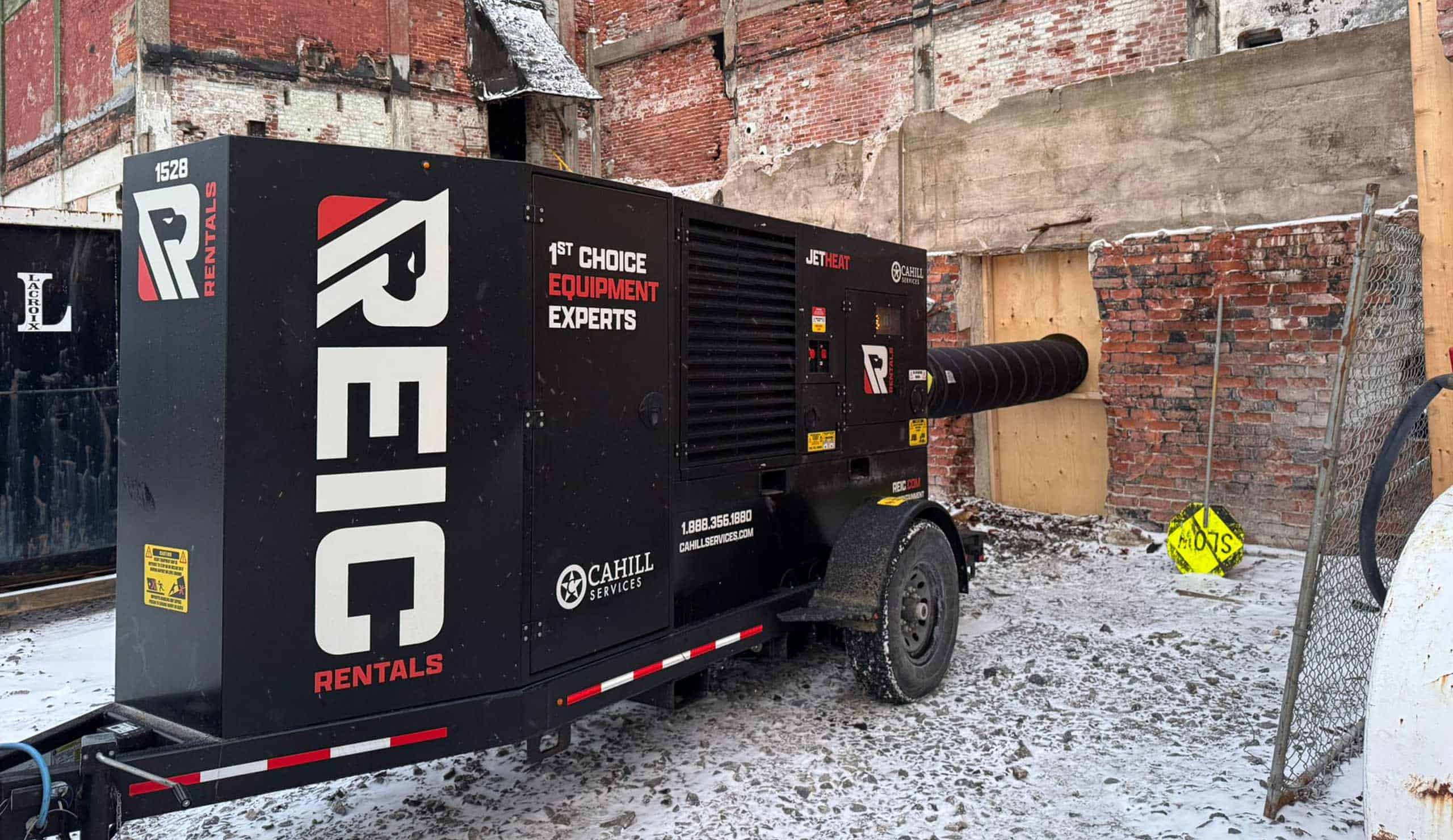
REIC Rentals deploys temporary heating solutions for warehousing and distribution facilities, with indirect-fired heaters and the exclusive Jet Heat flameless system suited to the scale and operational environment of large-footprint facilities. Request a quote or find a location near you to discuss your facility’s requirements.
1.888.356.1880 | in**@**ic.com | reic.com
Service You Trust. Equipment You Need.
