
A flooring installation that misses its moisture specification window does not simply delay one trade. It delays final inspections, which delays the certificate of occupancy, which delays the lease commencement date, which determines when rent starts. In retail and commercial tenant fit-out construction, concrete and flooring are schedule-critical milestones tied directly to contractual obligations. When winter conditions push those milestones, the financial consequences fall on both the tenant and the landlord.
Cold weather changes how concrete behaves. It slows curing, extends the drying timeline before flooring can go down, and creates moisture conditions that adhesives and flooring systems were not designed to tolerate. For projects targeting Black Friday openings, back-to-school dates, or fiscal year-end deadlines, an incorrectly managed December slab pour can result in a February flooring failure that no one budgeted for.
REIC Rentals provides temporary heating equipment, dehumidification and drying equipment, and HVAC accessories for retail and commercial tenant fit-out projects through every cold-weather phase. This article covers how winter conditions affect concrete placement and flooring installation, and what project teams can do to protect the schedule when the lease date does not move.
Cold Weather Concrete: What the Standards Require
ACI 306 guidelines define cold weather concrete conditions as when average daily air temperatures fall below 40 degrees Fahrenheit for more than three consecutive days, with more than half of each 24-hour period below 50 degrees Fahrenheit. At those thresholds, concrete curing slows dramatically. The hydration reaction that builds concrete strength does not stop, but it operates at a fraction of its warm-weather rate. A slab that would reach design strength in 7 days at 70 degrees Fahrenheit may take two to three times as long in cold conditions without active temperature management.
For retail and commercial tenant fit-out projects, this matters because every slab pour in the fit-out scope, whether a sales floor infill, a trench patch for plumbing or electrical, or a leveling pour for new flooring, faces these constraints from October through April in most Mountain West, Northern Plains, and Western Canada markets.
The first 72 hours after placement are the highest-risk window. Fresh concrete that freezes before reaching 500 psi compressive strength can permanently lose a significant portion of its design strength. A daytime pour at 45 to 50 degrees Fahrenheit can be undermined by overnight lows that drop well below freezing. In lightly heated empty tenant spaces during the construction phase, before permanent HVAC is operational, the slab is highly susceptible to early-age freeze damage, including surface scaling, delamination, and hairline cracking that compromises the finished floor.
Frozen subgrade is a separate and non-negotiable constraint. Placing concrete on frozen ground can cause severe differential settlement and cracking around columns, door thresholds, and equipment bases. The subgrade must be thawed before any pour proceeds.
How Cold Conditions Affect Flooring System Performance
Most flooring failures in retail and office tenant fit-outs on new projects trace back to moisture. Cold weather compounds moisture risk in two specific ways: it significantly slows slab drying and creates condensation conditions that adhesives cannot tolerate.
Flooring manufacturers specify maximum moisture vapor emission rates and maximum internal relative humidity thresholds that slabs must meet before installation can begin. These thresholds apply to carpet tile, luxury vinyl tile, sheet vinyl, rubber flooring, epoxy systems, and hardwood alike. A December-poured slab in a cold, unheated tenant space that still tests above the manufacturer’s maximum moisture threshold in February is not unusual. That condition puts the tenant’s planned opening at direct risk and calls the flooring manufacturer’s warranty into question if installation proceeds regardless.
Cold surfaces create condensation problems that are separate from slab moisture content. Warm interior air contacting cold perimeter slabs and exterior wall bases generates intermittent surface moisture that permanently undermines adhesive bonds. Cold temperatures also affect the dimensional behavior of flooring materials: LVT, sheet vinyl, and hardwood all expand and contract differently at low temperatures, and installation outside the manufacturer’s specified temperature range produces gapping, curling, and internal stress that shows up after occupancy.
De-icing salts tracked into the space from building entries and loading docks during cold months attack unsealed concrete and migrate under finish floors, accelerating adhesive degradation and contributing to moisture intrusion that is not visible until flooring failure is already in progress.
Schedule Risk: What Happens When the Concrete Phase Slips
In commercial construction, the project schedule is a contractual obligation, not an internal target. Lease clauses tie rent commencement to defined delivery conditions, such as substantial completion or the complete installation of flooring. Work letters define what must be done and by when. Cold-weather concrete delays cascade predictably through every dependent milestone.
The sequence that produces missed opening dates in retail and commercial tenant fit-outs:
- Late slab placement or extended cold-weather curing pushes moisture testing beyond its planned window.
- Failed or delayed moisture testing postpones flooring installation.
- Delayed flooring installation pushes the final punch list and final inspections.
- Delayed inspections push certificate of occupancy and lease commencement.
- Late commencement means tenants pay rent before opening and miss critical sales periods while their space is unavailable.
For tenants, the financial consequence is a rent obligation without revenue. For landlords, it means extended vacancy periods, delayed recovery of tenant improvement allowances, and, in some retail centers, co-tenancy clause exposure when anchor or inline tenant openings slip past committed dates. A seven- to ten-day slip in the concrete phase during the winter months can consume all the schedule buffer in a tight tenant improvement program.
Planning and Design Strategies That Reduce Cold Weather Risk
Many winter problems in retail and commercial tenant fit-outs can be mitigated during pre-construction if they are anticipated. The earlier cold weather conditions are built into the project plan, the fewer surprises there are for the schedule.
Sequencing is the highest-leverage planning decision. Prioritize structural slab work and exterior infills before deep winter, aiming to complete them before sustained freezing temperatures arrive. Interior toppings, leveling pours, and finish floor preparation under controlled temperatures after the building envelope is sealed are significantly more manageable than pours in open or partially enclosed spaces during cold months.
Concrete mix design for cold-weather pours should specify lower water-cement ratios, non-chloride accelerating admixtures, and high-early-strength cement mixes, while still meeting the flatness and moisture emission requirements of the specified flooring system. Coordinate mix design with the flooring subcontractor before the pour, not after a moisture test failure reveals a mismatch.
Schedule buffers for moisture testing should reflect actual cold-weather drying timelines rather than warm-weather assumptions. The window between pour and flooring installation in cold conditions is typically four to six weeks compared to two to three weeks in warm weather, and that difference must be reflected in the project schedule at the outset rather than discovered during the project.
REIC Rentals engages with project teams during pre-construction to review temporary heating and dehumidification requirements for the specific fit-out scope, helping general contractors and MEP teams identify where supplemental climate control is needed before concrete placement begins. Request a quote to begin that planning conversation.
Field Controls During Cold-Weather Concrete Placement
Once the project enters the construction phase during winter, on-site environmental controls determine whether the slab meets specification or becomes a warranty issue.
Ground preparation is mandatory before any cold-weather pour. The subgrade must be completely thawed and frost-free before concrete placement. Active heating of the subgrade, using ground heaters or blankets staged across the area 24 to 48 hours before the pour, brings ground temperatures above freezing throughout the depth that will be in contact with fresh concrete.
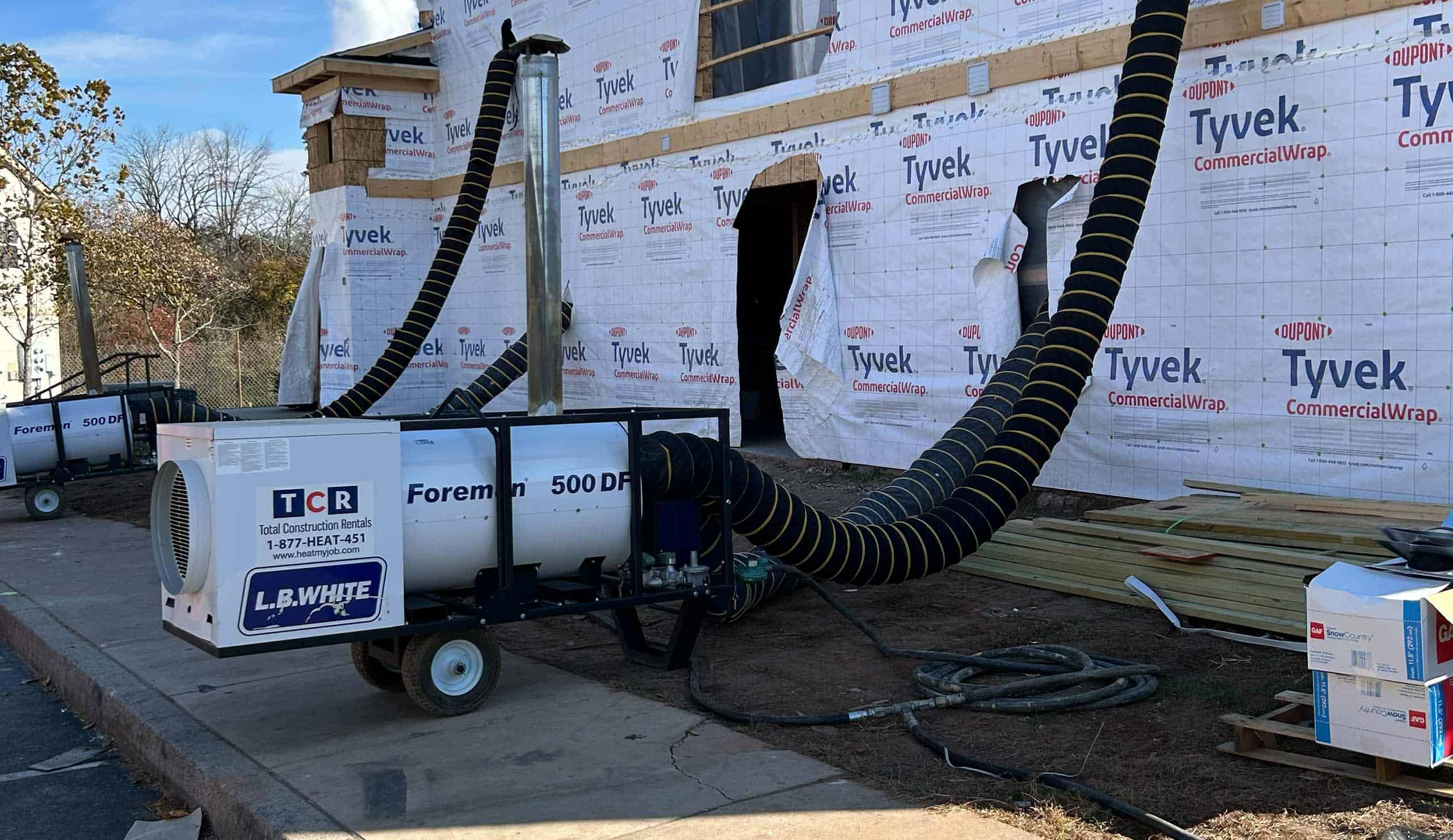
Protection during curing requires maintaining concrete temperatures above 50 degrees Fahrenheit throughout the protection period, typically 72 hours or longer, depending on ambient conditions and the mix design’s cold-weather specifications. Insulated curing blankets trap heat from hydration for thin slabs and finishing pours. Temporary enclosures with indirect-fired heating equipment from REIC Rentals maintain ambient temperatures that allow hydration to proceed at an adequate rate without requiring continuous blanket coverage, particularly for larger pour areas where blanket logistics become complex.
Temperature monitoring throughout the curing period is required for both compliance documentation and practical quality management. Thermal sensors or maturity meters placed at the slab surface and at one-third depth confirm that temperatures remain within the required range. Those records support flooring manufacturer warranty requirements, building official inspections, and any future disputes about slab quality.
Concrete mix adjustments for cold-weather pours include heated mix water, where the ready-mix supplier can provide it; non-chloride accelerating admixtures that reduce set time without introducing chlorides that would corrode embedded reinforcement; and air-entrained mixes when freeze-thaw durability of the slab surface is a concern under the specific exposure conditions.
Accelerating Slab Drying for Flooring Installation
Cold weather slows slab drying in ways that are not visible from the surface. Slabs that appear dry can carry moisture vapor emission rates and internal relative humidity levels well above flooring manufacturer thresholds for weeks after surface appearance would suggest they are ready. REIC Rentals’ drying and dehumidification equipment accelerates moisture removal from both the slab surface and the surrounding air, reducing the gap between pour and flooring-ready condition in cold weather.
The combination of dehumidification and air movement is more effective than either approach alone. Removing moisture from the air reduces the vapor pressure differential that slows moisture release from the slab. Air movement across the slab surface lifts moisture into the air stream, where dehumidification can capture it. Both operating together produce faster drying than dehumidification positioned at a single point in the space without directed air movement.
Heating the space alongside dehumidification accelerates evaporation from cold concrete slabs, which release moisture more slowly at low temperatures than warm ones. Indirect-fired heaters that deliver clean, dry heat are the appropriate choice for spaces where flooring materials are being acclimated or where adhesives have been applied, because combustion moisture from direct-fired equipment would counteract the drying effort.
One challenge our teams regularly help project managers navigate is the moisture testing sequence under schedule pressure. A failed initial moisture test does not mean flooring must be delayed indefinitely. It means active drying must be deployed and testing repeated at defined intervals until the slab reaches specification. Having REIC Rentals’ drying equipment operational before the first moisture test, rather than after a failure result prompts the search for equipment, is what keeps the remediation timeline within the schedule rather than outside it.
Flooring Installation Coordination in Cold Weather
Flooring installation in cold-weather conditions requires specific coordination between trades, material acclimation, and environmental management that warm-weather projects do not require to the same degree.
Flooring materials must acclimate to the job site environment before installation. Most manufacturers require 24 to 72 hours of acclimation at the specified installation temperature range before planks, tiles, or rolls are laid. Bringing material from a cold delivery vehicle into a space that has only recently been heated to installation temperature and proceeding immediately creates dimensional instability in the installed product, which manifests as gapping or curling after the space reaches its permanent operating temperature.
HVAC and electrical rough-ins should be complete, and the space should be actively conditioned before flooring installation begins. Controlling humidity and dust before floors go down is not only a quality measure. It is a practical requirement for adhesive performance and for maintaining the acclimation conditions specified by flooring manufacturers. A flooring installation that begins before the space reaches stable, conditioned conditions is at risk of adhesive failure that voids the warranty.
Where schedule pressure is extreme, flooring selections that reduce dependence on slab-drying timelines offer an alternative path. Polished concrete, moisture-tolerant adhesive systems, and floating installation methods in back-of-house areas allow flooring to proceed on a faster timeline than traditional adhesive-bonded systems over marginally dry slabs. Coordinating flooring selection with cold-weather schedule realities during design is more effective than discovering the timeline conflict during construction.
Protecting Finished Floors After Installation
A flooring installation completed on schedule under cold-weather conditions requires ongoing protection to remain in the condition in which it was installed through the punch list, final inspections, and tenant move-in.
Entry mats at all building access points limit de-icing salt and moisture tracking onto newly installed floors. Salt migrating along the edges of resilient flooring progressively degrades adhesive bonds and produces edge curling that is visible before the space opens. Limiting de-icing salt applications near building entries and using alternative traction materials in immediate entry zones protects installed flooring without compromising slip prevention.
Controlling temporary heat and humidity in the space after flooring installation prevents the gapping and dimensional movement that occurs when newly installed flooring cycles through temperature swings outside its specified operating range. Maintaining the space at a consistent temperature and humidity throughout the period between installation and tenant move-in is the operational discipline that ensures finished floors remain within specification.
REIC Rentals supports retail and commercial tenant fit-out projects through temporary heating and dehumidification for every phase of the concrete and flooring sequence: ground thaw and subgrade preparation, curing enclosures, slab drying, installation environment management, and post-installation protection. Find a location near you or request a quote to build a cold-weather climate control plan for your next tenant fit-out project before the schedule makes it urgent.
1.888.356.1880 | in**@**ic.com | reic.com
Service You Trust. Equipment You Need.
