
A CLT panel that absorbs moisture during three weeks of coastal staging does not dry evenly when the building is enclosed and heated. The exterior wood layer dries faster than the interior layer, creating differential moisture gradients that cause warping, dimensional changes at panel joints, and alignment problems in an assembly fabricated to tolerances measured in fractions of an inch. In mass timber construction, the climate control decisions made during storage, erection, and enclosure determine whether those tolerances hold.
Mass timber and prefabricated modular construction have expanded significantly across North America since 2020, with cross-laminated timber, glulam, and factory-built modules appearing in larger and more complex projects every year. That growth brings higher stakes: the precision tolerances these systems require leave almost no room for the material movement caused by uncontrolled temperature and humidity.
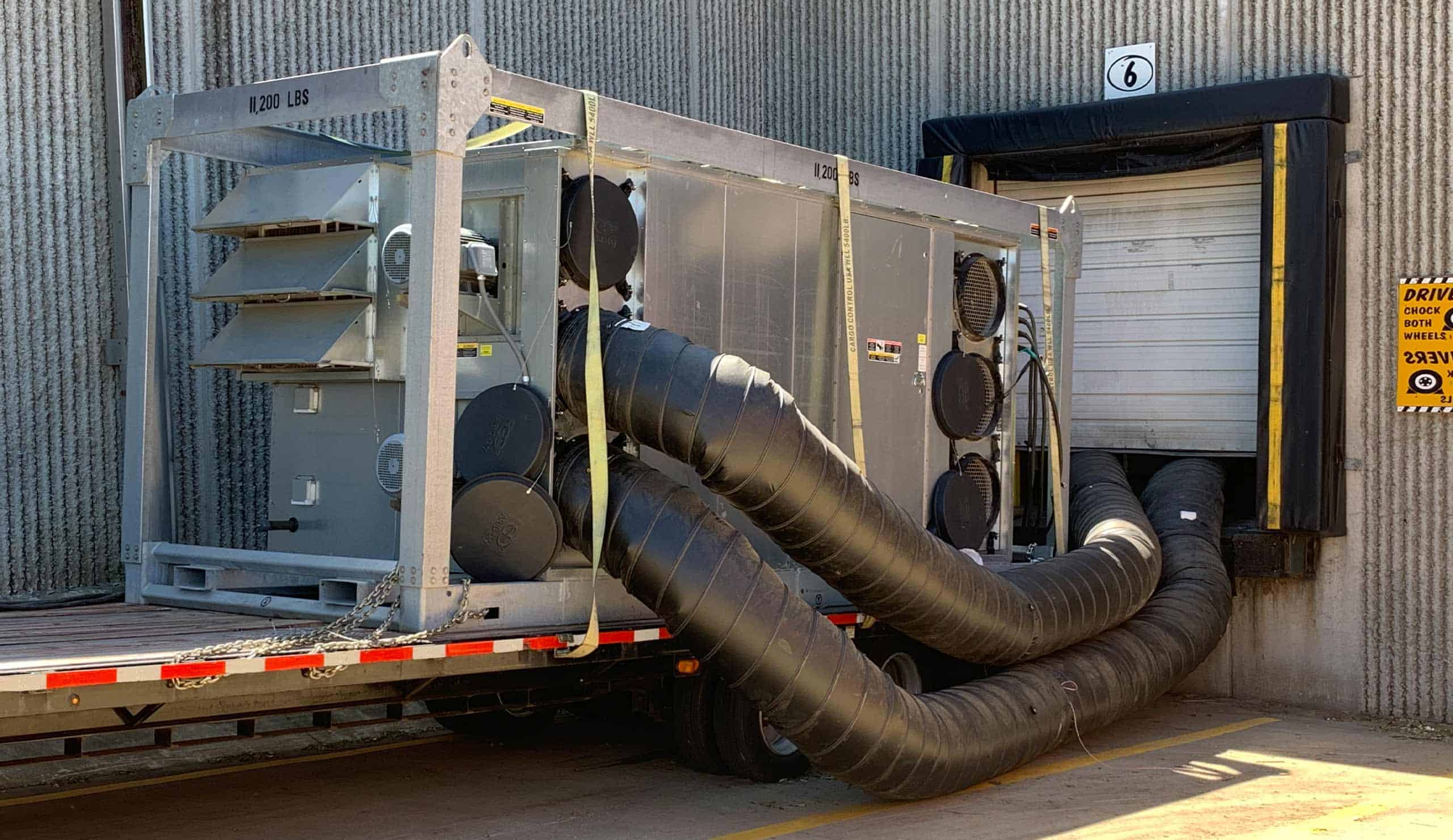
REIC Rentals provides temporary climate control for mass timber and modular construction projects, including heating, dehumidification and drying equipment, cooling, and HVAC accessories sized to protect CLT panels, glulam assemblies, and prefabricated modular components from the moment they arrive on site through final commissioning.
Why Mass Timber and Modular Systems Need Stricter Climate Control
Mass timber and prefabricated modular units behave differently from conventional concrete and steel construction when exposed to adverse weather conditions. CLT panels, glulam beams, and nail-laminated timber decks are hygroscopic: they absorb and release moisture in response to ambient relative humidity, expanding and contracting as conditions change.
Precision-fabricated modular units, including bathroom pods, hotel room modules, and workforce housing modules, are constructed with positional tolerances measured in fractions of an inch. When framing or sheathing absorbs moisture, cumulative dimensional change can push assemblies outside those tolerances. A module built in a dry interior factory and transported to a humid coastal site undergoes condensation cycles during transit and staging, creating moisture gradients and dimensional changes that only a controlled environment can prevent.
Field studies on CLT roof assemblies have confirmed that exterior wood layers dry at rates significantly slower than interior layers, meaning excess moisture from rain exposure or high-humidity staging conditions lingers in assemblies much longer than visual surface inspection suggests. Moisture that appears to have dried on the panel surface may still be driving differential movement within the interior layers, affecting joint alignment and connection behavior.
Moisture Control: The Primary Protection Mechanism
Moisture, not temperature alone, drives the most significant long-term material damage in mass timber and modular construction. When relative humidity stays elevated, wood equilibrium moisture content rises. Above approximately 18 percent moisture content, decay fungi become a meaningful risk. The mold growth threshold is lower: mold can establish on organic substrates within 48 to 72 hours at very high relative humidity, and gypsum board, OSB, and exposed wood surfaces in partially enclosed buildings regularly experience those conditions during wet construction phases.
Delamination along glue lines in CLT is the failure mode most directly associated with repeated moisture cycling. When panels repeatedly cycle between near-saturated and very dry conditions, differential movement at the glue line stresses the adhesive bond, reducing structural performance. Steel connectors and fasteners embedded in wood face a parallel risk: relative humidity above 60 percent accelerates corrosion at connection points that are inaccessible for inspection once the assembly is complete.
REIC Rentals deploys commercial dehumidifiers and temporary ventilation equipment to maintain target relative humidity in the 40 to 60 percent range in storage tents, laydown yards, and enclosed building sections. The goal is controlled, gradual drying rather than aggressive, rapid drying, which causes the cracking and warping that is as damaging as the original moisture exposure.
Temperature Management and Dimensional Stability
Temperature swings compound moisture-driven movement in wood assemblies. Combined thermal expansion and contraction in CLT, glulam, and light-frame elements can misalign panel joints, create uneven floor surfaces, and cause doors and windows to bind in frames that were correctly sized at installation. In modular assemblies where multiple elements are pre-installed before the module is set, misalignment affects interior finishes, MEP connections, and the stack behavior of modules in multi-story configurations.
Many adhesives, sealants, and flooring compounds applied during modular fit-out or on-site finishing have specific temperature requirements that cold or hot conditions violate. Applied outside their recommended temperature bands, these materials fail to achieve their specified bond strength, cure inconsistently, or require application conditions that cannot be maintained without active climate control. Indirect-fired heaters, which maintain warmth in cold construction environments, and portable air conditioners, which prevent heat buildup in staging areas, are both elements of a complete temperature management approach.
REIC Rentals uses indirect-fired heaters and air-movement systems to reduce temperature stratification in high-volume mass-timber atriums and modular assembly halls. The common problem of very warm air at the ceiling and cold conditions near the floor creates both material installation problems and worker safety risks. An even temperature distribution across the work zone allows materials to be installed under their specified conditions at every elevation in the building.
Protecting Mass Timber During Storage, Erection, and Enclosure
The most vulnerable period for mass timber is between factory production and final enclosure, when panels, columns, and beams sit exposed to actual weather on the construction site. Effective protection during this window is what allows the precision tolerances of factory fabrication to be maintained through to installation.
Best practices for outdoor mass timber storage include sloped stacking for drainage, breathable covers rather than impermeable plastic sheeting that traps moisture beneath it, and end-grain sealing on cut elements. When the schedule requires longer on-site storage, temporary shelters with active dehumidification and heating maintain conditions within safe ranges.
During erection, heaters and dehumidifiers dry surfaces between rain events so that membranes, tapes, and sealants adhere to substrates that are actually dry rather than to those that appear dry. Mass timber can tolerate brief surface wetting if followed by controlled drying. Unlike thin light-frame sheathing, which can permanently deform or delaminate under repeated wetting, CLT has sufficient thermal and moisture mass to recover from brief exposure when drying is actively managed rather than left to ambient conditions.
REIC Rentals designs project-specific setups for mass timber projects: supplying heated and dehumidified air through temporary duct runs to partially enclosed multi-story cores while facade work continues, maintaining construction materials within specification throughout the erection sequence. HVAC accessories, including flexible ducting and distribution components, extend climate control to the specific zones where mass timber elements are being placed rather than conditioning only the spaces adjacent to the equipment.
Protecting Prefabricated Modules in Transit and Staging
through road transport to site staging. The factory maintains stable temperatures and humidity. Transport exposes modules to cold nights, rain, and, in some cases, significant temperature differentials between the factory and destination site climates. Condensation inside sealed cavities during transit creates moisture with no pathway to escape until the module is opened for MEP connections.
In staging areas, wrapped modules sitting outdoors cycle between solar heat gain during the day and rapid radiative cooling at night. That temperature swing repeatedly drives moisture into wall and roof assemblies with no pathway out. Pre-installed hardware inside sealed cavities, including electrical components, plumbing fittings, and structural connectors, is exposed to moisture without the protection a conditioned environment would provide, and remains invisible until the module is opened for connections.
REIC Rentals creates buffered environments in staging warehouses or clear-span tents using rental air conditioners, heaters, and dehumidifiers that maintain conditions within the module manufacturer’s specified storage ranges. That protection during the staging period is what separates a managed off-site construction program from one that absorbs rework costs from moisture damage discovered after modules are set and connections are made.
Indoor Air Quality During Mass Timber and Modular Fit-Out
Indoor air quality during construction affects material durability as well as occupant health. High indoor moisture, construction dust, and off-gassing from adhesives and sealants interact with wood fibers, coatings, and metal fasteners in ways that cause staining, discoloration, and corrosion on exposed mass timber and factory-finished surfaces.
Early air quality management on mass timber projects, using filtered ventilation, negative pressure in high-dust zones, and controlled outdoor air intake, reduces airborne contaminants that settle on sensitive architectural wood surfaces. Exposed mass timber that develops surface mold or discoloration from elevated relative humidity during unfinished construction phases may require sanding or treatment before finishes are applied, adding labor cost and schedule impact that active humidity control would have prevented.
REIC Rentals specifies filtration levels and ventilation rates for temporary HVAC equipment to protect both workers and newly installed materials, ensuring that indoor air remains clean and dry throughout the construction and commissioning phases. Request a quote or find a location near you to begin the climate-control planning conversation for your next mass-timber or modular project during the design phase.
1.888.356.1880 | in**@**ic.com | reic.com
Service You Trust. Equipment You Need.
