
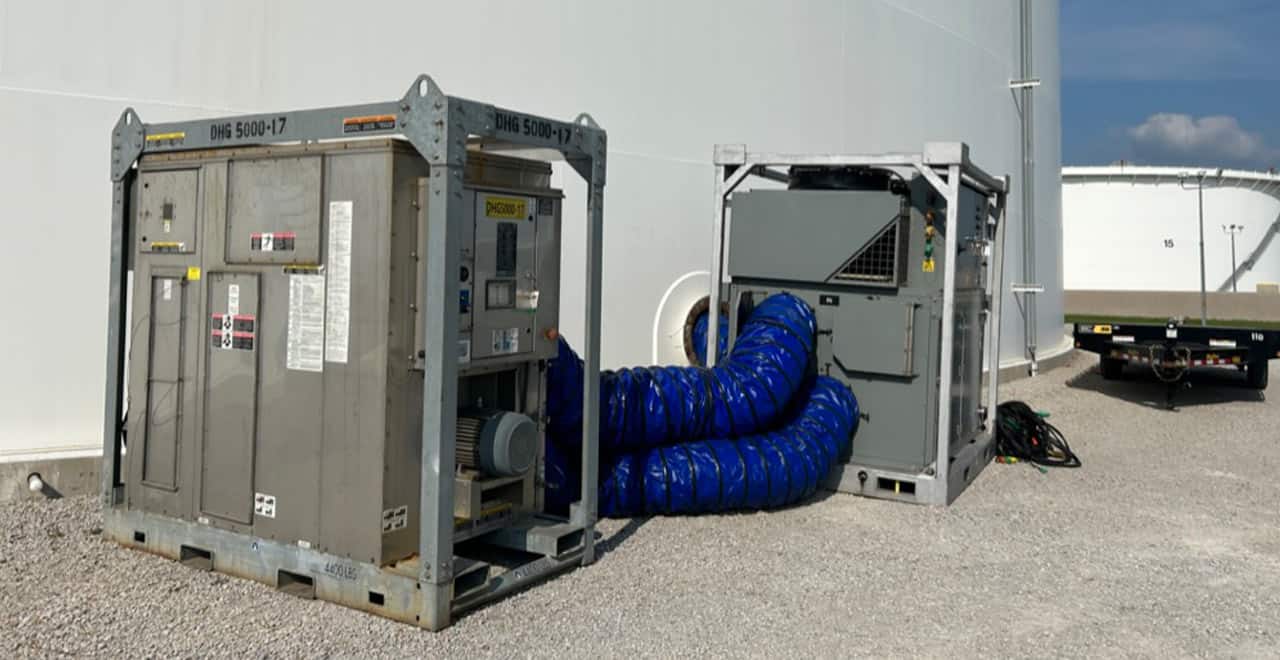
On modern construction and industrial coatings projects, moisture control is no longer optional. It is a core part of project management that directly affects productivity, cost control, and the ability to take on larger and more complex scopes. Excess moisture causes delays across nearly every trade. When humidity remains above acceptable levels, materials do not cure properly, adhesives fail, and coatings do not perform as intended. These are not minor inconveniences. They translate into rework, blown budgets, and failed inspections.
The pattern is consistent across project types. A commercial interior that cannot dry to specification holds up flooring, paint, and millwork simultaneously. An industrial coating applied in conditions outside the manufacturer’s specified humidity range fails within weeks of application, requiring complete removal and reapplication. A concrete slab that carries excess moisture vapor past the acceptable threshold causes adhesive failures in finished flooring months after turnover. In every case, the cost of correction far exceeds what controlled dehumidification would have cost during the active phase.
REIC Rentals provides temporary dehumidification and drying solutions built for construction and coatings work. Our drying equipment integrates with heating and cooling systems to achieve controlled site conditions throughout the phases where moisture control is most critical. This article covers how dehumidification affects project schedules and budgets, the types of equipment that serve different applications, and how REIC Rentals supports contractors from preconstruction planning through project completion.
How Humidity Affects Construction Productivity
Uncontrolled humidity slows down almost every trade on a construction site. Concrete, drywall, flooring, paints, epoxies, and specialty coatings all have specific moisture and relative humidity requirements set by manufacturers. When those requirements are not met, materials do not perform as designed. Maintaining acceptable humidity levels without mechanical intervention is often impossible on active sites, particularly during humid seasons, in partially enclosed structures, or in climates where ambient conditions regularly exceed specification limits.
Concrete curing releases substantial moisture vapor as it gains strength. Without dehumidification in an enclosed space, that moisture accumulates, raises relative humidity across the work zone, and extends dry times for subsequent trades. Interior build-outs in humid conditions face similar challenges, as do high-rise interiors where floors are not yet sealed and ambient moisture compounds across multiple levels simultaneously. The result in each case is schedule stacking: trades waiting for conditions that do not arrive without intervention.
High humidity also extends drying times for joint compounds, paints, and adhesives, compressing the available window between phases and creating pressure on downstream trades. Crews sit idle or are mobilized inefficiently. Overtime increases. The schedule slips. Each of those outcomes carries a cost that accumulated dehumidification rental would have prevented.
The risk of rework compounds these issues. Warped millwork, bubbling floor coverings, blistered coatings, and adhesive failures all occur when installers work outside manufacturer-specified temperature and humidity limits. These failures require removal and reinstallation, delaying subsequent phases and triggering additional mobilization costs. Variance analysis of completed projects frequently traces cost overruns directly to uncontrolled moisture conditions during critical phases, which were treated as background variables rather than managed risks.
Dehumidification and Coatings Performance
Industrial and architectural coatings are engineered around precise environmental conditions. High-performance epoxies, urethanes, and specialty linings require specific temperature and humidity ranges during surface preparation, application, and cure. When those conditions are not maintained, the coating system does not perform to specification regardless of application quality or product selection.
Ambient and substrate moisture affect coatings in well-understood ways within the industry. Flash rusting occurs on prepared steel surfaces when humidity rises above acceptable levels before the coating is applied. Osmotic blistering develops on concrete substrates with elevated moisture content, typically appearing weeks or months after application when the failure mechanism is no longer reversible without full removal. Amine blush forms on epoxy surfaces in high-humidity environments, compromising adhesion and intercoat compatibility. These failures share a common root cause: conditions that were outside specification during a critical window.
Coating manufacturer datasheets establish the environmental requirements for each system, typically including maximum relative humidity and the requirement that substrate temperature remain above the dew point by a defined margin. For immersion service coatings in tanks, wastewater structures, and similar applications, maintaining specified conditions through surface preparation, application, and the full cure period is mandatory rather than advisory. Dehumidification is not an add-on to those projects. It is a prerequisite for the application.
REIC Rentals supports coatings contractors by sizing and supplying drying systems tailored to coating manufacturer specifications and site conditions. A tank lining job in early spring, facing cold, damp conditions, requires different equipment than a food plant floor coating installation in summer. REIC Rentals plans for surface preparation windows, application periods, and cure cycles, delivering the right equipment at the right time.
Cost Control: How Planned Dehumidification Protects the Budget
Renting dehumidification equipment is shown as an additional line item in the project budget. In practice, it functions as a risk management tool that protects margin on schedule-driven projects. The cost of planned dehumidification is predictable and proportional to the project scope. The cost of the problems it prevents is not.
Direct cost savings are concrete. Avoiding material replacement for failed flooring or blistered coatings eliminates a rework scope that is typically multiples of the original installation cost once removal, surface preparation, and reinstallation are included. Preventing failed moisture inspections avoids remobilization costs and the schedule disruption that follows. On milestone-driven contracts where delays carry financial consequences, schedule protection is a budget item that justifies investment in controlled conditions throughout critical phases.
Indirect savings compound the direct ones. Stabilized conditions reduce overtime, weekend work, and the inefficient crew mobilizations that occur when phases cannot proceed as planned. Delay claims from subcontractors who cannot proceed decreases. Warranty callbacks in the months following turnover, including osmotic blistering and adhesive failures that develop slowly under finished surfaces, are prevented rather than managed after the fact.
REIC Rentals helps contractors model the cost trade-off during the budgeting process. Comparing rental costs to financial exposure from schedule slip and coating failures makes the investment decision straightforward. Projects with proactive dehumidification consistently show tighter adherence to budget and fewer change orders related to environmental conditions.
Scaling Up: Dehumidification on Larger and More Complex Projects
As projects scale in size, value, and technical complexity, environmental control moves from helpful to essential. Multi-phase hospital builds, large logistics facilities, wastewater treatment plants, and bridge recoating projects all require planned dehumidification to maintain productivity and quality across extended timelines and multiple simultaneous workfronts.
Large general contractors and specialty coatings firms use dehumidification to confidently bid and execute complex scopes in challenging climates. The ability to control conditions regardless of ambient weather extends the available working season and expands geographic reach. Projects that would otherwise be unbiddable in certain seasons or climate zones become viable when conditions can be controlled rather than waiting for them to occur.
REIC Rentals engineers scalable systems for large projects. Desiccant units feed multiple zones through ductwork. Portable dehumidifiers can be deployed across multiple floors or work areas. Phased deployment aligns with project milestones, scaling up for critical coating or flooring windows and adjusting as areas are completed. This approach applies across warehousing and distribution center builds, hospitals and healthcare facilities, data centers, and skyscraper construction, where zoned systems maintain conditions for epoxy floors and sensitive finishes across multiple stories simultaneously.
Having a dehumidification partner in REIC Rentals allows project teams to pursue work in challenging climates and seasons with confidence. That capability represents a real competitive advantage for contractors looking to expand their market reach without taking on the risk of uncontrolled conditions.
Choosing the Right Dehumidification Approach
Effective dehumidification requires matching equipment type and capacity to the climate, the building stage, and the material requirements for the active phase. Adding machines to a space without proper planning wastes rental budget and may fail to achieve the conditions required by the specification.
Refrigerant-based dehumidifiers work well for warm, humid construction interiors. These units cool air below its dew point to condense and remove moisture, handling high moisture loads efficiently in moderate to warm temperatures. They are portable, straightforward to deploy, and effective for drywall, painting, and general interior drying phases. Desiccant dehumidifiers excel in colder conditions, high-specification coatings work, and large-volume enclosed spaces. Using rotary desiccant media to adsorb moisture from the air stream, they perform at low temperatures and achieve lower dew points than refrigerant systems, making them the appropriate choice for structural coating applications, tank linings, and enclosed spaces that cannot be heated to the temperatures required for refrigerant equipment to operate efficiently. Both types are available through REIC Rentals’ drying equipment inventory.
Dehumidification works in combination with heating and air movement, not in isolation. Desiccant systems paired with indirect-fired heaters deliver dry, warm air without combustion contaminants that could affect coating adhesion. Air movers increase circulation across surfaces, accelerating evaporation and preventing moisture pockets that extend drying times in corners and low-airflow areas. The integrated system achieves conditions that no single piece of equipment can maintain on its own.
Relying on under-construction HVAC systems for moisture control is a mistake that produces predictable results. Those systems are designed for occupied comfort conditions, not construction-phase moisture loads. They cannot handle the dust and debris of an active site, and they lack the capacity for true dehumidification. Cooling air to a comfortable temperature is not the same as removing moisture from it. A space can feel acceptable to work in while still carrying relative humidity levels that will compromise coatings, adhesives, and concrete flatwork. By the time that shows up as a failure, the work is already installed and the cost of correction is a multiple of what controlled dehumidification would have cost during the active phase.
How REIC Rentals Approaches Dehumidification Planning
REIC Rentals follows a defined process that begins with a review of the project scope, schedule, and site conditions before making any equipment recommendation. Understanding the space volume, the target humidity levels required by the specification, the ambient conditions expected during critical phases, and the on-site power availability produces a sizing approach that reflects actual conditions rather than a generic estimate.
Load calculations translate those inputs into an equipment mix: how many units, what type, and how they are distributed across the space to achieve uniform conditions rather than pockets of controlled air surrounded by untreated zones. Recommendations address the dehumidification equipment itself, the heating or cooling systems needed to support it, the air movement strategy, the power requirements, and the monitoring approach to verify that conditions remain within specification throughout the critical window.
Ongoing support during the project includes performance checks, adjustments as phases change, and rapid response when conditions shift unexpectedly. REIC Rentals coordinates dehumidification with other temporary systems, including power distribution and ventilation, reducing the general contractor’s coordination burden. For major projects, REIC Rentals Expert Solutions integrates climate control planning with the broader equipment strategy across all rental categories, providing a single point of accountability rather than separate vendors for each system.
Applications Across Construction and Industrial Sectors
Dehumidification applies across a wide range of project types and sectors served by REIC Rentals. In dehumidification and restoration work, rapid moisture removal following water intrusion is time-critical. In commercial office and retail construction, controlled conditions protect tenant-finish materials during the final phases, when schedules are most compressed. In coating and curing applications, dew point control is a specification requirement rather than an option. In oil and gas, petrochemical, and refinery work, tank and vessel coatings applied during planned outages must meet strict environmental specifications within a fixed maintenance window.
Food processing plants and food storage facilities present additional requirements because coatings in those environments must meet food-contact compliance standards, which means the coating system itself must perform flawlessly. Food processing plants and food storage facilities require conditions that protect both the coating application and the downstream compliance of the finished surface. REIC Rentals has supported these environments and understands the requirements that go beyond standard construction dehumidification.
Planning Ahead: Integrating Dehumidification from the Start
The most effective dehumidification plans are built before mobilization, not assembled as a response to conditions that have already gone wrong. Cost control starts during bid and preconstruction, not as an emergency measure after materials have been installed and are failing. Treating dehumidification as a planned line item in schedule and cost development, alongside formwork, cranes, and temporary power, produces predictable outcomes and protects project margins.
Key planning inputs include the humidity and substrate moisture requirements specified by material manufacturers for each critical phase, the ambient conditions expected during the project schedule in the project region, the phases with the highest moisture-related risk, and the site’s power and logistical constraints. Engaging REIC Rentals early in that process produces a concept plan and budget number that supports accurate estimating rather than a contingency that may or may not reflect actual exposure.
Three Outcomes That Justify the Investment
The role of dehumidification in construction and coatings projects comes down to three outcomes that matter on every project. Controlled conditions increase productivity by keeping the drying and curing phases on schedule and preventing trade stacking that occurs when humidity delays compound processing. They protect budgets by preventing rework costs, failed inspections, and warranty callbacks caused by uncontrolled moisture. And they create the confidence to take on larger, more demanding, and more technically complex work in any season or climate.
REIC Rentals delivers the equipment, planning support, and ongoing service to achieve all three. Explore the drying equipment inventory, review the full HVAC range, including heating and cooling, or request a quote to start the planning conversation before moisture becomes the constraint that determines your schedule.
1.888.356.1880 | in**@**ic.com | Get a Quote
Service You Trust. Equipment You Need.
