Spring industrial turnarounds are among the highest-stakes events in refining, petrochemical, and heavy manufacturing operations. From March through May, facilities across North America enter peak turnaround season: a concentrated window when planned shutdowns, major inspections, vessel entries, and critical tie-ins converge. Moderate Q2 weather makes this the preferred window for outdoor work, aligning with post-winter demand cycles and avoiding the extreme summer heat that complicates confined space entries. The facilities running these events are not getting simpler. Many refineries operating today are over 40 years old, requiring more extensive interventions during each turnaround cycle. A single day’s delay during a large refinery turnaround can cost more than $1 million in opportunity costs. That number makes proactive equipment planning essential rather than optional.
REIC Rentals brings decades of experience supporting shutdown and turnaround operations across major Gulf Coast and Midwest facilities. From temporary power and climate control to access equipment and site services, we deliver the proven solutions that keep critical path work moving. This article covers how smart, early equipment planning protects the schedule, safety, and budget during spring execution, and what that planning looks like in practice across the turnaround lifecycle.
Understanding Spring Turnarounds and What Sets Them Apart
A turnaround is a planned, comprehensive shutdown in which normal operations halt for maintenance, inspections, repairs, and upgrades over several weeks. It is a categorically different event from routine maintenance involving minor online repairs, or from unplanned outages driven by equipment failure that require immediate reactive response. Turnarounds are meticulously scheduled, typically running 3 to 8 weeks, and they demand a scale of equipment and logistical coordination that no other industrial event matches.
Many refineries and chemical plants schedule major work for March through June because average temperatures of 50 to 70 degrees Fahrenheit in Texas and Louisiana compare favorably with the 90-plus-degree heat of summer, and because completing extensive scope before the peak summer driving season serves product demand cycles. Spring conditions do not simplify the work, however. Temperature swings of 20 to 80 degrees, heavy rains that create mud and saturated ground, and humidity levels of 70 to 90 percent all create challenges that require specific rental solutions. Dehumidifiers are critical for preventing flash rust on carbon-steel piping. Additional site-prep equipment addresses mobility across soft ground. The moderate weather that makes spring the preferred turnaround window also introduces environmental variability, making equipment planning more demanding, not less.
Not all outages are the same, and the equipment strategy that serves one type rarely translates to another. A full spring turnaround operates on a 12-to-24-month planning horizon, runs 3 to 8 weeks, and can simultaneously concentrate 500 to 2,000 craft workers at a single facility. The scale and duration of that event demand a fundamentally different approach than a planned shutdown scoped over 3 to 6 months with localized work and moderate equipment needs. A small outage mobilizes in 1 to 4 weeks with 50 to 200 workers and minimal rental volume. An unplanned event requires an immediate reactive response with no planning horizon.
Each category demands a different equipment strategy, and confusing one for another is where planning gaps originate. The guidance in this article focuses on the full turnaround, where the planning horizon and the scale of execution create both the greatest risk and the greatest opportunity for equipment-driven performance improvement. We have worked across all four categories. The difference in outcomes between a turnaround planned 18 months out and one assembled in the final weeks is not subtle.
12 to 18 Months Out: Building the Equipment Strategy
Best-in-class facilities initiate equipment planning 12 to 18 months before their spring turnaround window, aligning with overall scope definition during annual budgeting cycles. This planning horizon allows operations teams to map critical paths, estimate peak craft headcount, and translate workforce requirements into specific rental categories. For large Gulf Coast refineries, peak headcount often exceeds 1,000 craft workers, each requiring the infrastructure to perform their tasks safely and efficiently. Translating that workforce into power loads, climate-control requirements, compressed-air capacity, equipment counts, and site services is the work in this phase.
REIC Rentals account managers conduct equipment load studies tied to projected crews and 24/7 shift schedules. This analysis prevents the two most costly equipment planning errors: under-sizing, which delays tie-ins and extends schedules, and over-renting, which inflates budgets without adding operational value. The framework accounts for how equipment categories interact across systems. Generators powering welding operations, climate control maintaining vessel entry conditions, and compressed air driving pneumatic tools all run simultaneously, and the load study needs to reflect that concurrency rather than treating each category in isolation.
The planning timeline for Q2 turnarounds follows a consistent sequence, and the consequences of falling behind it are predictable. In Q3 of the prior year, nine to twelve months before the outage, primary power and climate control commitments should be locked. These are the highest-demand, longest-lead categories where availability tightens first as spring approaches and where late reservations force compromises on unit specifications, delivery timing, or both. In Q4 of the prior year, access equipment, material handling, and lighting were confirmed. In Q1 of the turnaround year, contingency units, backup equipment, and site services are finalized. In February and March, pre-mobilization inspections and delivery scheduling are completed before ground conditions and competing traffic make coordination harder.
Each stage builds on the prior one. Delays at the front do not just push back the affected stage. They compress every stage that follows and put availability at risk during the peak demand window when alternatives are hardest to source. We have seen that sequence play out often enough to know where the gaps appear when planning starts late. Primary power and climate control are almost always the first categories to tighten, and they are almost always the ones that get addressed last.
The equipment categories requiring early forecasting span the full operational scope of the turnaround. Temporary power from 100 to 2,000 kW generators with distribution panels supports welding circuits, compressed air systems, and temporary buildings. Climate control, including chillers and desiccant dehumidifiers, maintains safe temperatures and controls the humidity that drives corrosion and coating failure. Compressed air packages at 185 to 1,600 CFM for power sandblasting, pneumatic tools, and instrumentation testing. Material handling equipment, including forklifts and telehandlers with capacities of 5 to 12 tons, keeps laydown yards functioning and supply lines flowing. Aerial work platforms reaching 45 to 135 feet support exchanger bundle pulls and structural inspections. LED lighting towers extend productive work hours across the site. Site services, including restroom trailers, break trailers, and fuel tanks, support the workforce through multi-week execution windows.
Each of these categories has a different lead time, a different availability profile during peak season, and a different consequence when it arrives late or undersized. Planning them together, rather than sequentially as each need becomes apparent, produces a turnaround equipment plan that actually holds up under execution pressure.
Jobsite Readiness: Site Access, Layout, and Ground Conditions
Even the best rental plan fails if the site is not physically ready for equipment arrival in late winter and early spring. Inadequate site preparation accounts for 30 to 40 percent of turnaround delays, which is why jobsite readiness demands the same planning attention as equipment selection. Ground conditions in February and March vary significantly: frozen soil in Midwest locations, saturated surfaces along the Gulf Coast following spring rains. Equipment arriving at a site that is not ready to receive it does not just cause a delivery delay. It backs up the entire mobilization sequence and can damage equipment that should not be moving on compromised ground.
Key readiness requirements cover multiple dimensions. Crane paths need to be verified before heavy equipment positioning begins. Laydown yards must be compacted to 95 percent Proctor density to support the ground pressure generated by generators and chillers under load. Drained surfaces with 1 to 2 percent slopes prevent water ponding under critical equipment during spring rain events, which are a near-certainty during March through May turnarounds. Underground utility locates need to be completed by mid-February for all planned cable tray and hose routes. Fuel storage areas require secondary containment that holds 110 percent of the tank volume to meet environmental requirements on saturated spring ground.
REIC Rentals performs pre-turnaround walk-throughs at every major deployment, using site mapping to optimize equipment placement. These assessments identify power distribution locations that minimize cable runs, HVAC positioning that ensures proper airflow in confined spaces, and lighting placement that reduces trip hazards in high-traffic areas. For Midwest sites where frozen ground thaws unevenly through March, the walk-through identifies areas requiring additional ground preparation before equipment mobilization begins. We take that step on every significant deployment because the problems it prevents are far more disruptive than the time it takes.
Core Rental Equipment for Spring Turnarounds
Spring conditions create unique demands within each equipment category, and understanding those demands is what separates a comprehensive turnaround equipment scope from one that leaves gaps surfacing during execution.
Temporary power forms the foundation. Generators from 100 to 2,000 kW supply welding circuits, compressed air systems, and temporary buildings. Tier 4 Final units satisfy Gulf Coast air quality permit requirements. Spring storm season makes backup power non-negotiable: grid outages spike during this period, and a 15-minute loss during vessel cleaning or hydrotesting can set schedules back by days. The backup power strategy should be part of the plan from the start.
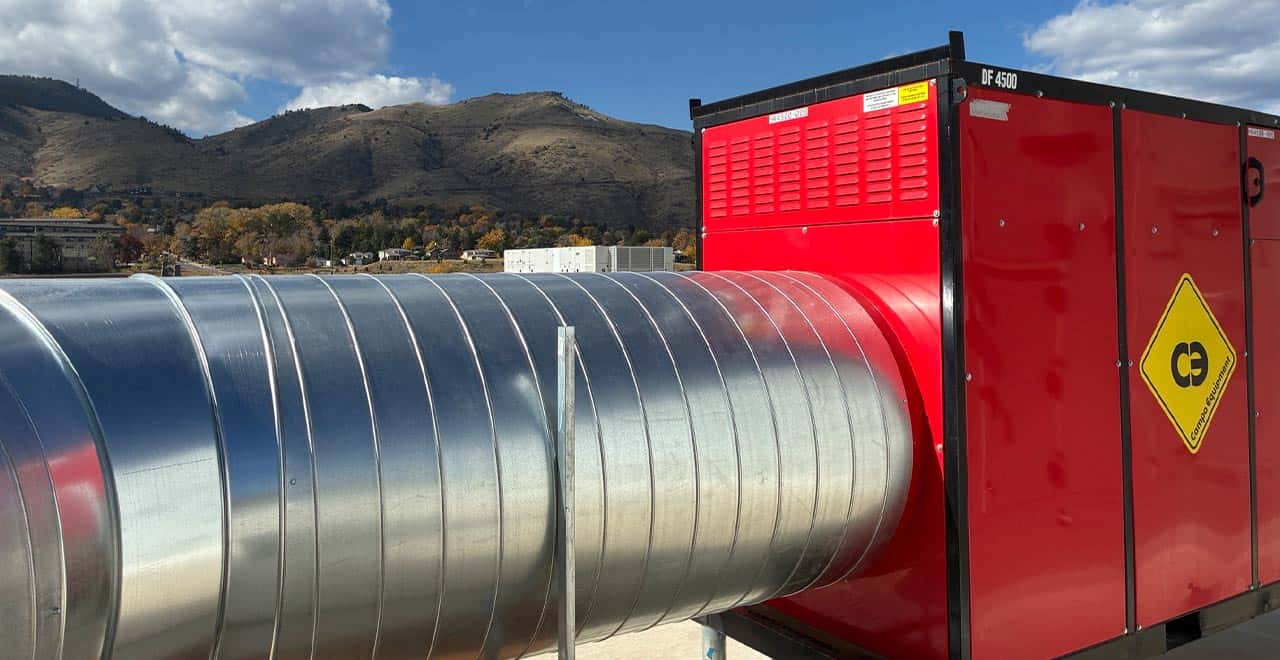
Climate control and dehumidification address the humidity challenges that peak in spring. Industrial chillers maintain safe temperatures in temporary control rooms. Desiccant dehumidifiers, removing 50 to 200 pounds of moisture per hour, prevent corrosion in piping systems and support coating work in vessel entries. When relative humidity exceeds 80 percent, flash rust forms on carbon steel within hours. Dehumidification is a quality control requirement, not a comfort measure.
Compressed air packages at 185 to 1,600 CFM for power sandblasting, pneumatic tools, and instrumentation testing. Pumps handling 500 to 5,000 gallons per minute support hydrotesting at 1.5 times design pressure, a critical path activity that cannot be delayed without pushing the overall schedule.
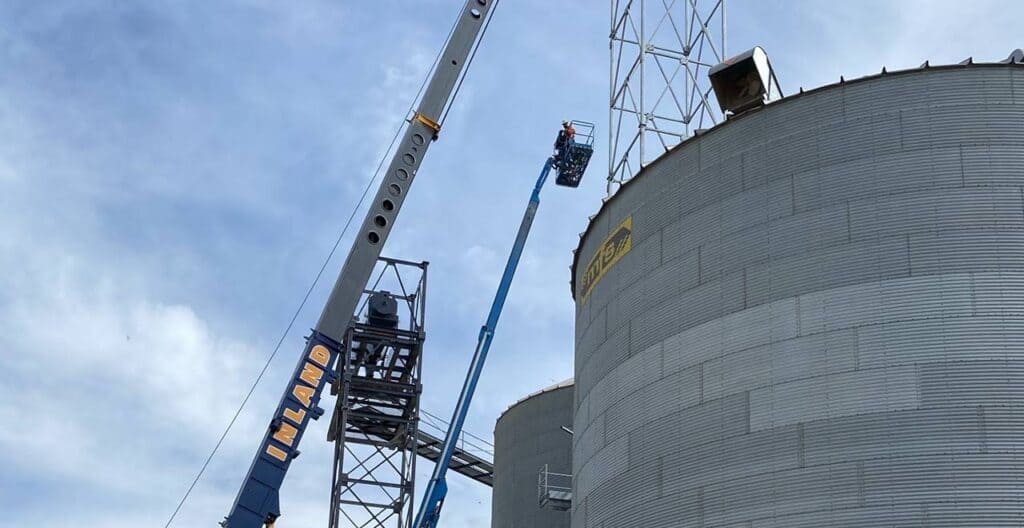
Aerial work platforms reaching 45 to 135 feet support exchanger bundle pulls and structural inspections. Telehandlers and forklifts with capacities of 3 to 15 tons keep laydown yards organized and supply lines flowing. LED lighting towers extend productive hours across 24/7 shift operations. Explosion-proof ventilation fans maintain air quality during vessel entries in classified hazardous locations.
REIC Rentals maintains Tier 4 Final generators, high-static desiccant dehumidifiers, and late-model access equipment specifically suited to turnaround demands. With 55 locations across North America, when the scope expands mid-turnaround, the equipment needed to cover it is readily available rather than weeks away.
Execution Phase: Deliveries, Setup, and Daily Coordination
Once the outage cutover date arrives, tight coordination of equipment deliveries and commissioning keeps critical path work moving. Primary equipment, generators, chillers, and compressors, should be staged 7 to 10 days before the day-one shutdown to allow commissioning and testing before craft workers need it operational. Load-in windows aligned with plant traffic rules prevent access conflicts that occur when equipment deliveries and contractor mobilization compete for the same gates. Backup units for power and climate control need to be pre-staged to support the first-week peaks, which typically exceed 2,000 man-hours per day. Fuel delivery at the scale of large-site continuous generator operations requires its own logistics plan, rather than assuming supply will be available on demand.
Role clarity during execution prevents the coordination failures that surface when multiple parties assume someone else owns a problem. The plant turnaround manager is responsible for overall schedule accountability and scope management. Contractor supervision manages craft coordination and work package completion. The REIC Rentals project coordinator owns equipment setup, fuel service, daily checks, and mid-turnaround adjustments. For a 35-day FCC turnaround starting April 1, initial generator and chiller commissioning should be complete by March 25, allowing testing before unit cool-down begins and ensuring equipment is fully operational when craft workers execute their first vessel entries.
REIC Rentals provides 24/7 on-call support throughout the turnaround window. When scopes grow, as they routinely do when inspection findings add work that was not in the original plan, the equipment mix adjusts with them. Adding compressed air capacity or mobilizing additional lighting for night-shift expansion can be done within 24 to 48 hours through regional inventory. A 35-day plan that becomes a 42-day plan need not become a sourcing problem. That responsiveness is what the fixed outage window requires from an equipment partner, and it is only possible when the relationship and the inventory are already in place before the change is needed.
Safety, Compliance, and Environmental Requirements
Equipment planning connects directly to safety performance. Under compressed spring turnaround schedules where hundreds of workers interact with temporary systems daily, the compliance status of rental equipment is as important as its availability.
Temporary power requires GFCI protection with a 5-milliamp trip threshold for all portable equipment, grounding systems achieving 25 ohms or less, cable routing per OSHA 1926.405 with protected crossings at traffic areas, and daily inspections per NFPA 70E. These are not aspirational standards. They are the baseline for operating temporary power safely in environments where wet spring conditions amplify electrical fault risks.
Confined space climate control requires ventilation at a minimum of 10 feet per minute air velocity, explosion-proof blowers in areas with flammable atmospheres, and temperature management for workers inside vessels and tanks where air quality depends entirely on the temporary systems brought in to maintain it.
Generators and compressors must operate below 85 dBA at 5 meters. Tier 4 Final engines satisfy the air permit requirements enforced across regulated locations. REIC Rentals maintains compliance documentation ready for customer audits, reducing the administrative burden on plant HSE teams during the outage window, when their attention should be on execution.
Fuel storage on saturated spring ground requires containment berms that hold 110 percent of the tank volume. These requirements belong in the site readiness plan. Discovering them during the turnaround creates exactly the delays they were designed to prevent.
Managing Cost, Utilization, and Contingency Capacity
Turnaround equipment costs on large sites can reach $5–20 million, making the rental strategy a significant lever on total event spend. The decisions on duration, utilization, and contingency capacity determine whether budgets hold or escalate beyond projections set 12 to 18 months earlier.
Right-sizing rental durations means aligning base terms with planned turnaround days plus 10 to 20 percent float through restart, scheduling off-rent by system or area as work packages complete rather than carrying the full fleet through the final days, and tracking utilization above 80 percent through telematics to catch idle equipment before it accumulates cost. These practices require active management during execution. A utilization target written into a plan but never monitored produces the same outcome as no target at all. REIC Rentals tracks these metrics throughout the turnaround window and flags adjustment opportunities before they become budget variances.
Contingency planning requires pre-negotiating options for deployable shadow generators within 24 hours, reserving capacity for additional compressors or lighting if the scope expands, and establishing rate clauses that limit cost escalation for duration extensions. A planned 28-day hydrocracker outage that extends to 34 days due to inspection findings is a common scenario in turnaround work. With contingency clauses in place, the equipment cost escalation stays within managed limits through phased-off renting of non-critical items and pre-negotiated extended rates. Without those clauses, incremental costs are sourced at open-market rates that can significantly exceed the budgeted figure. REIC Rentals provides turnkey budget estimates during the fall budgeting cycle, enabling facilities to accurately account for equipment resources before fiscal-year commitments are finalized.
Demobilization and Lessons Learned
Structured demobilization in the final 3 to 7 days of the outage protects the schedule, reduces safety exposure, and prevents unnecessary extra rental days. A chaotic load-out creates congested laydown areas, competing traffic patterns, and equipment left running without purpose. The sequencing of equipment removal should follow the completion of work scopes: non-critical lighting and surplus HVAC units come out first as work areas close, excess forklifts and material handling scale down as remaining scope concentrates, primary power and climate control remain through final tie-ins and system testing, and backup units release only after restart confirmation is received.
Within 30 days of restart, conduct a joint equipment performance review, capturing which units were over- or under-utilized and where spring weather created unexpected needs. Turnarounds completed in March through May should complete this review by June 30, while operational details remain present in team memory. These findings inform the scoping of the next 3- to 5-year turnaround cycle. If dehumidification ran under-utilized due to mild spring conditions, adjust the next forecast. If additional aerial platforms were mobilized mid-turnaround to cover scope additions, build that capacity into the baseline plan. Continuous improvement in equipment planning compounds efficiency gains across multiple turnaround events, cumulating into meaningful reductions in both cost and schedule risk.
Why Partner with REIC Rentals for Spring Turnaround Execution
REIC Rentals delivers the resources and expertise that spring turnarounds demand. A large, modern fleet with 70 percent of equipment less than 5 years old ensures reliability when operations depend on every unit performing through a fixed outage window. The industrial turnaround focus means our account managers understand the pace, pressure, and priorities that make these events different from standard construction projects. Account managers who have supported Gulf Coast coker turnarounds and Midwest hydrocracker outages bring the context that generic equipment rental cannot replicate. Our 55 locations across North America, including regional yards near major refinery and chemical corridors in Houston, Baton Rouge, and Midwest hubs, reduce lead times to 48 hours or less for the most time-sensitive mobilization needs.
Contact REIC Rentals by late summer or early fall to begin equipment planning for your next spring turnaround season. Building your rental strategy 12 to 18 months ahead protects the schedule, controls the budget, and ensures the equipment you need is confirmed and reserved when cutover arrives. Tell us about your facility, outage window, peak headcount, and scope priorities. We will build the equipment plan that keeps your turnaround on schedule from day one.
1.888.356.1880 | in**@**ic.com | Get a Quote
Service You Trust. Equipment You Need.