
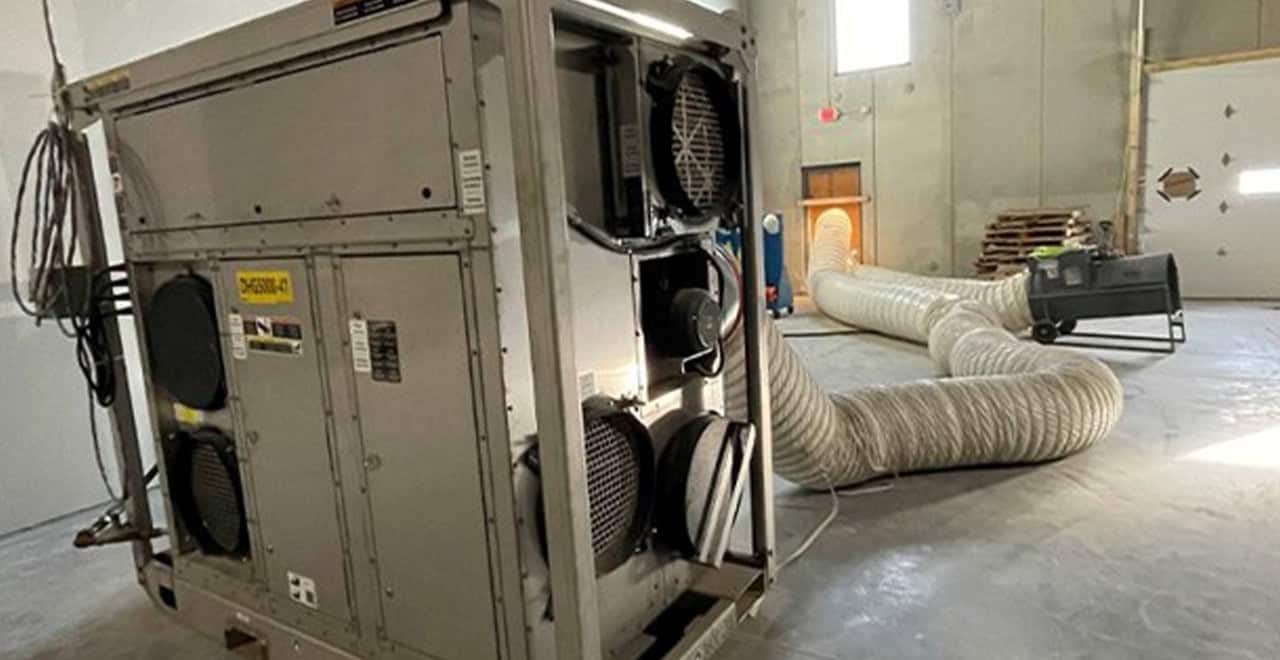
Interior construction is where the quality, finish, and long-term performance of a building take shape. It is also where uncontrolled moisture does the most damage. Humidity that goes unmanaged during critical interior phases not only slows things down; it can cause problems. It warps materials, compromises adhesion, delays curing, and creates conditions that lead to mold, rework, and failed inspections.
Managing moisture during interior work is not a precaution. It is a core part of delivering a project that holds up. At REIC Rentals, we work with project managers and contractors across North America to deploy the right dehumidification equipment at the right time, before moisture becomes a problem. This article covers what happens when humidity goes uncontrolled, which phases are most at risk, and how to deploy dehumidification effectively to keep your project on schedule and your materials performing as specified.
What Uncontrolled Moisture Does to an Interior Build
Moisture damage during interior construction rarely announces itself. It accumulates quietly, often inside walls, under flooring, or behind finishes, until it shows up as a failed inspection, a warranty claim, or a callback months after handover.
The materials used in interior construction are particularly sensitive. Drywall, wood framing, flooring products, insulation, adhesives, and coatings all have defined performance parameters that depend on humidity staying within a certain range. When it does not, the consequences are predictable:
- Wood framing and flooring absorb moisture and swell, warp, or split, often permanently.
- Joint compound and plaster will not dry or cure at elevated humidity, stalling the finishing schedule.
- Paint and coatings fail to bond properly, leading to peeling, bubbling, and premature wear.
- Adhesives lose strength or fail to cure, compromising tile, flooring, and panel installations.
- Insulation becomes wet and loses its thermal rating, leading to long-term energy performance issues.
- Mold establishes itself wherever moisture persists, requiring remediation that is expensive, disruptive, and hard to schedule around.
Beyond materials, moisture affects the schedule. Wet conditions extend drying and curing times across every trade. One uncontrolled humidity problem can create a cascade of delays that runs through flooring, painting, and the punch list, pushing handover and increasing costs across the board.
Interior Phases Most Vulnerable to Moisture
Not every phase carries the same risk, but the following stages are consistently where humidity causes the most damage when not controlled. Each one has specific moisture thresholds that must be met for the work to perform as designed.
Drywall Installation and Curing
Excess humidity prevents joint compound and plaster from drying properly, causing surface defects, delays, and potential rework.
Flooring Installation
Wood and laminate flooring can warp, buckle, or fail to adhere when moisture levels are too high. The damage is often irreversible without full replacement.
Painting and Coatings
High humidity interferes with curing, causing finishes to peel, bubble, or wear prematurely. Failed coatings lead to rework and schedule delays.
Insulation Installation
Wet insulation loses its thermal effectiveness. Moisture trapped inside walls during installation creates long-term performance and air quality problems.
HVAC and Mechanical Rough-In
Excess humidity can compromise ductwork, components, and connections during installation, creating issues that are difficult and expensive to address after enclosure.
Adhesive and Sealant Applications
Most adhesives and sealants have strict humidity requirements for proper bonding. Out-of-range conditions lead to bond failures and product warranty voids.
In most cases, these phases overlap. A flooring installation running concurrently with painting in an adjacent area means both trades are affected by the same humidity conditions. Managing moisture is a whole-building responsibility during interior work, not a phase-by-phase afterthought.
How Dehumidification Works in a Construction Setting
Temporary dehumidification removes excess moisture from the air inside the building envelope during construction. The right system, sized and placed correctly, maintains humidity within the range required for materials to perform and for work to proceed on schedule.
There are two primary types of systems used in construction environments:
Refrigerant Dehumidifiers
Refrigerant units work by drawing air across a cooled coil, condensing moisture from the air, and draining it away. They are most effective in warmer environments where temperatures stay above approximately 65 degrees Fahrenheit. For summer construction in temperate climates, refrigerant dehumidifiers are typically the right choice.
Desiccant Dehumidifiers
Desiccant units use a rotating wheel treated with a moisture-absorbing material to extract humidity from the air. They perform well across a wider temperature range, including colder conditions where refrigerant units lose efficiency. For winter construction, cold-climate projects, or spaces that are difficult to heat, desiccant systems are often the better option.
Choosing the Right System
The right dehumidifier for your project depends on the ambient temperature, the space size, the moisture load, and the construction phase. Our team helps you to assess those factors and specify the equipment needed to maintain the conditions your project requires.
Deploying Dehumidification Effectively on a Construction Site
Equipment selection is only part of the solution. How dehumidification is deployed determines whether it actually maintains the conditions the project needs. These practices make the difference between a system that performs and one that runs without delivering results.
Assess Site Conditions Before Specifying Equipment
Local climate, building design, envelope tightness, and upcoming interior phases all affect which equipment is needed and when. The earlier in the project this assessment happens, the better positioned the team is to avoid moisture problems rather than respond to them.
Size Equipment for the Space and the Load
An undersized dehumidifier running continuously will not maintain target humidity levels. An oversized unit cycling on and off creates uneven conditions. Proper sizing accounts for the cubic footage of the space, the number of moisture sources present, and the ambient conditions outside the building envelope.
Monitor Conditions Continuously
Humidity sensors placed throughout the work area give the project team accurate, real-time data on conditions. Relying on manual checks or visual indicators is insufficient for interior work, where small deviations from target humidity can cause material failures. Monitoring keeps the team informed and allows for adjustments before damage occurs.
Coordinate with All Trades
Moisture control is most effective when every trade on site understands the humidity targets and the drying or curing requirements for their work. Painting a surface before the substrate has reached the correct moisture content, or installing flooring before the concrete slab has dried sufficiently, produces failures that are difficult and expensive to fix. Coordination prevents those conflicts.
Plan for Ongoing Maintenance
Temporary dehumidification systems require regular checks to confirm they are running correctly and draining properly. A unit that fills its reservoir and shuts off, or one with a blocked filter, stops controlling moisture. Building maintenance checks into the project schedule prevents gaps in coverage during critical phases.
The Project Management Case for Dehumidification
Dehumidification is sometimes treated as an add-on or a response to a problem rather than a standard part of project planning. That approach costs more in the long run. Rework on failed finishes, remediation for mold, warranty claims on flooring and adhesives, and schedule extensions caused by extended drying times all exceed the cost of deploying proper moisture control from the start.
Beyond cost, there is a quality and reputation dimension. Projects delivered with controlled interior environments are more likely to perform as specified, pass inspections on the first attempt, and hold up after handover. That matters to the owner and to the contractor’s track record.
We work with project managers and contractors across construction, restoration, and commercial build-out to specify and deploy the right dehumidification equipment for the work at hand. Our team assesses the space, recommends the right system, delivers and installs it, and provides 24/7 support throughout the rental period. When dehumidification needs to work alongside temporary heating, cooling, or ventilation, we can build an integrated climate control package that covers the full scope.
The best time to deploy dehumidification is before interior work begins. Getting moisture control in place early protects materials, keeps curing and drying on schedule, and gives every trade the conditions they need to do their best work.
Talk to our team about dehumidification for your next interior project.
1.888.356.1880 | in**@**ic.com | Get a Quote
Service You Trust. Equipment You Need.
