
Production rates on outdoor construction tasks decline measurably once temperatures drop below 40 degrees Fahrenheit. On a large commercial or mixed-use project with a fixed completion date, that decline does not disappear into the schedule. It compounds across every trade that depends on work completed before it and every milestone that follows.
The projects that finish on time through a cold-weather season are not the ones that got lucky with the forecast. They are the ones that built winter into the plan before the first cold snap arrived and had the equipment, enclosures, and logistics in place before they were urgently needed. For general contractors and developers managing complex projects with multiple active trades, occupied neighbors, and hard tenant commitments, cold weather is an operational planning problem with a well-defined solution.
REIC Rentals provides temporary heating, power and lighting, dehumidification, and HVAC accessories for large commercial and mixed-use construction projects throughout the winter season.
Start With a Winter-Ready Project Plan
The single most effective thing a project manager can do for cold-weather productivity is to build winter conditions into the baseline schedule during preconstruction, rather than reacting when temperatures drop. Winter does not arrive as a surprise. The planning window to prepare for it is in the summer and early fall.
Key elements of a winter-ready construction plan:
- Build in float for cold-weather realities: longer concrete cure times, temperature-dependent inspections, and reduced working hours due to shorter daylight windows.
- Sequence exterior work early: prioritize envelope closure, including roofing, curtain wall, and utility tie-ins, before mid-November, so interior trades can work under temporary heat regardless of outdoor conditions.
- Use historical first-freeze dates and NOAA 10- to 14-day outlooks for the specific project location when modeling concrete placement windows and crane availability.
- Coordinate with local agencies early: noise restrictions, lane closures, and delivery blackout windows often tighten during winter holiday periods in urban markets.
- Verify equipment readiness: fluids, filters, and batteries on heavy equipment require attention before the first sub-freezing morning.
Our teams regularly help project managers on large commercial builds identify the schedule gaps that cold weather will expose and work through them during preconstruction rather than under deadline pressure in January.
Manage Concrete, Masonry, and Envelope Work When Temperatures Drop
Cold temperatures hit structural and envelope trades hardest. ACI 306 defines cold weather concreting as any period when ambient temperatures may fall below 40 degrees Fahrenheit within the first 24 hours after placement. Once that threshold is reached, cold-weather measures are required: heated water, accelerating admixtures, insulated blankets, and extended monitoring until the concrete reaches an adequate compressive strength.
A 20-degree Fahrenheit drop in concrete temperature roughly doubles set time. On a project with a compressed schedule and occupied floors above, that extension cascades into every trade following the concrete crew.
Practical cold-weather concrete measures for large commercial projects include Type III high-early-strength cement when accelerated strength gain is needed, non-chloride accelerators for projects with exposed reinforcement, and temporary heating equipment to keep slabs and walls above critical curing temperatures. Subgrade must be thawed and frost-free before placement. Reinforcement must be clear of ice and snow. Everything should be documented: ambient temperatures, mix temperatures, curing durations, and protection methods.
Envelope trades face a parallel constraint. Many sealants, adhesives, and air barrier products have minimum installation temperatures of around 40 to 50 degrees Fahrenheit. Those trades either move earlier in the sequence or work under temporary enclosures that maintain ambient conditions within manufacturer requirements.
Use Temporary Heat and Enclosures to Keep Interior Trades Moving
Once the building envelope is partially or fully closed, temporary climate control is what keeps interior trades productive through the coldest months. The principle is straightforward: create a controlled environment inside the building so that drywall, taping, painting, flooring, and MEP testing can continue even when exterior temperatures are well below freezing.
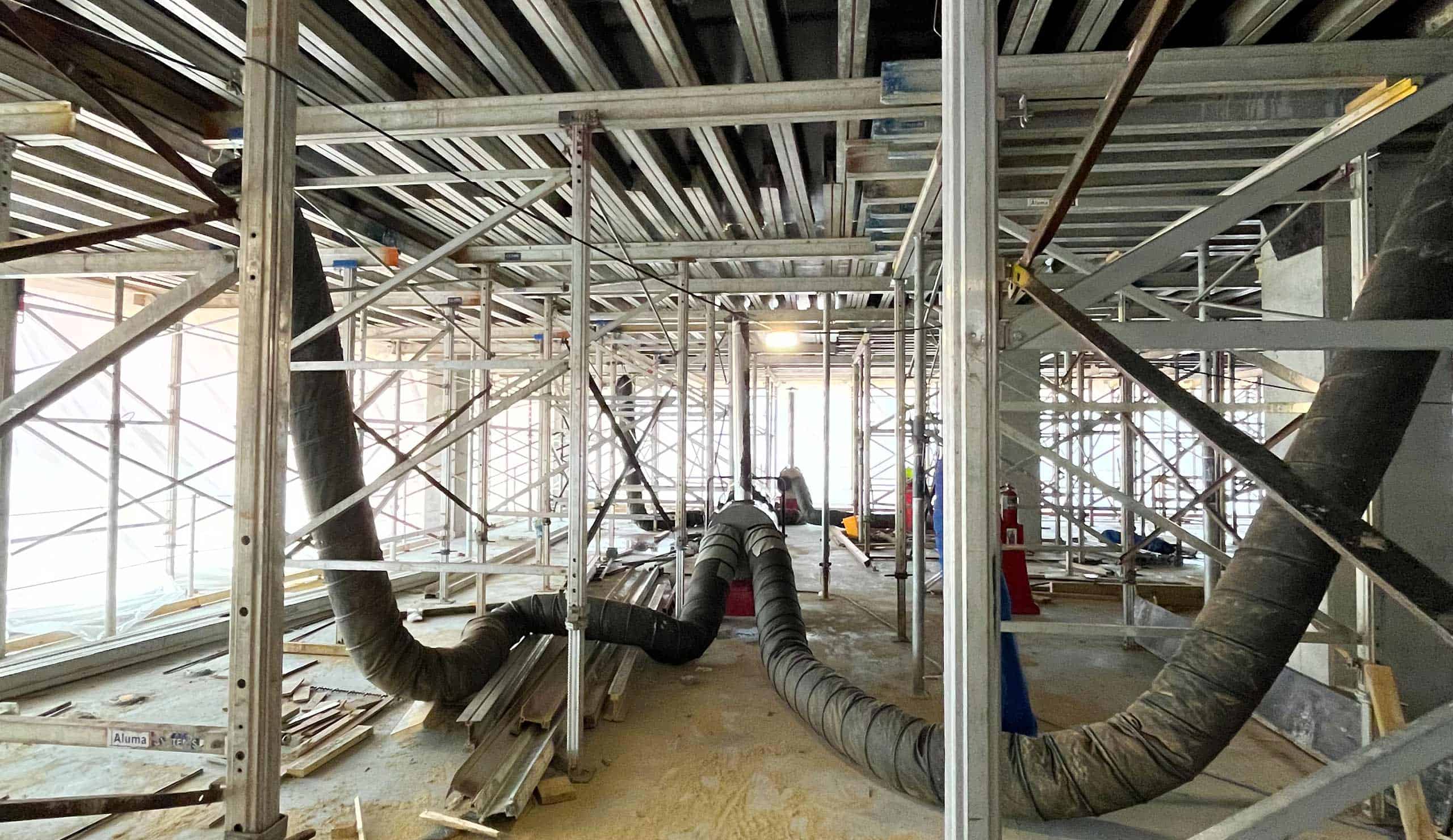
Indirect-fired heaters deliver clean, dry air without combustion byproducts entering the workspace, making them the appropriate choice for enclosed interiors and occupied-adjacent applications. REIC Rentals’ exclusive Jet Heat flameless system handles long duct runs to reach interior zones on large floor plates and is the right choice for applications that require clean heat without an open flame or emissions. Electric heaters suit smaller enclosed areas where an electrical supply is available, and noise restrictions apply near occupied neighbors.
Poly sheeting, rigid panels, and scaffold wrap around loading docks and core areas extend the effective heated zone and reduce fuel consumption by containing conditioned air. Properly sizing systems and calculating BTUs based on volume, insulation gaps, and air changes produce systems that work throughout a shift rather than losing ground as temperatures drop overnight.
One challenge our teams commonly help commercial project managers solve is CO monitoring and exhaust routing in tight urban sites where adjacent occupied buildings and air intakes are in close proximity. Equipment positioning and exhaust direction are planned before delivery, not resolved in the field.
Protect Materials and Systems From Cold Weather Damage
Moisture, freezing rain, and freeze-thaw cycles damage materials, costing far more to replace than to protect. Identifying the vulnerable materials on a commercial project is the first step. Gypsum board, taping compounds, adhesives, roofing membranes, PVC piping, and temperature-sensitive fireproofing all degrade when stored or applied in cold conditions.
Material protection measures that consistently pay their return:
- Store materials off the ground and covered; use heated storage targeting 50 degrees Fahrenheit or higher for most finish products.
- Control moisture aggressively: snow and slush tracking into cores and saturated subfloors from melt create mold risk and compromise finishes before they are installed.
- Schedule just-in-time delivery on dense urban sites where a limited laydown area means materials cannot be staged far in advance.
- Hoist restrictions apply when surfaces are icy or plow schedules conflict with access windows; plan delivery logistics around those constraints.
REIC Rentals supplies dehumidification, temporary power, and climate control to protect finish materials and sensitive building systems through the winter production phase.
Keep Crews Safe and Efficient on Winter Jobsites
Worker safety and productivity are inseparable in cold weather. Cold stress can occur at temperatures above 40 degrees Fahrenheit when wind and damp clothing accelerate heat loss. Manual dexterity declines measurably as temperatures drop, increasing the risk on precision tasks. OSHA’s cold stress guidance defines hazards, including hypothermia, frostbite, and trench foot, all of which can develop more quickly on exposed construction sites than supervisors typically anticipate.
Practical cold-weather crew management:
- Implement a buddy system to catch early cold stress symptoms before they progress.
- Schedule critical-path tasks requiring precision during the warmest midday hours.
- Provide heated break areas close to active work zones, not at the site perimeter, where transit time reduces how often they get used.
- Select PPE that balances thermal protection with the dexterity required by the specific task.
- Ensure hot beverages and warm meals are accessible throughout the shift.
REIC Rentals’ temporary lighting reduces hazards on stair towers, roof levels, and loading areas during dark winter mornings and late-afternoon operations when visibility is a primary safety risk.
Manage Urban Site Constraints Through the Winter
Cold weather amplifies every urban constraint on a commercial construction project. Shorter daylight hours, rush-hour restrictions on adjacent streets, snow emergency routes, and holiday blackout windows all compress the available time for deliveries, crane picks, and exterior operations.
Noise ordinances in many cities limit late-evening operations, restricting generators, ice-removal equipment, and certain mechanical work after specified hours. Occupied buildings on all sides are sensitive to generator noise, heater exhaust, and fumes. Equipment positioning matters not just for the construction operation but for the relationship with the neighbors who are there throughout the winter.
Engaging building owners, local business associations, and municipal contacts early to align winter work windows and holiday blackout periods helps avoid the confrontations that arise when coordination is reactive, after complaints have already been made.
Budget and Risk for Winter-Heavy Project Schedules
Winter conditions drive costs that must be modeled into the budget from the start, not absorbed as overruns when they arrive. Fuel consumption for heaters, generator rentals, enclosure materials, dehumidification, and snow removal all have real dollar values that can be estimated during preconstruction if the analysis is done.
Developers and general contractors on large commercial and mixed-use projects should carry explicit winter allowances in contracts rather than relying on general contingency to absorb costs that are predictable in advance. Defining responsibility for extreme-weather shutdowns, snow emergencies, and city-mandated closures before work begins prevents disputes that cost both time and relationship capital when they must be resolved during an active project.
Engaging REIC Rentals during preconstruction allows accurate temporary utility estimates, including heater sizing, fuel consumption modeling, and power distribution planning that reduce change orders and disputes later. Request a quote or find a location near you to begin the winter planning conversation for your next commercial project.
1.888.356.1880 | in**@**ic.com | reic.com
Service You Trust. Equipment You Need.
