
A branch office server closet that drops to 52 degrees Fahrenheit overnight does not generate a monitoring alert on most IT dashboards. It generates POS failures and network issues the following morning when staff arrive, and equipment that cooled below its operating range tries to restart. Edge computing sites and small server rooms are where cold-weather climate control problems are least planned for and most operationally disruptive.
Large enterprise data centers have redundant cooling, dedicated staff, and detailed environmental monitoring. An IDF closet in a retail branch, a server room in a medical clinic, or a micro data center at a logistics hub typically has a shared rooftop unit, no backup system, and no one watching overnight. When Winter Storm Uri cut power to millions of facilities in February 2021, it was these small distributed sites that went offline first and came back last.
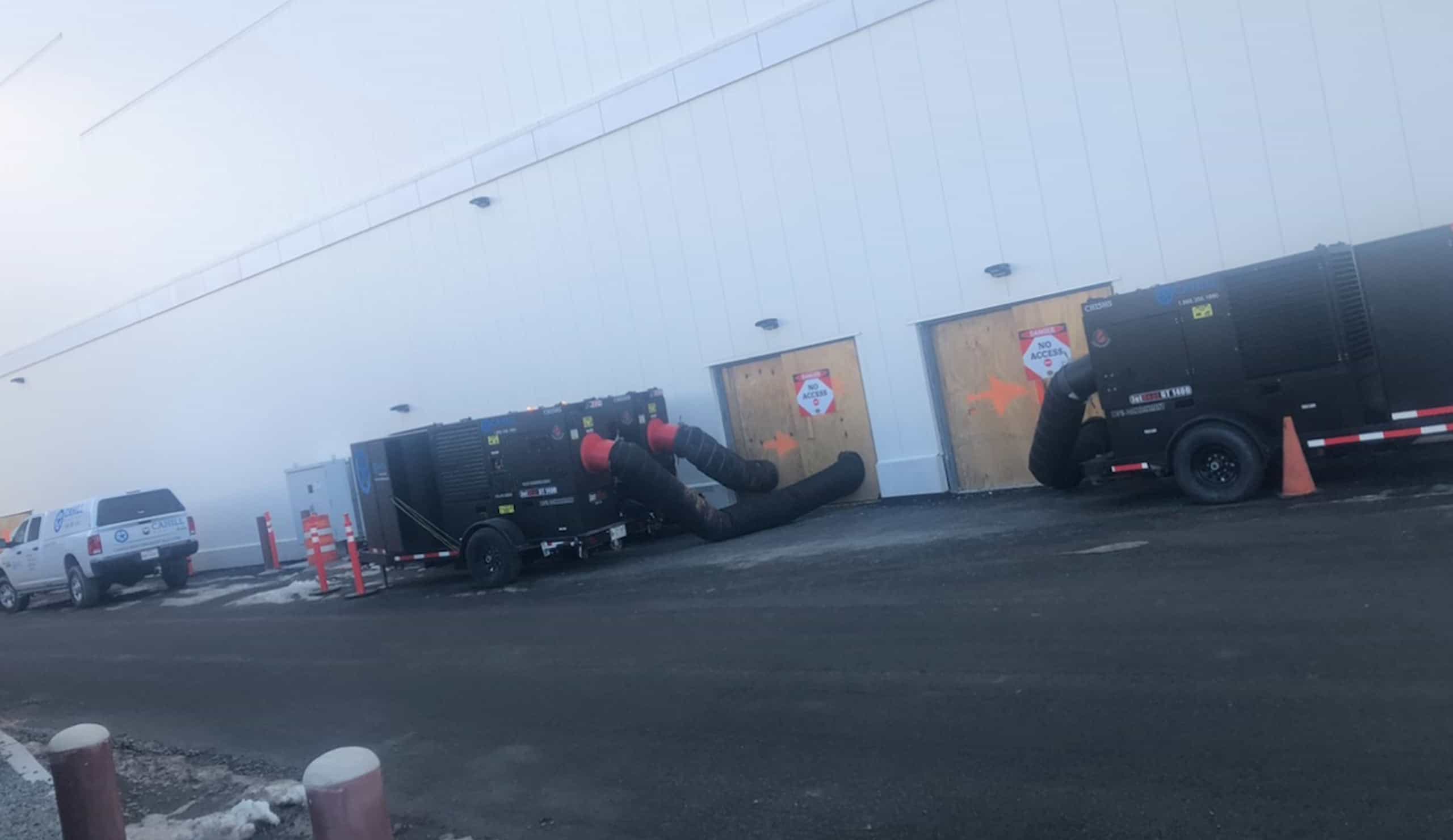
REIC Rentals provides temporary and supplemental cooling, heating, dehumidification, and power distribution equipment for edge computing sites, IDF and MDF closets, and branch server rooms. Here is what could go wrong in winter and how to prevent it.
How Cold Weather Creates Problems Inside Small Server Rooms
Cold outdoor air does not guarantee safe conditions inside a server room. Servers generate heat continuously regardless of outdoor temperature, and when a building’s heating and cooling systems respond to cold conditions, the results inside a small server room are often worse than in summer.
The most common cold-weather failure modes:
- Overcooling from oversized rooftop units: Rooftop units short-cycle in cold weather, causing inlet temperatures to swing below the safe range of 64 to 81 degrees Fahrenheit at rack level.
- Humidity collapse: Cold outdoor air holds very little moisture. When it is heated to room temperature without humidification, indoor relative humidity drops to 15 to 20 percent, well below the safe range of 40 to 60 percent. Below 30 percent, the static discharge risk increases significantly, leading to hardware resets and component damage.
- Condenser freeze-up: Outdoor coils ice over when temperatures drop below the unit’s operating limit, triggering safety sensors that shut the unit down completely.
- Economizer dampers stuck open: Dampers that pull in cool outdoor air can freeze open during storms, sending uncontrolled cold air across racks.
- Overnight thermostat setbacks: Building management systems reduce heating overnight to save energy. The server room cools below 60 degrees Fahrenheit. When heat returns, condensation forms on cold metal surfaces and connector pins.
Temperature and Humidity Targets for Small Server Rooms in Winter
ASHRAE TC 9.9 thermal guidelines recommend server inlet temperatures between 64 and 81 degrees Fahrenheit. For practical operation at branch and edge sites, target 70 to 75 degrees Fahrenheit at rack inlets with relative humidity between 40 and 60 percent. These ranges provide enough margin against both overcooling and overnight setbacks.
Four practical rules for winter:
- Do not apply overnight or weekend thermostat setbacks in any space with active IT equipment.
- Keep temperature deadbands narrow at 2 to 3 degrees Fahrenheit to avoid condensation during startup.
- Ensure supply air is diffused rather than blowing directly across rack surfaces.
- Add a backup electric heater that activates if the room temperature falls below 64 degrees Fahrenheit.
Why Edge Sites Are More Vulnerable Than Enterprise Data Centers
Edge computing infrastructure is deployed in strip malls, bank branches, warehouses, and clinics because proximity to the data source matters for the applications it supports. That deployment pattern puts IT equipment in spaces that were never designed for data center environmental management.
The physical conditions that make edge sites vulnerable in winter:
- Exterior walls and roofs act as cold sinks, pulling surface temperatures below the dew point when indoor air is warm and outdoor air is cold.
- Gaps around cable penetrations, conduit entries, and poorly sealed access doors draw cold air directly into the space.
- Weekend building shutdowns cut HVAC to office zones while IT equipment continues running and generating heat, resulting in uncontrolled temperature conditions with no one present to notice.
- Many sites have no overnight staff, so the first sign of a problem is a failed application or an offline POS system the next morning, not an environmental alarm.
For locations supporting point-of-sale processing, video analytics, or AI inference workloads, a thermal incident is immediately visible to customers or operations. There is no backup system absorbing the load while the primary site recovers.
A Winter Readiness Checklist for Small Server Rooms
Run this review in September or October, before winter equipment demand peaks and before the first sustained freeze.
Site inventory: Document IT load per rack, existing HVAC type, damper and economizer configuration, and available power distribution capacity. Sites with a single HVAC unit serving all IT load and no backup are your highest priority.
Single point of failure review: Identify every instance where a single cooling or heating unit failure takes everything down. Each failure scenario needs a defined response, including where the REIC Rentals equipment would connect.
Envelope hardening: Add door sweeps and weatherstripping, seal cable penetrations and conduit gaps, and insulate exterior walls adjacent to server closets. These are low-cost measures that prevent cold infiltration, which drives both overcooling and humidity collapse.
Control settings review: Disable overnight setbacks for all spaces with IT load, confirm alarm thresholds are set within safe operating ranges, and review economizer controls to prevent uncontrolled admission of cold air during extreme weather.
Backup plan: Add REIC Rentals to the escalation contact list for every site, document where portable equipment would be staged and connected, and assign a named owner for each site’s winter readiness. The sites that produce January emergency calls are almost always the ones without a named owner.
Scenarios: How Pre-Planning Changes the Outcome
Consider a regional retailer with dozens of branch locations. When a rooftop unit fails at a high-traffic store during a week of extreme cold, the server closet temperature drops below 55 degrees Fahrenheit within four hours. For a retailer with a pre-arranged relationship with REIC Rentals and documented site access, a portable electric heater is deployed to stabilize conditions within hours of the first call. POS stays online. The permanent unit is repaired on its own timeline, not under emergency pressure.
Or consider a healthcare clinic where the server room houses a micro data center for diagnostic imaging during a hot, humid summer. Relative humidity climbs above 70 percent as the building’s shared HVAC struggles to manage the combined heat load from IT equipment and warm outdoor air infiltrating through poorly sealed penetrations. Condensation begins forming on cold rack surfaces, and imaging workstation performance becomes erratic. A REIC Rentals dehumidification unit brings the space to 45 percent relative humidity within 24 hours. Performance stabilizes. A monitoring sensor confirms humidity holds within range through the remainder of the summer season, and the clinic maintains uninterrupted diagnostic imaging for its patient population throughout.
Neither outcome is possible without the pre-season site assessment that documented access, connection points, and equipment requirements before the event put pressure on the schedule. The event itself is unpredictable. The response capability is not.
Monitoring: Catching Problems Before They Take Sites Offline
Most cold-weather incidents in small server rooms are detectable as developing conditions before they cause hardware failure, if the right monitoring is in place.
Key things to monitor:
- Server inlet temperature, not just room ambient
- Relative humidity and dew point at rack level, not at the thermostat
- Door status sensors to detect propped-open access doors before cold infiltration accumulates
- HVAC circuit power draw to detect abnormal short-cycling patterns
Cold-weather alarm thresholds worth setting:
- Supply air drops below 64 degrees Fahrenheit
- Temperature drops of more than 5 degrees Fahrenheit in 10 minutes
- Relative humidity falls below 30 percent
- Outdoor air damper confirmed open when outdoor temperature is too low for economizer use
For sites without building management system access, standalone networked sensors with SMS and email alerts give IT and facilities teams the visibility to respond before conditions cause damage.
Contact REIC Rentals before winter to schedule pre-season site assessments for your highest-risk locations, confirm equipment availability, and develop a winter-readiness plan covering every IDF and MDF room in your distributed infrastructure. Find a location near you to connect with the team supporting distributed IT environments in your area.
1.888.356.1880 | in**@**ic.com | reic.com
Service You Trust. Equipment You Need.
