
Loss of cooling in a hospital is not a comfort problem; it is a clinical one. Patient safety, medication integrity, diagnostic equipment, surgical schedules, and regulatory standing are all affected the moment cooling capacity falls below the facility’s requirements. The cascade of consequences that follows an unmanaged cooling failure in a healthcare environment is faster and more serious than in almost any other building type, and the window for effective response is shorter.
REIC Rentals provides temporary cooling solutions for hospitals and healthcare facilities, delivered and supported by a team that understands the operational and regulatory constraints of active clinical environments. This article covers why cooling resilience is a clinical priority, what temporary cooling looks like in healthcare applications, and how to build a preparedness plan before a failure makes those decisions urgent.
Why Cooling Is Foundational to Healthcare Operations
Modern hospitals depend on stable cooling throughout the facility. HVAC systems in healthcare buildings do more than manage temperature. They control ventilation rates, filtration, and pressure differentials that are foundational to infection control. Operating rooms, intensive care units, procedure rooms, pharmacies, laboratories, and server rooms operate within specific temperature and humidity ranges defined by clinical standards, such as ASHRAE 170, rather than general comfort preferences.
Even small deviations from those ranges create consequences. Elevated temperature and humidity in clinical spaces compromise sterile fields, stress patients who cannot regulate their body temperature, and create conditions conducive to microbial growth. Temperature-sensitive medications, including biologics, chemotherapy agents, insulin, and vaccines, require storage within defined ranges. Ambient conditions that stress pharmaceutical refrigeration systems pose a risk of product loss, with both financial and patient safety consequences.
Digital infrastructure supporting electronic medical records, imaging archives, laboratory systems, and clinical communications requires continuous, precise cooling in the server rooms and data closets that house it. An overheating server room in a hospital does not produce an inconvenient outage. It can take clinical systems offline across the facility, affecting every function that depends on that infrastructure.
Healthcare facilities require cooling resilience as a component of patient care continuity, not as an operational amenity. That framing is what drives both the urgency of emergency response and the importance of preparedness planning before an event occurs.
When Healthcare Facilities Need Emergency or Temporary Cooling
Cooling failures in healthcare facilities occur through several distinct pathways, and the appropriate temporary solution varies by scenario.
Unplanned failures are the highest-urgency scenarios. A chiller breakdown, refrigerant leak, cooling tower failure, or electrical fault affecting the primary HVAC system can remove cooling capacity from part or all of a facility without warning. The response timeline in those scenarios is compressed by the clinical sensitivity of the affected spaces. An operating room that loses cooling mid-procedure, an ICU that begins warming during a summer heat event, or a pharmacy that loses ambient temperature control all require a response measured in hours rather than days.
Planned maintenance and upgrade work create predictable windows where temporary cooling is needed in advance. Chiller replacement, commissioning of new building wings, and major renovation projects all require taking permanent cooling capacity offline for defined periods. Pre-staging temporary equipment before the permanent system comes down eliminates the gap left by an unplanned failure and allows clinical operations to continue without interruption.
Surge conditions, including extreme heat events and emergency increases in patient volume, push existing systems beyond their design capacity. A facility that operates comfortably under normal summer conditions may find its cooling infrastructure insufficient when a sustained heat wave coincides with a full patient census. Supplemental cooling equipment addresses that capacity gap without requiring permanent infrastructure changes.
Specialized temporary healthcare applications, including mobile vaccination clinics, pop-up triage sites, converted non-clinical spaces pressed into patient care use, and field hospital operations, all require portable climate control that can be deployed, commissioned, and removed within a specific operational window.
Protecting Patients, Staff, and Clinical Outcomes
Patient safety is the primary driver of cooling requirements in healthcare environments, and it operates through specific mechanisms that distinguish healthcare cooling from general commercial building climate management.
Patients who cannot regulate their own body temperature, including neonates, elderly patients, post-surgical patients, and those with neurological or cardiovascular conditions, are directly harmed by elevated ambient temperature in clinical spaces. Heat stress in those populations accelerates physiological deterioration in ways that require immediate clinical intervention. The connection between cooling failure and patient harm in a hospital ICU or neonatal unit is not indirect or theoretical. It is a documented clinical risk that facility engineers and clinical leadership both recognize as requiring active mitigation.
Staff performance in clinical environments is also affected by temperature. Surgical teams working in elevated ambient temperatures in operating rooms experience increased fatigue and reduced precision during extended procedures. Clinical decision-making under heat stress is impaired in ways that affect the quality of patient care, even when the temperature deviation does not reach the level that triggers a formal response.
Targeted temporary cooling deployed to priority clinical spaces before general facility conditions deteriorate is what protects the highest-risk patients and enables clinical operations to continue while permanent systems are restored. REIC Rentals works with facility engineering and clinical leadership to identify and prioritize the spaces where cooling must be restored first based on the clinical populations and equipment they serve.
Equipment and Medications: What Cannot Tolerate Temperature Excursions
The financial and clinical consequences of losing temperature control for healthcare equipment and pharmaceutical inventory are significant and, in some cases, irreversible.
Pharmaceutical storage is the most time-sensitive concern. Biologics, chemotherapy agents, vaccines, insulin, and other temperature-sensitive medications require storage within temperature ranges specified in their regulatory approval. A product that experiences a temperature excursion outside those ranges cannot be administered to patients and must be discarded. The replacement cost is compounded by the clinical disruption of not having those medications available during the gap between the excursion and restocking.
Medical imaging equipment, including MRI systems, CT scanners, and linear accelerators, requires continuous ambient cooling and, in some cases, dedicated cooling circuits. These systems generate significant heat during operation and include thermal protection systems that shut the equipment down when ambient temperature exceeds defined thresholds. Downtime on imaging equipment in an active clinical environment creates a backlog of delayed diagnoses and cancelled procedures, with both clinical and financial consequences.
Laboratory analyzers, process instruments, and the reagents they require operate within stable temperature and humidity ranges. Performance drift due to thermal instability affects the accuracy of results that depend on clinical decisions. Research samples and stored biological materials that cannot be replaced represent a loss that extends well beyond replacement cost. The data, the collection time, and the downstream decisions that depend on them cannot be recovered once the samples are compromised.
Server rooms and data closets supporting EMRs, PACS systems, telehealth platforms, and clinical communications require cooling maintained within the equipment’s operating ranges. An auto-shutdown triggered by overheating can take clinical systems offline across the full facility, affecting every function that depends on that infrastructure until the systems are safely restarted after cooling is restored.
REIC Rentals provides portable cooling equipment for imaging suites, central pharmacies, laboratory spaces, and server rooms to protect those assets during primary system failures.
Temporary Cooling Equipment for Healthcare Applications
Equipment selection for temporary cooling in healthcare is determined by the size of the affected space, the clinical criticality of the environment, the required deployment speed, and the integration of temporary equipment with existing building infrastructure.
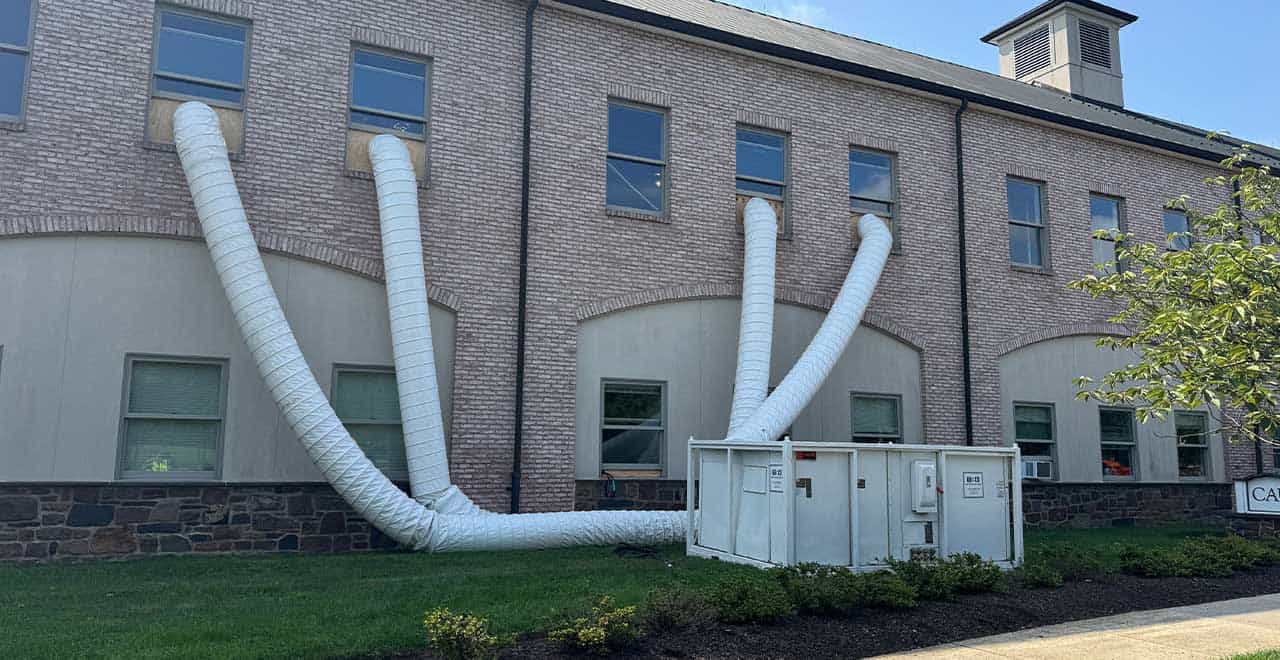
Portable air conditioners are the fastest-deploying option and suit individual rooms, imaging bays, nurse stations, data closets, and small laboratory spaces. Units can be operational within minutes of delivery and require only a standard power circuit and an exhaust pathway. They are the appropriate first response for localized failures affecting single rooms or small zones, while a broader response is assembled for larger affected areas.
Larger temporary cooling systems connect to existing building infrastructure to restore cooling capacity to full wings or the complete facility. These systems require advanced planning to confirm electrical capacity, establish connection points to the building’s chilled water or air distribution systems, and coordinate with the facility’s mechanical contractor. The lead time for larger deployments is longer than for portable units, which is why pre-planning that documents connection points and confirms equipment availability enables rapid deployment in the event of a major system failure.
Temporary air handlers deliver conditioned air to specific zones, including mobile triage facilities, modular recovery units, and renovated wings where existing distribution cannot reach. They can be paired with filtration to maintain the air quality, pressure, and air change rate requirements of the specific clinical spaces they serve. HVAC accessories, including ducting components, connect temporary equipment to the spaces being served through existing louvers, doors, or temporary penetrations coordinated with the facility team.
Temporary power equipment supports temporary cooling deployments when existing electrical infrastructure cannot accommodate the additional load, or when primary power is itself affected by the event that caused the cooling failure. Coordinating cooling and power requirements through a single conversation with REIC Rentals ensures both systems are sized to work together from the start.
Healthcare-Specific Constraints on Temporary Equipment
Healthcare facilities have operational, regulatory, and physical constraints that affect how temporary cooling equipment must be deployed and managed.
Infection control requirements mean that airflow direction, filtration, and pressure relationships must be maintained even when temporary equipment is being used. Rooms that require negative-pressure containment or positive-pressure protection cannot have those relationships disrupted by temporary cooling equipment that introduces uncontrolled airflow. REIC Rentals coordinates with facility infection control teams to ensure that temporary equipment placement and configuration maintain the pressure relationships and filtration standards required by active clinical areas.
Noise and vibration constraints apply in patient care areas, where temporary equipment must not disrupt the rest and recovery patients require or interfere with sensitive imaging equipment, which has its own vibration tolerances. Equipment selection and placement must account for those constraints, which are more restrictive in healthcare environments than in commercial or industrial applications.
Physical access and egress requirements mean that temporary equipment, hoses, ducting, and cabling must be routed so as not to block corridors, doorways, or emergency egress paths. In an active clinical facility, any pathway involved in patient movement, emergency response, or routine clinical workflow cannot be obstructed by the installation of temporary equipment.
Regulatory compliance with Joint Commission standards and ASHRAE 170 guidelines for surgical environments, pharmacy storage, and indoor air quality applies to temporary and permanent conditions. Temporary cooling that maintains the required temperature and humidity ranges within the specified ranges protects the facility’s regulatory standing during an event. REIC Rentals’ team works within those requirements rather than treating them as secondary considerations.
Building a Healthcare Emergency Cooling Plan
The most effective response to a healthcare cooling emergency is one that was planned before the emergency occurred. The components of that plan are all available during normal operations. Building them into a documented contingency plan means the response to an actual event is a logistics activation rather than a planning process conducted under clinical pressure.
The plan should map critical spaces by their cooling requirements and clinical sensitivity, documenting the temperature and humidity ranges each area requires, the clinical populations it serves, and the priority it receives in a staged restoration sequence when not all areas can be addressed simultaneously. Operating rooms, ICUs, neonatal units, pharmacies, and server rooms typically represent the highest-priority tier. General patient wards, administrative areas, and support spaces are lower priority but still require a defined plan.
Pre-approving logistics means confirming the physical connection points for temporary cooling equipment in advance: where temporary chillers can be staged, how hoses and ducting are routed to the affected areas, what electrical capacity is available, and where portable units can be positioned on each clinical floor without blocking egress or clinical workflows. REIC Rentals conducts site assessments for healthcare facilities to document those details before they are needed under time pressure.
Contact information, decision authority, and activation thresholds should be documented and distributed to everyone involved in the response. Facilities engineering, clinical leadership, biomedical engineering, infection control, and the REIC Rentals account team should all have current contact details for each other and a clear understanding of who authorizes each step of the response.
Request a quote or find a location near you to schedule a healthcare facility assessment and build an emergency cooling plan before the next event makes it urgent.
Scenario: Chiller Failure During a Summer Heat Event
Consider a regional hospital where the primary chiller fails during a sustained summer heat event. Outdoor temperatures are significantly above normal, and the building’s secondary cooling systems lack sufficient capacity to maintain clinical areas without the primary chiller in service.
In that scenario, a facility with a documented emergency cooling plan developed during a pre-season assessment with REIC Rentals would already have the connection points for temporary cooling equipment identified, the electrical capacity confirmed, and the priority sequence for restoring cooling to clinical areas established. Within hours of the failure, REIC Rentals would deploy temporary cooling equipment. Portable units restore conditions in priority clinical areas while a larger temporary system connects to the building’s chilled-water loop to restore capacity across the broader facility.
In that outcome, operating rooms continue without cancellation. Pharmacy storage maintains required ambient conditions throughout the event. The server room supporting EMR and imaging systems remains within its safe operating temperature range. Patients in the ICU and neonatal unit are not moved. The facility maintains regulatory compliance throughout the outage.
None of that is possible if the planning starts after the chiller fails. The connection points need to be identified when access is easy, not when clinical staff are managing a deteriorating environment. The electrical capacity needs to be confirmed when there is time to address any constraints, not when the equipment is already on the way. REIC Rentals’ role in that plan is the equipment, the logistics, and the team that executes the deployment under time pressure in an active clinical environment. But the plan itself has to exist before the pressure arrives.
Long-Term Resilience: Connecting Emergency Planning to System Investment
Emergency cooling planning aligns with a broader strategy for HVAC resilience and infrastructure investment in healthcare facilities. The vulnerabilities that emergency cooling addresses, aging chillers, undersized air handling capacity for expanded digital infrastructure, and single points of failure in critical cooling loops, are also the targets of longer-term capital investment.
Periodic HVAC audits that identify vulnerabilities support phased upgrade planning that addresses them before they lead to an emergency. Temporary rental equipment from REIC Rentals bridges the operational gap during planned upgrades, allowing patient care areas to remain open while permanent infrastructure work is underway rather than forcing a choice between infrastructure investment and clinical continuity.
Remote monitoring and environmental sensing that provides continuous temperature and humidity data across critical clinical areas allows anomalies to be detected and addressed before they escalate into cooling failures. Building that visibility into the facility’s ongoing operational practices reduces the frequency and severity of events requiring emergency response.
Supporting Healthcare Continuity When It Matters Most
In healthcare, cooling is inseparable from patient safety, medication integrity, and the reliability of clinical technology. Emergency and temporary cooling solutions are not afterthoughts or last-resort contingency measures. They are operational infrastructure that every healthcare facility requires, planned and ready before the events that activate them.
REIC Rentals serves hospitals and healthcare facilities with temporary cooling equipment, heating, drying, and HVAC accessories, delivered and supported by a team that understands the constraints of active clinical environments. Explore the full HVAC range or request a quote to build a healthcare emergency cooling plan that is ready before it is needed.
1.888.356.1880 | in**@**ic.com | reic.com
Service You Trust. Equipment You Need.
