
When building HVAC fails mid-project or summer heat pushes a facility past its cooling capacity, temporary cooling equipment becomes essential to keeping work on track. The choice between targeted cooling and portable air conditioning comes down to what you are protecting, where the heat is coming from, and how contained the affected area needs to be. Getting that selection right determines whether the equipment you deploy actually solves the problem.
REIC Rentals provides temporary cooling solutions for construction sites, industrial facilities, and events across a range of environments and conditions. This article covers how portable air conditioners and targeted cooling approaches differ, when each makes sense, and how to match the right solution to the specific demands of your project.
The Core Distinction: Targeted Cooling vs General Comfort Cooling
The fundamental difference between targeted and general cooling is coverage. General comfort cooling, delivered through portable air conditioners, conditions a defined space by evenly distributing cooled air throughout it. The goal is to bring the ambient temperature throughout the space into an acceptable range for the people working in it.
Targeted cooling concentrates airflow on a specific zone, piece of equipment, or workstation rather than conditioning the full room. It is the right approach when the heat source is localized, when the affected area is too large or too open to cool efficiently as a whole, or when the equipment or process generating heat requires direct, controlled airflow rather than a reduction in general ambient temperature.
Neither approach is universally superior. The right choice depends on what is generating the heat, where it is concentrated, what is at risk if temperatures rise, and what power and infrastructure constraints exist on site. Many projects use both in combination, with portable air conditioners handling occupied work zones and targeted cooling addressing specific equipment or high-heat areas within the same facility.
Portable Air Conditioners: General Comfort Cooling for Occupied Spaces
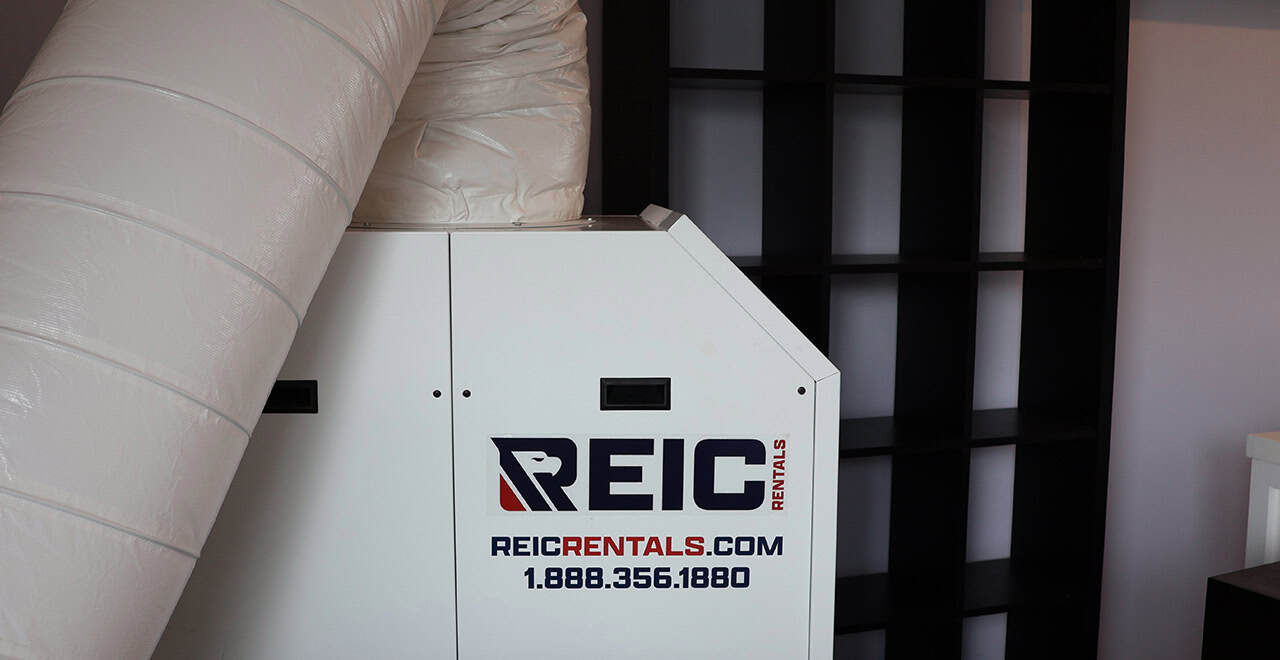
Portable air conditioners from REIC Rentals are the standard solution for occupied spaces that require broad comfort cooling. They draw warm room air across a refrigerant coil, distribute cooled air across the space through front-facing vents or adjustable outlets, and exhaust hot air through ducting routed to the exterior or into a ceiling plenum. The result is a measurable reduction in ambient temperature across the conditioned space, suited to environments where crew productivity, comfort, and safety are the primary concerns.
Portable air conditioners work best in enclosed or semi-enclosed spaces where cooled air can be retained rather than dissipating immediately into a larger unconditioned volume. They are well suited to interior build-out spaces awaiting permanent HVAC, temporary offices and site trailers, enclosed event venues and tented spaces, and occupied areas in facilities where permanent cooling systems are offline for maintenance or replacement.
In humid conditions, portable air conditioners provide the additional benefit of latent cooling, removing moisture from the air alongside reducing temperature. That combination matters in environments where humidity and heat affect crew comfort and productivity, or where materials and finishes require humidity control alongside temperature management.
Where exterior venting of hot air is impractical, water-cooled configurations provide an alternative that does not require routing exhaust outdoors. REIC Rentals advises on which configuration suits the site constraints during the planning conversation, so the equipment that arrives is matched to what the space actually allows rather than requiring field modifications after delivery.
Targeted Cooling: Concentrated Airflow for Equipment and High-Heat Zones
Targeted cooling directs high-velocity conditioned air to a specific area rather than conditioning the full room. It is the appropriate solution when a localized heat source, such as a server rack, a production machine, or a high-density electrical installation, requires direct airflow that general comfort cooling cannot provide efficiently at the room scale.
In data center and server room environments, the requirement is not simply to lower the ambient room temperature. It is to maintain inlet air temperatures at the equipment within the manufacturer’s specified range for reliable operation. A room can feel acceptably cool to a person working in it while rack inlet temperatures remain high enough to cause thermal throttling or equipment shutdowns. Targeted cooling addresses heat at the source rather than diluting it throughout the entire room.
Industrial environments with localized heat sources present similar requirements. A production line generating concentrated heat in one area of a large facility is not efficiently addressed by cooling the entire facility footprint. Directing conditioned airflow to the heat source and exhausting the hot air from that zone controls the problem without the power and equipment costs of conditioning the entire space.
Consider a scenario: a facility manager overseeing a planned chiller outage in a building with active server rooms must maintain equipment inlet temperatures throughout the maintenance window. General comfort cooling for the broader space helps, but the server aisles require direct, concentrated airflow targeted at the equipment rather than the ambient air. Targeted cooling units, positioned and ducted to address the rack-level heat load, keep the equipment within operating specifications during the outage. REIC Rentals reviews the specific layout and heat load before making recommendations so the deployment matches what the environment actually requires.
Evaporative Coolers: The Right Tool in the Right Climate
Evaporative coolers are a third option suited to specific conditions. They draw hot air across water-saturated media to produce a meaningful temperature reduction with lower power requirements than refrigerant-based systems. They are effective in open or partially open environments in arid climates, including warehouses, covered staging areas, outdoor work zones, and fabrication yards, where the air is sufficiently dry to support evaporative cooling and deliver a genuine benefit.
The trade-off is climate dependence. Evaporative cooling becomes less effective as ambient humidity rises. In humid conditions, the air approaching the media already contains significant moisture, which limits evaporative cooling and reduces the temperature drop the unit can achieve. In those conditions, refrigerant-based portable air conditioners are the more reliable choice, whether the goal is targeted cooling or general comfort.
Understanding the expected climate conditions during the project window is part of the equipment selection process. REIC Rentals advises on the appropriate cooling approach for the site location and season, preventing the situation where evaporative equipment arrives on a humid site and underperforms expectations set during planning.
Industrial Fans: Air Movement as a Cooling Strategy
Industrial fans do not reduce temperature as effectively as refrigerant-based cooling, but air movement itself has a meaningful effect on the conditions crews experience at a given temperature. By accelerating the body’s natural cooling process, well-positioned industrial fans can make a hot environment significantly more manageable even when active cooling of the full space is not practical.
For large open areas, warehouses with open doors, or outdoor work zones where containing cooled air is not feasible, industrial fans are often the most cost-effective way to improve conditions without the power and infrastructure requirements of active cooling. They work particularly well in combination with evaporative coolers in arid conditions, accelerating the evaporative process and distributing the cooled air more widely across the work zone.
In enclosed spaces with active cooling, industrial fans improve the distribution of conditioned air, reducing the temperature variation between areas immediately adjacent to the cooling unit and areas at the far end of the space. Well-positioned fans mean the cooling equipment is actually serving the full space rather than creating a comfortable pocket near the unit while conditions in the surrounding area remain unaddressed.
Ventilation and Exhaust: Why Equipment Placement Matters
Cooling performance depends on how air moves through a space, not just on the capacity of the cooling equipment. A portable air conditioner or targeted cooling unit that is poorly positioned, exhausting hot air back into the conditioned space, or operating in a room with inadequate makeup air will underperform regardless of its rated capacity. The equipment selection and the ventilation strategy must be considered together.
Proper exhaust routing removes heat from the conditioned zone rather than recirculating it. When exhaust is improperly managed, the cooling unit works harder to maintain temperature against a heat load it is partially creating itself. The result is higher energy consumption, reduced cooling performance, and a space that never reaches the target conditions the equipment should be capable of achieving.
REIC Rentals reviews exhaust routing, power supply, and air distribution as part of the planning conversation rather than treating them as installation details to resolve on delivery day. HVAC accessories, including ducting and distribution components, are available alongside cooling equipment to complete the installation rather than leaving field teams to source components separately. That coordination is what converts correctly sized equipment into consistent, reliable performance across the project window.
Matching Cooling to Facility Type and Project Scope
The right cooling approach varies by facility type and the project’s requirements. Data centers and server room environments require targeted cooling to maintain equipment inlet temperatures within manufacturer specifications, particularly during planned outages or equipment commissioning, when permanent systems may be offline or undersized for the temporary load. Commercial office and retail spaces during HVAC replacement or build-out require portable air conditioners that maintain occupant comfort and protect sensitive finishes. Warehousing and distribution centers with large open floor areas benefit from a combination of industrial fans for general air movement and targeted or portable cooling in occupied work zones and offices.
Industrial applications, including petrochemical and refinery maintenance, power station shutdowns, and food processing plants, require cooling solutions that account for both the extreme ambient conditions of industrial environments and the specific requirements of the processes and equipment operating within them. Hospitals and healthcare facilities require controlled conditions in occupied-adjacent environments where noise levels and air quality are operational constraints alongside temperature.
For events, tented events, festivals, and other special events in summer conditions, portable air conditioners sized to the tent volume and expected occupancy are required, with power coordinated through temporary generators when site infrastructure cannot support the load.
Power Planning for Temporary Cooling Equipment
Temporary cooling equipment requires correctly sized and stable power. Running multiple portable air conditioners or targeted cooling units across a large facility can create a significant electrical load that must be planned for before equipment arrives on site. When the existing site power cannot support the cooling load, temporary generation steps in.
Coordinating cooling and power requirements through a single planning conversation with REIC Rentals ensures both systems are sized to work together. The combination of generators and cooling equipment, planned as an integrated system, avoids the situation in which correctly specified cooling equipment cannot run because the power supply was not designed to support it. REIC Rentals manages both categories and can build a coordinated plan that covers equipment, power, and distribution as a single scope.
Planning Ahead: Getting the Right Equipment Before the Heat Arrives
Temporary cooling equipment availability is tight during peak summer demand, when construction projects, industrial shutdowns, and events compete for the same inventory. The projects that have the right equipment when they need it are the ones that planned early, confirmed reservations before peak season, and worked through equipment selection with enough lead time to address any site-specific constraints before delivery.
Reactive cooling planning, triggered by a heat event that has already stopped work or an HVAC failure that has already affected operations, compresses the timeline for every subsequent decision. Equipment that would have been readily available in spring may be fully reserved during a summer heat wave. REIC Rentals works with project teams ahead of the season to assess requirements, confirm equipment availability, and stage units on site before the conditions that require them arrive.
The planning process includes a site or facility review, a load assessment that accounts for space volume, heat sources, occupancy, and ambient conditions, and a recommendation covering equipment type, quantity, placement, power requirements, and exhaust routing. Request a quote or find a location near you to start the conversation before peak demand arrives.
Choosing the Right Cooling Solution with REIC Rentals
The choice between portable air conditioning and targeted cooling is not a question of which is better in general. It is a question of what the project requires, what the site allows, and what is at risk if conditions go unmanaged. Both have clear applications and clear limitations, and many projects use both in combination across different zones and phases.
REIC Rentals provides the equipment, planning support, and on-site service to match the right cooling solution to each project’s specific conditions. Explore the full cooling inventory, review the complete HVAC range, including heating and drying, or request a quote to discuss your project’s requirements and build a cooling plan that performs when conditions demand it.
1.888.356.1880 | in**@**ic.com | reic.com
Service You Trust. Equipment You Need.
