
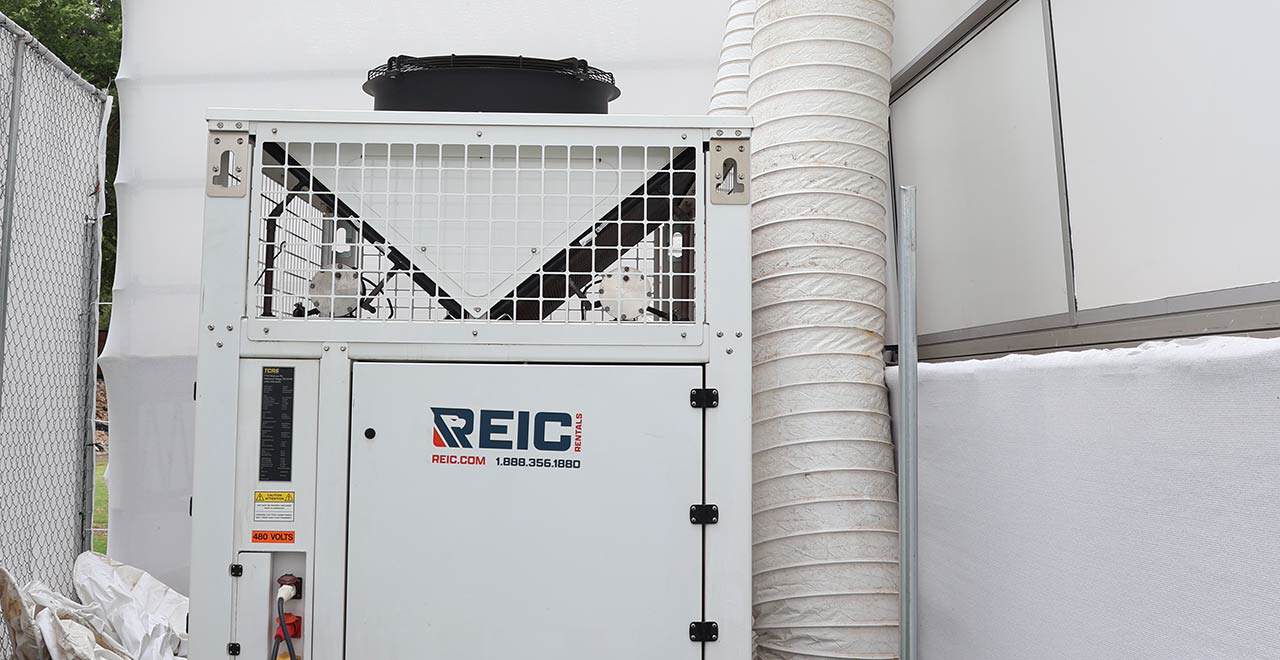
Extreme heat on summer jobsites creates operational and safety risks that demand proactive planning. When ambient temperatures climb and radiant heat from concrete, metal structures, and active equipment push conditions even higher, crews face an environment that slows productivity and poses real health risks. The projects that manage through summer heat consistently are the ones that plan for it before the season arrives, not after the first heat event stops work.
Heat affects every aspect of site performance. Crew output drops as conditions become difficult to sustain. Sensitive materials and finishes require controlled environments that open-air summer conditions cannot provide. Equipment operating in extreme heat runs harder and requires more maintenance attention. The compounding effect across a multi-week summer phase adds up in ways that show clearly at project closeout, even if no single event appears catastrophic during execution.
REIC Rentals provides temporary cooling equipment for active construction sites, industrial operations, and large-scale events. Our range includes portable air conditioners, evaporative coolers, and industrial fans suited to the full range of environments and requirements created by summer project conditions. This article covers how to match cooling equipment to jobsite conditions, how to plan for peak demand, and how a coordinated approach to temporary climate control protects both crew performance and project outcomes.
Understanding Summer Heat on Active Jobsites
The conditions that create heat risk on a construction or industrial site go beyond the ambient air temperature. Radiant heat from asphalt, concrete slabs, metal decking, and heavy equipment surfaces significantly raises the effective temperature beyond what a weather reading shows. Enclosed or partially enclosed spaces without permanent HVAC trap heat that accumulates through the shift. Roof work, interior build-outs awaiting permanent systems, and industrial plant shutdowns create particularly demanding environments where crews have limited natural relief.
Heat stress progresses in stages, from heat cramps and reduced concentration to heat exhaustion, and then to heat stroke, a medical emergency. The progression can be rapid in extreme conditions, and early symptoms are easy to miss on a busy site where crews are focused on production. OSHA requires employers to protect workers through engineering controls, including ventilation and cooling, before relying solely on administrative measures such as scheduling and rotation. Cooling equipment is not a comfort amenity on a summer site. It is part of the site’s safety infrastructure.
Planning cooling requirements in spring, before peak demand arrives, is what separates sites that manage through summer heat from those that scramble for equipment during a heat event when lead times are longest, and availability is tightest. REIC Rentals works with project teams ahead of the summer season to assess requirements and stage equipment so it is on site before it is urgently needed.
Matching Cooling Equipment to Site Conditions
Selecting the right cooling equipment requires understanding the environment, the work being done, and the on-site power and water infrastructure. REIC Rentals’ cooling range covers three primary equipment types, each suited to different conditions.
Portable air conditioners provide direct, controlled cooling for enclosed spaces. They suit control rooms, electrical enclosures, finished interior spaces awaiting permanent HVAC, and any environment requiring precise temperature control. These units require standard power and a means of exhausting hot air from the conditioned space. Where exterior venting is not practical, water-cooled configurations provide an alternative. Portable air conditioners work best in enclosed or semi-enclosed spaces where the cooled air can be contained rather than dissipating into open air.
Evaporative coolers are effective in arid climates and open or partially open environments such as warehouses, covered staging areas, and fabrication yards. They draw hot air across water-saturated media to produce a meaningful temperature drop with relatively modest power and water requirements. The trade-off is that effectiveness decreases as ambient humidity rises. In humid climates or during periods of high relative humidity, evaporative cooling offers diminishing returns, making portable air conditioning a more reliable choice. Understanding the climate conditions expected during the project window is part of selecting the right equipment type.
Industrial fans move high volumes of air across work zones, staging areas, and break areas. Air movement alone does not reduce temperature as effectively as active cooling does, but it significantly improves safety and comfort at a given temperature by accelerating the body’s natural cooling process. Industrial fans are often the most practical solution for large open areas where containing cooled air is not feasible, and they complement active cooling equipment in enclosed spaces by distributing conditioned air more effectively across the full work zone.
Sizing Cooling Equipment to the Work
Cooling equipment that is undersized for the space and the heat load produces the same result as no cooling at all: conditions that do not improve meaningfully and crews that do not get the relief the equipment was supposed to provide. Sizing starts with understanding the volume of the space to be cooled, the heat load generated within it by equipment and occupants, the ambient conditions outside, and how well the space retains cooled air.
For enclosed spaces, the required cooling capacity depends on the space volume, insulation, the number of people working in the space, and the heat output of equipment operating within it. A server room or electrical enclosure has very different requirements from a large interior floor awaiting tenant fit-out. Applying a single rule of thumb across different space types produces unreliable results. REIC Rentals reviews site conditions and load requirements before making equipment recommendations, ensuring the equipment that arrives performs as expected rather than falling short under real conditions.
For open or partially open environments, the goal shifts from cooling a contained space to improving conditions within a defined work area or recovery zone. Air volume, directional airflow, and the placement of equipment relative to where crews are working all affect how much benefit the equipment delivers. Recovery zones that combine shade, directional airflow from industrial fans, and evaporative cooling where humidity allows, create conditions that support regular rotation without long walks across the site. Planning those zones is as important as selecting the equipment itself.
Power Planning for Temporary Cooling
Temporary cooling equipment requires stable, correctly sized power. Portable air conditioners draw meaningful electrical load, and running multiple units across a large site adds up to a power requirement that must be planned for rather than assumed. Where site power infrastructure is not yet in place or cannot support the cooling load, temporary generators provide the supply needed. Coordinating cooling and power requirements through a single planning conversation with REIC Rentals ensures both systems are sized to work together rather than discovering a power gap after cooling equipment is already on site.
HVAC accessories, including ducting and distribution components, extend cooling capacity from a central unit into multiple zones, which can be more efficient than deploying individual units in every work area. REIC Rentals advises on distribution layout as part of the planning process, because a well-designed distribution system is what converts correctly sized equipment into consistent conditions across the full work area, not just the zone immediately adjacent to the unit.
Crew Safety and Productivity in Summer Conditions
Cooling equipment is one component of a summer heat management plan, not a complete solution in itself. Crews working in exposed conditions need access to cooled recovery areas at regular intervals, consistent access to water, and supervisors trained to recognize early signs of heat stress before they progress to a medical event. Engineering controls like cooling and ventilation reduce the heat load, but they work in combination with sound operational practices, not instead of them.
The productivity case for adequate cooling is straightforward. Crews working in manageable conditions sustain output across the full shift. Crews working in unmanaged heat slow progressively as conditions accumulate, make more errors, and require more recovery time. On a project with a compressed summer schedule, the difference between a crew operating at full capacity and one that is losing production to heat compounds across weeks in ways that erode schedule and margin simultaneously.
Recovery zones positioned near active work areas reduce the time and distance between intense work and relief, supporting more frequent rotation without disrupting production flow. Industrial fans that create airflow through work corridors reduce the felt temperature of the environment even when active cooling is not practical in the open work area itself. These decisions about equipment placement are part of what REIC Rentals reviews during the site assessment conversation.
Applications Across Construction and Industrial Sectors
Summer cooling requirements span a wide range of project types and sectors served by REIC Rentals. Commercial office and retail construction requires cooling for enclosed interior spaces during tenant finish work, before the permanent HVAC system is operational. Warehousing and distribution center builds involve large enclosed spaces with limited natural ventilation during active construction phases. Data centers require precise temperature control for sensitive equipment during commissioning and fit-out. Hospitals and healthcare facilities require controlled conditions to protect crew safety and materials in occupied and adjacent environments.
Industrial applications, including petrochemical and refinery shutdowns, power station maintenance, and oil and gas operations, create some of the most demanding summer heat conditions, where radiant heat from process equipment combines with ambient temperature to create environments that require a deliberate cooling strategy. Plant shutdowns that run through the summer peak require cooling planned as a core part of outage logistics rather than an add-on after the scope is already defined.
Outdoor and tented events during summer months require cooling for guest areas, hospitality spaces, and operational zones. REIC Rentals supports special events, festivals, sporting events, and tented events with cooling equipment sized to the event’s footprint and requirements, coordinated with power and other temporary systems to deliver a complete climate solution.
Planning Ahead: Integrating Cooling into the Summer Project Plan
The most effective cooling plans are put in place before summer arrives. Equipment availability tightens when multiple projects and events compete for the same inventory across a region, and that competition peaks precisely when the need is most urgent. A project that has confirmed equipment, established delivery logistics, and staged units on site before the first heat event is operating from a position of control. One that initiates the process after conditions have already stopped working is not planning. It is reacting, and the cost of that difference shows up in every hour crews cannot be on site.
Key planning inputs include the project schedule and which phases will be active during the peak summer window, the site environment and how much natural ventilation or shade exists in active work areas, power infrastructure and whether temporary generation will be needed to support the cooling load, and any specific requirements for temperature-sensitive materials or processes active during the summer phase.
REIC Rentals provides site assessments, either in person or virtually, as part of the planning process. That assessment translates site conditions into an equipment recommendation covering cooling type, capacity, placement, and power requirements before equipment arrives on site. Request a quote or find a location near you to start the summer cooling conversation before peak demand arrives.
Keeping Crews Productive and Safe Through the Summer Season
Extreme heat is a predictable challenge on summer jobsites. It is also a manageable one when cooling is treated as a planned part of the project rather than an emergency response. The right combination of portable air conditioners, evaporative coolers, and industrial fans, sized to actual conditions and supported by properly planned power distribution, creates an environment where crews can sustain productive output throughout the full shift and where sensitive materials and processes are protected during the peak summer window.
REIC Rentals delivers the cooling equipment, planning support, and on-site service to make that practical across construction, industrial, and event applications. Explore the full cooling inventory, review the complete HVAC range, including heating and drying, or request a quote to build a summer climate plan before the season demands it.
1.888.356.1880 | in**@**ic.com | reic.com
Service You Trust. Equipment You Need.
