
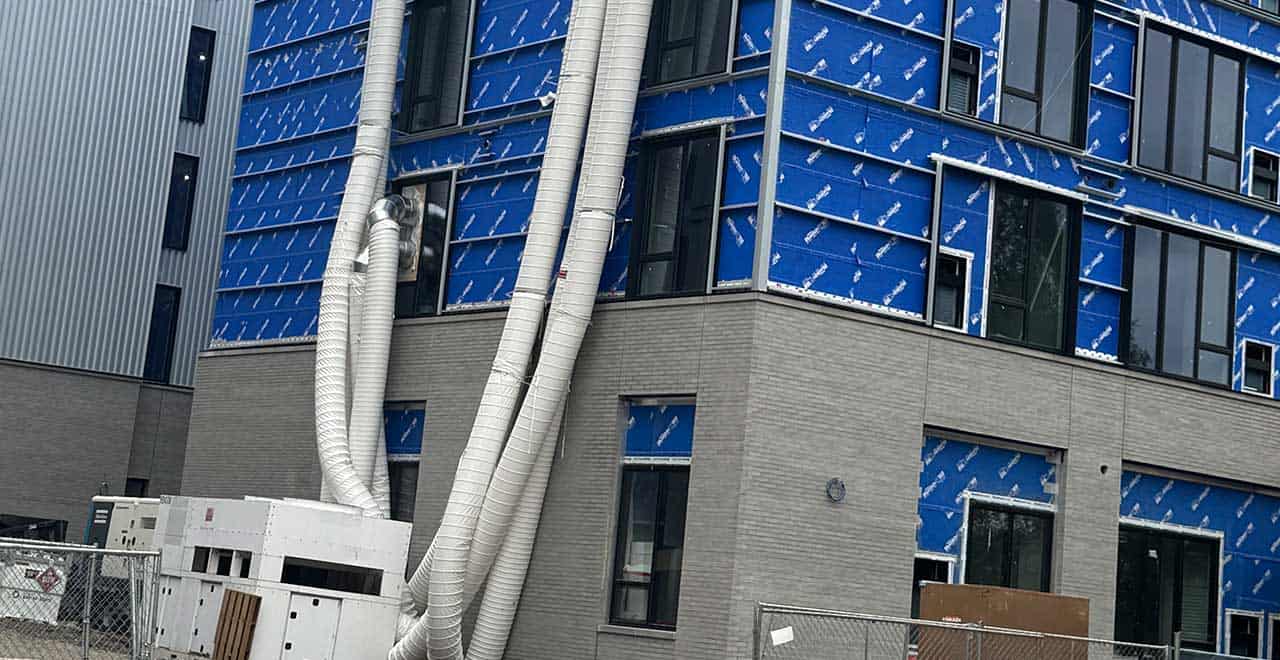
Excess moisture is one of the most persistent threats on an active construction site. Fresh concrete pours release water vapor as they cure. Seasonal humidity infiltrates unsealed envelopes. Wet framing lumber brings moisture into the structure before finishes are installed. Each source compounds the others, and the combined effect on materials, schedules, and costs is significantly worse than any single factor in isolation.
The damage rarely announces itself immediately. Flooring failures surface months after handover. Mold behind baseboards appears in year two. Paint that looked acceptable at turnover blisters through the first winter. By the time those problems become visible, the construction team is managing warranty claims rather than delivering projects, and the connection between inadequate moisture control during construction and the failure in service is not always easy to establish or defend.
REIC Rentals provides temporary dehumidification and drying solutions for construction projects, from slab-drying phases through interior finishes to final commissioning. This article covers how moisture affects specific building materials during construction, what controlled conditions are required in practice, and how planned dehumidification protects both the materials and the schedule.
How Moisture Damages Building Materials
Moisture affects building materials through several distinct mechanisms, and understanding which mechanism applies to each material type is key to proper dehumidification planning.
Wood-based materials, including framing, flooring, millwork, and casework, absorb moisture and expand. When that expansion is constrained by adjacent materials or fasteners, the result is warping, cupping, delamination, and joint failure. When moisture eventually leaves the material in a drier environment, shrinkage follows, producing gaps, cracks, and dimensional changes that affect both function and appearance. The damage is not always visible at the time of installation. It develops as the material responds to the conditions in which it was installed rather than to the conditions for which it was designed.
Gypsum-based materials are highly sensitive to moisture. Drywall board edges soften and lose structural integrity. Joint compound stays soft, cracks, or shrinks rather than curing correctly. Paper facings become a substrate for mold when ambient relative humidity remains elevated for extended periods. Once primer and paint are applied, gypsum’s ability to release trapped moisture drops significantly, so moisture locked in the assembly has fewer pathways to escape afterward.
Adhesives and coatings are chemistry-dependent. Most flooring adhesives, paints, and coating systems have defined application and cure conditions that include maximum relative humidity thresholds. Applied outside those conditions, adhesives lose bond strength, coatings blister or peel, and the failure mode is not immediately visible. The result is a surface that passes visual inspection at handover and fails in service, which is the worst possible outcome from both a warranty and a reputational standpoint.
Metal components, including studs, fasteners, and flashings, corrode under sustained exposure to moisture. In a building occupied before those connections are fully protected by finishes, corrosion progresses invisibly and compromises structural connections that are no longer accessible for inspection or repair.
Protecting Flooring Systems
Flooring failures are among the most expensive moisture-related problems in construction because the failure mode often requires full removal and reinstallation rather than a surface repair. Vinyl, resilient sheet, carpet tile, hardwood, engineered wood, laminate, and coated concrete all have specific moisture tolerances that must be met before installation, and most flooring manufacturers tie warranty coverage to those thresholds being verified before work begins.
Concrete slabs release moisture vapor throughout the curing process. In an enclosed space without dehumidification, the moisture vapor accumulates in the surrounding air and in the slab surface itself, keeping relative humidity and moisture vapor emission rates elevated well beyond the thresholds that flooring installation requires. The gap between when concrete is placed and when conditions are actually ready for flooring is the primary schedule risk that dehumidification addresses.
REIC Rentals’ drying equipment accelerates slab drying by simultaneously pulling moisture from the slab surface and the surrounding air. That combination is more effective than either approach alone because removing moisture from the air reduces the vapor pressure differential that slows moisture release from the slab. Air movers increase airflow across the slab surface, accelerating evaporation and preventing the moisture boundary layer from re-saturating the surface between dehumidifier cycles.
Measuring slab relative humidity per ASTM F2170 before any flooring finish installation is a documented requirement of most flooring manufacturers and a practical risk-management step for any contractor who intends to hold the flooring warranty. REIC Rentals supports that process by providing the equipment and planning guidance that bring slab conditions within specification, not just by delivering machines and leaving documentation to the site team.
Protecting Drywall and Interior Wall Systems
Drywall installation on a site without controlled humidity creates conditions that the Gypsum Association’s moisture control guidelines and multiple North American building codes specifically address. The practical requirement is straightforward: ambient humidity should be controlled before and during gypsum installation, not managed reactively after problems develop.
Joint compound requires stable, controlled conditions to cure correctly. In elevated humidity, the compound remains soft, takes longer to sand, and is prone to cracking and shrinkage once it dries. The recoat and finishing schedule that the drywall crew builds their production around depends on the compound curing at the manufacturer-specified rate, which requires the manufacturer-specified conditions.
The longer-term risk is more serious. Elevated humidity during drywall installation creates conditions where mold can colonize paper facings and wall cavities before finishes are applied. Once primer and paint seal the assembly, moisture trapped in the cavity has limited pathways to escape, and mold established during construction persists behind surfaces that look dry and finished from the exterior. The resulting remediation requires the full removal and replacement of affected assemblies, re-taping, re-finishing, repainting, and re-inspection of areas already considered complete.
REIC Rentals supports drywall phases with dehumidifier and air mover packages sized for large open floor plates, high ceilings, and multi-story projects. The goal is to maintain conditions within the target range throughout the installation and curing period, not to achieve them briefly and then allow conditions to drift.
Protecting Finishes, Millwork, and Casework
Finished in construction means dimensionally stable, properly cured, and protected within a controlled environment. It does not mean visually complete in conditions that will cause the material to fail after occupancy. That distinction is where moisture control during the finishes phase matters most.
Most coating manufacturers specify maximum relative humidity and minimum temperature thresholds for both application and cure. When those windows are missed, the consequences are not always immediate. Paint that appears to have dried correctly in high humidity may blister, develop uneven sheen, or peel during the first thermal cycle after occupancy. Coatings applied to concrete or masonry in elevated humidity conditions can fail at the adhesion layer, requiring full removal and reapplication of work that passed visual inspection at the time.
Wood millwork and casework respond to humidity conditions in the space where they are installed. Doors and frames swell in humid conditions and may operate properly during construction, but may bind after the building is occupied and conditions normalize. Cabinet joints open or twist after installation in humid air. Veneers blister or delaminate when adhesives cure outside the manufacturer’s specifications. These failures are expensive to remediate because the work is by definition in finished spaces. Repairing a door that binds, a cabinet joint that has opened, or veneer that has delaminated requires working around completed finishes, protecting adjacent surfaces, and, in many cases, undoing work that was already signed off on before the problem became visible.
REIC Rentals designs temporary climate-control packages for finishing phases that combine dehumidification, heating, and air movement to create the stable, controlled environment that coating and finishing systems require. The approach reflects what the materials need, not what is convenient for the construction schedule.
Schedule Protection: The Operational Case for Dehumidification
Moisture control on construction sites is as much about schedule protection as it is about material protection. Every day crews wait for a surface to dry before they can proceed is a day of lost production that cannot be recovered without adding cost. Re-sequencing trades when a wet area is not ready for the next phase disrupts the coordination that keeps a construction schedule intact. Failed inspections triggered by moisture damage or mold growth generate delays that compound across all downstream work.
The compounding effect is significant on large projects. A slab that takes longer than planned to reach installation-ready moisture levels delays flooring installation, which delays millwork, which delays painting, which delays the trades that follow. Each delay is larger than the one before it because each downstream trade has less schedule buffer to absorb the impact. Dehumidification that brings slab conditions to specification within a defined window is not simply material protection. It is critical path management.
Consider a large commercial project in which a slab is poured in early summer, the building is enclosed, permanent HVAC is not yet operational, and ambient humidity is consistently elevated. Without dehumidification, flooring and paint installation are delayed by weeks while slab moisture vapor emission rates remain above installation thresholds. With rental drying equipment deployed at the enclosure, conditions reach specification within a defined window, keeping downstream trades on schedule and avoiding the overtime and liquidated damage exposure that schedule slippage generates on fixed-deadline contracts.
Dehumidification deployed early, at the enclosure rather than when moisture problems are already visible, produces better results at lower cost than reactive deployment after damage has occurred. REIC Rentals works with project teams during preconstruction planning to identify the phases where moisture control is most critical and to build the equipment and monitoring plan into the schedule rather than treating it as an add-on after problems develop.
Dehumidification in Cold Weather and Winter Construction
Moisture control is not exclusively a summer or warm-climate concern. Winter construction in the Pacific Northwest, Mountain West, and Canada creates conditions where cold temperatures slow drying rates, condensation on cold surfaces introduces moisture into enclosed spaces, and the heating equipment used to maintain workable temperatures can introduce combustion moisture if not correctly specified.
Desiccant dehumidifiers perform effectively at low temperatures, making them the appropriate choice for cold-weather construction phases where refrigerant-based equipment loses efficiency. Paired with indirect-fired heating equipment that delivers dry heat without combustion moisture, desiccant dehumidification creates controlled conditions for winter concrete curing, drywall installation, and coatings application that would otherwise be impossible to achieve in cold, damp conditions.
REIC Rentals’ experience in winter construction across its Pacific Northwest, Rocky Mountain, and Canadian markets is directly relevant to cold-weather moisture control planning. The equipment combinations and deployment approaches that work in those environments are not the same as those that work in a warm summer build, and applying the wrong approach produces the same outcome as applying no approach at all.
Best Practices for Dehumidification on Active Construction Sites
Effective dehumidification requires proper deployment, not just the right equipment selection. The most common failures are not equipment failures. They are placement failures, containment failures, and monitoring failures that prevent correctly specified equipment from achieving the conditions it is capable of maintaining.
Containment is the prerequisite. Starting dehumidification before the building is adequately enclosed is largely ineffective because humid outdoor air continuously replaces the moisture being removed. Sealing major openings, isolating zones with temporary barriers, and preventing continuous infiltration are what allow dehumidification to drive conditions toward the target rather than simply maintaining them against an unlimited incoming moisture load.
Placement determines coverage. Dehumidifiers positioned in the center of a large open floor plate without adequate air movement leave dead zones in corners, behind partitions, and in low-airflow areas where conditions remain elevated. Combining dehumidifiers with strategically positioned air movers creates airflow patterns that move moisture from the entire space to the dehumidifier’s intake, rather than conditioning only the air in the immediate vicinity of the unit. REIC Rentals advises on placement and air-movement strategy as part of the planning process, because a correctly positioned system achieves the target conditions throughout the space, whereas a poorly positioned one creates the illusion of control without delivering it.
Monitoring verifies results. Hygrometers and data loggers positioned by zone provide the documentation that material manufacturers, inspectors, and project records require. Setting target relative humidity levels appropriate to the materials being protected and tracking conditions against those targets throughout the active phase allows the project team to confirm that controlled conditions were maintained, not simply assumed. REIC Rentals supports monitoring planning alongside equipment selection, so the documentation that protects the project is built into the process from the start.
Applications Across Construction Sectors
Dehumidification requirements vary by project type and by the specific construction phase. Commercial office and retail construction requires moisture control through flooring, drywall, and finishing phases to protect tenant improvements and meet handover specifications. Hospitals and healthcare renovation and construction require moisture control that protects both materials and indoor air quality in environments where mold contamination has regulatory as well as operational consequences. Data centers require controlled humidity during fit-out and commissioning to protect sensitive equipment from moisture damage during the window before permanent environmental systems are operational.
Warehousing and distribution center construction involves large slab areas that require extended drying periods before floor coatings and sealing systems can be applied. Coating and curing projects, including tank linings, industrial floor systems, and structural coatings, require dew point control throughout surface preparation, application, and cure periods that REIC Rentals’ desiccant dehumidification and integrated heating systems are specifically designed to support. Dehumidification and restoration following water intrusion events require rapid moisture removal to prevent secondary damage and mold establishment in building materials that are already compromised.
Planning Dehumidification with REIC Rentals
The most effective moisture control plans are built at preconstruction, when the project schedule, enclosure sequence, and critical material installation windows are known. Engaging REIC Rentals at that stage produces a dehumidification plan integrated into the schedule, rather than deployed reactively when moisture problems are already affecting materials or trades.
The planning process includes a review of the project scope and enclosure sequence, an assessment of the climate conditions expected during critical phases, sizing calculations based on the volume of the space and the moisture loads being managed, equipment placement recommendations that account for floor plate geometry and air movement, and a monitoring protocol that documents conditions throughout the active phase.
Request a quote or find a location near you to start the moisture control conversation for your next project before the schedule demands it.
Protecting What Has Already Been Built
Dehumidification during construction protects flooring from adhesive failure and dimensional change, keeps drywall assemblies free from mold before finishes are applied, ensures coatings and millwork cure to the conditions they were designed for, and protects the schedule from the compounding delays that uncontrolled moisture produces across every downstream trade.
REIC Rentals delivers the drying equipment, heating, and HVAC accessories needed for construction moisture control, backed by planning support and on-site service. Explore the full HVAC range, or request a quote to build a dehumidification plan that is ready before moisture causes a phase to fall behind.
1.888.356.1880 | in**@**ic.com | reic.com
Service You Trust. Equipment You Need.
