
The first server has not powered on yet. The racks are staged, the cabling is roughed in, and the UPS room sat unheated through a cold November weekend. By Monday morning, there is condensation on a copper bus bar, corrosion starting on a PCB solder joint, and a battery warranty voided by two nights below the manufacturer’s minimum storage temperature. In data center construction, the environmental conditions maintained before IT load turns up determine whether the facility commissions cleanly or absorbs weeks of remediation before it can.
The decision between temporary and permanent heating during data center construction is not just an equipment choice. It shapes schedule, cost, risk exposure, and the long-term operational integrity of the facility. Getting it wrong can damage sensitive infrastructure, delay commissioning, and push revenue milestones back in ways that are difficult to recover from.
REIC Rentals provides temporary heating solutions for data center and technology facility construction, including indirect-fired heaters and the exclusive Jet Heat flameless system. This article covers when to use temporary versus permanent heating, how to manage the transition between them, and how to protect sensitive infrastructure through every phase of the build.
Why Environmental Conditions Matter Before a Single Rack Is Installed
ASHRAE TC 9.9 thermal guidelines define the recommended server-inlet temperature range as 64 to 81 degrees Fahrenheit, with relative humidity generally kept between 8 and 60 percent. Those targets matter before any IT equipment arrives on site.
Cold, unconditioned construction environments in winter expose copper bus bars, PCB solder joints, and storage subsystems to condensation, which increases the risk of corrosion. Going too dry increases the risk of static discharge. Batteries in UPS rooms are subject to warranty exclusions if exposed to temperatures below 32 degrees Fahrenheit or above 104 degrees Fahrenheit.
Interior finishes also require stable temperatures. Concrete slabs, drywall, fireproofing, and specialty coatings must cure within defined temperature and humidity bands. When those conditions are not maintained, micro-cracking, delamination, and adhesion failures follow, undermining the long-term performance of power and cooling infrastructure installed above them.
What Temporary Heating Means on a Data Center Construction Site
Temporary heating is any non-permanent, rental or portable system used to raise and stabilize temperature before the permanent mechanical plant is commissioned. Temporary systems are mobile, modular, and independent of the permanent utility grid, which makes them available from the earliest phases of construction.
Common temporary heating equipment for data center projects includes:
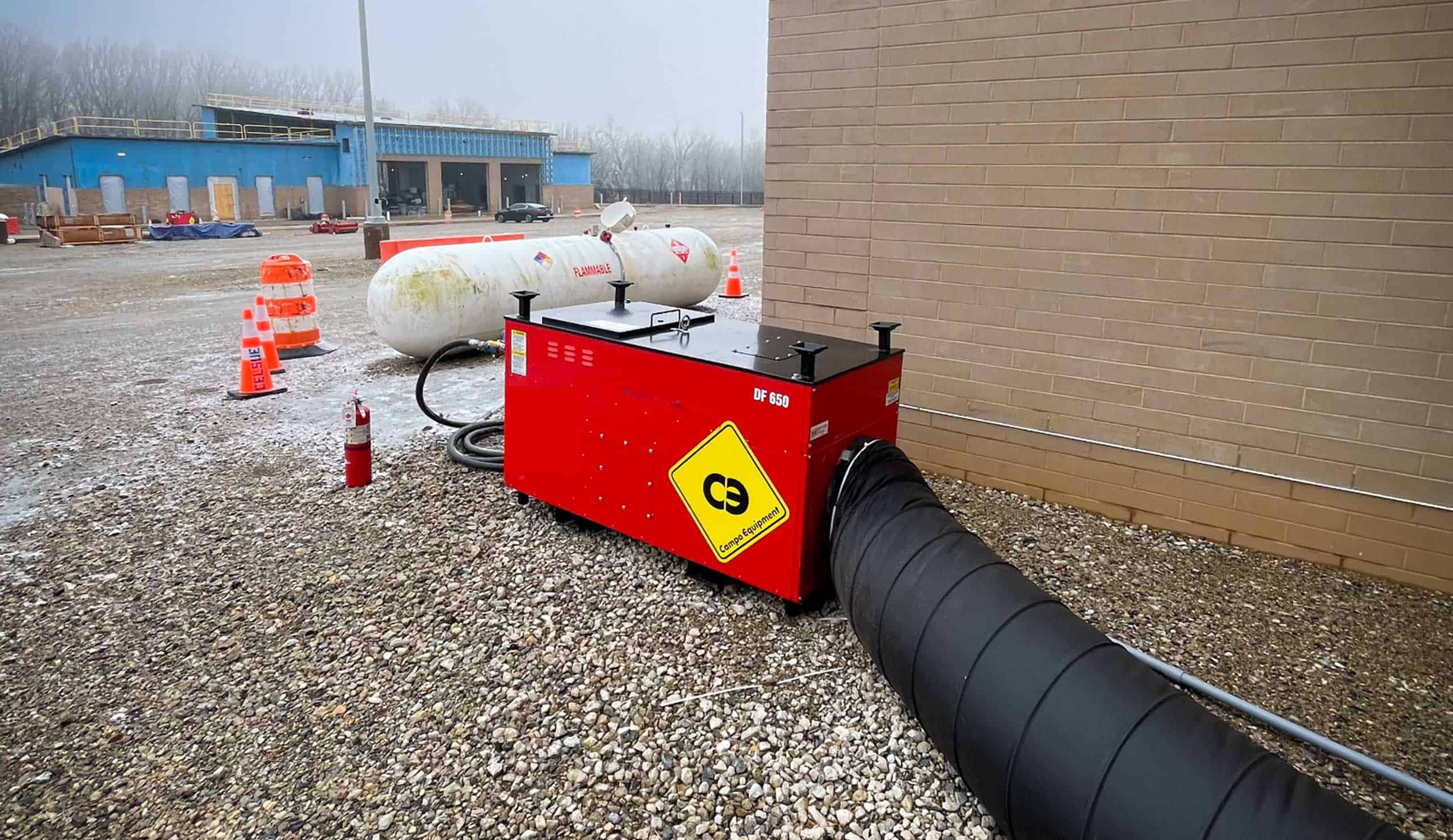
- Indirect-fired heaters running on diesel or natural gas, with ducted supply into interior spaces. Combustion gases are exhausted outside, keeping the heated space free of byproducts.
- Electric heaters, which produce zero combustion byproducts and are appropriate for white spaces, UPS rooms, and battery spaces, where air quality is a priority.
- Direct-fired heaters are generally not appropriate for data hall environments due to the moisture and particulate they introduce.
REIC Rentals’ Jet Heat flameless technology is particularly well suited to large data hall floor plates, where conventional heaters struggle to consistently reach interior zones. It delivers dry heat with no open flame and no combustion emissions, with long-distance ducting capability that reduces the number of units needed across a large footprint.
What Permanent Heating Means in Modern Data Centers
Permanent heating in a data center means the production HVAC systems: computer room air handlers, computer room air conditioners, air handlers, heat pumps, and supplementary reheat coils tied into the building’s mechanical plant. In most modern data centers, cooling rather than heating is the dominant design concern. But permanent systems still provide temperature control during shoulder seasons and can operate in heating mode during construction if commissioned early.
Permanent systems integrate with building automation and data center infrastructure management software to maintain tight environmental control. That integration is designed around live IT loads, not cold, empty halls. Using permanent systems too early leads to inefficient cycling, uneven temperatures across the data hall, and warranty exposure on chillers and air handlers that were not designed for partial-load construction conditions.
Key Decision Factors: When to Use Which
There is no single rule. Decisions should be made phase by phase through shell and core, white space build-out, MEP integration, and IT commissioning. The major factors include:
- Project schedule: Compressed timelines often require temporary heat to keep work moving during the cold months, regardless of the permanent system status.
- Climate zone: A project in the Mountain West or Western Canada faces fundamentally different heating demands than one in a mild coastal market.
- Utility availability: Generator-dependent sites affect heater selection and fuel logistics.
- Fire code restrictions: NFPA requirements and local fire marshal rules dictate heater types, clearances, and supervision requirements.
- Sequence of operations: The mechanical engineer’s commissioning plan determines when permanent systems can safely activate.
Industry guidance generally favors temporary heating during early and mid-construction phases: during slab pours and wet trades that introduce moisture, before permanent filtration is in place to protect coils from construction dust, and in spaces such as generator yards that will not receive permanent heat. Transitioning to permanent heating makes sense after pressure testing and cleaning of the hydronic piping are complete, and shortly before the mock load and IT equipment move-in.
Risk Comparison: Temporary vs Permanent
The risks differ meaningfully and should be evaluated explicitly for each project.
Temporary heating carries fire and life safety risks that require active management. Direct-fired equipment can create dangerous carbon monoxide levels indoors. All temporary heaters should be UL-, CSA-, or ETL-listed with automatic safety shutdown capability. Fuel storage on high-electrical-density sites requires NFPA-compliant containment.
Early use of permanent heating can void equipment warranties, increase maintenance requirements for chillers and air handlers, and expose coils and ductwork to construction dust that later migrates into rack spaces. Soot and combustion byproducts from poorly maintained temporary units pose the same contamination risk when units are improperly positioned or inadequately maintained.
REIC Rentals provides engineering support for temporary heating layouts in large white spaces and equipment rooms, with indirect-fired and electric heaters sized for multi-megawatt construction sites. Our teams coordinate with mechanical engineers and commissioning agents to ensure that temporary heat deployment does not conflict with permanent system startup.
Transitioning from Temporary to Permanent Heating
The handoff from rental systems to permanent HVAC is a critical milestone. The recommended sequence for data center projects:
- Complete all high-dust work, including core drilling, large-scale drywall sanding, and concrete cutting, while on temporary heat.
- Perform initial cleaning and flush-outs, then start permanent air handlers with construction-grade filters.
- Conduct integrated systems testing for HVAC controls, including alarms for temperature extremes and loss of cooling.
- Confirm environmental conditions are stable for at least 72 hours before moving in racks and powering servers.
REIC Rentals supports overlap periods in which temporary systems remain in place as a backup during the first weeks of permanent system operation. That redundancy provides resilience against unexpected faults and gives commissioning teams confidence before the IT load is activated.
Contact REIC Rentals early in the design phase to develop a project-specific roadmap for temporary versus permanent heating, aligned with your commissioning milestones. Request a quote or find a location near you to connect with the team supporting data center projects in your region.
1.888.356.1880 | in**@**ic.com | reic.com
Service You Trust. Equipment You Need.
