
When a combined-cycle power plant enters a planned outage in January, the internal heat sources that kept the turbine hall above freezing go offline with the plant itself. Steam extraction stops. Waste heat from running equipment disappears. In Northern Plains and Western Canada markets where sustained temperatures below minus 4 degrees Fahrenheit are a routine operating condition, the turbine hall can approach freezing within hours of shutdown. The maintenance work cannot start until the facility is safe and stable. Temporary heating is not a support function in that scenario; it is the prerequisite.
Power stations and energy generation facilities present a version of the industrial heating challenge that few other environments match in complexity. Turbine halls with ceilings over 100 feet, control rooms housing electronics that require precise environmental conditions, generator enclosures with strict open-flame restrictions, and sprawling ancillary buildings all simultaneously demand different heating approaches. A single heater type serves none of those zones adequately. A planned approach serves all of them.
REIC Rentals provides temporary heating for power generation facilities across North America, including indirect-fired heaters for turbine halls and enclosed work areas, the exclusive Jet Heat flameless system for classified and flame-restricted zones, and electric heaters for sensitive electrical and control spaces. This article covers the heating requirements specific to power generation facilities and how to plan temporary heating that keeps outage work on schedule.
Why Power Generation Facilities Are Uniquely Demanding
A power station is not a single industrial space. It is a collection of distinct micro-environments, each with its own temperature requirements, safety classification, and consequences for inadequate heating.
Turbine halls span enormous volumes, sometimes exceeding 200,000 square feet, with ceiling heights above 80 feet. The primary concern during shutdowns is preventing condensation on turbine rotor seals, generator windings, and exposed instrumentation. Once those components cool below the dew point of the surrounding air, moisture condenses, accelerating corrosion and increasing the risk of electrical tracking, which can affect the restart timeline long after the maintenance work is complete.
Control rooms and electrical rooms house PLCs, DCS systems, MCCs, and switchgear that require stable temperature and humidity throughout outages. These spaces are continuously occupied by operators and demand clean, filtered air without combustion byproducts from any heating equipment serving adjacent areas.
Fuel-handling areas around gas turbine enclosures, fuel gas skids, and hydrogen-cooled generators are classified areas where open-flame ignition sources are restricted. Standard direct-fired heaters cannot operate in these zones regardless of their efficiency or output. The heating solution must be flameless or indirect, with combustion air and exhaust routed entirely away from any explosive-risk boundary.
Ancillary spaces, including workshops, laydown areas, and temporary construction compounds, require adequate heating to maintain crew productivity during multi-month outage windows. Inadequate heating in these areas does not threaten equipment. It threatens the schedule through reduced productivity, extended task durations, and cold-stress incidents that pull workers off the job.
Cold-Weather Risks That Affect Outage Schedules
The consequences of inadequate temporary heating in a power generation facility during a winter outage extend beyond crew discomfort. They propagate through the maintenance scope and the restart timeline in ways that add cost that dwarfs the heating investment.
PVC and XLPE cable insulation becomes brittle in sustained cold, increasing the risk of cracking during handling and termination work. Lube oil lines that cool below their minimum operating temperature risk bearing starvation during restart. Moisture condensing inside switchgear and relay panels introduces arc-tracking faults that require additional inspection and cleaning before energization. Coatings, adhesives, and sealants applied below their minimum temperature specification cure incompletely, producing rework during commissioning.
The schedule risk is direct. A coating application that fails its specification due to cold-weather application requires stripping and reapplication, adding days to a phase that the outage schedule did not allow for. An instrumentation cabinet requiring moisture remediation before energization delays the restart sequence, cascading through every subsequent commissioning milestone.
Heating Technologies for Power Generation Applications
No single heater type is appropriate for every zone in a power station. Effective temporary heating requires equipment matched to the specific volume, occupancy, safety classification, and equipment sensitivity of each area.
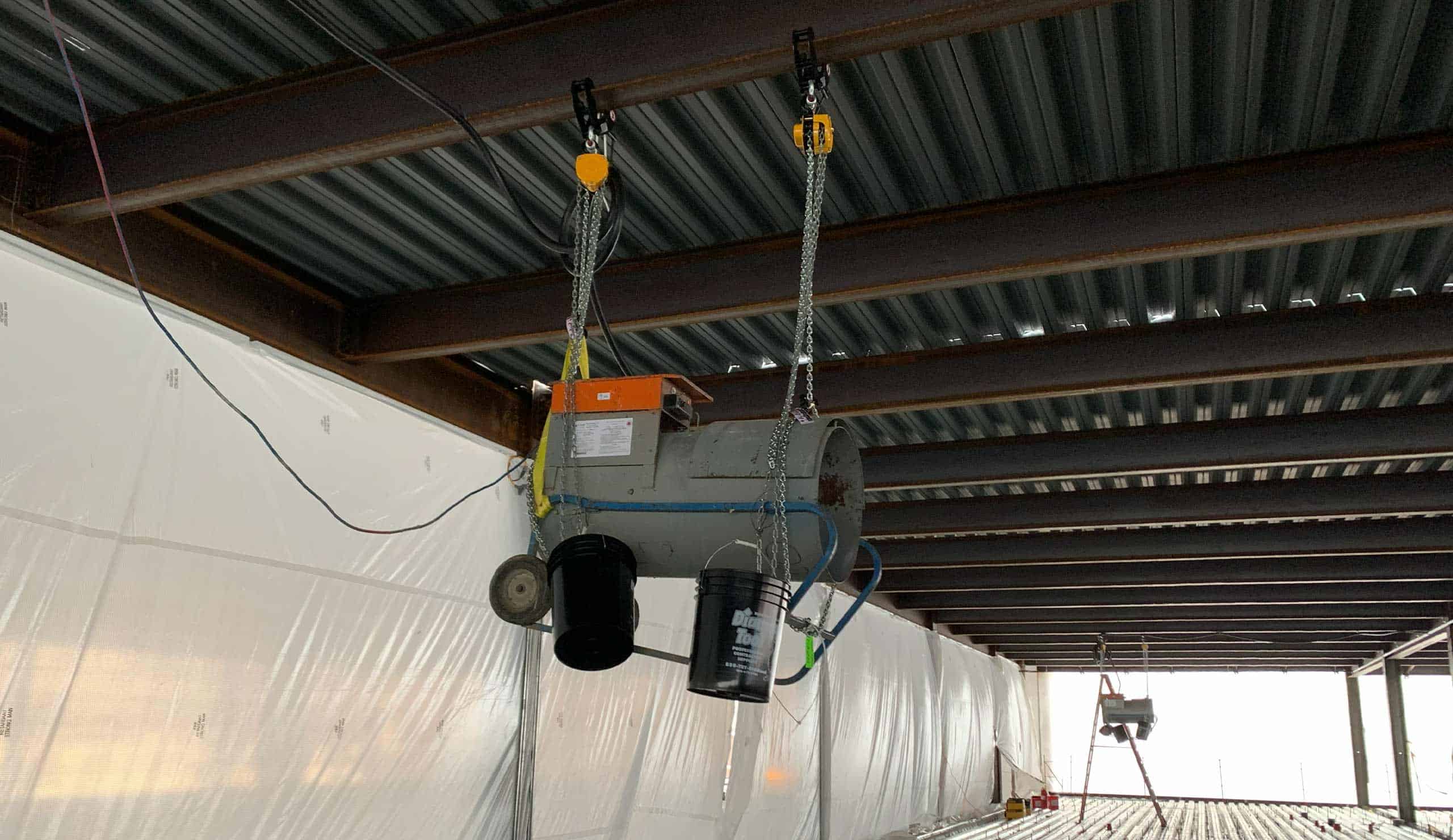
Indirect-fired heaters are the standard solution for large enclosed spaces where combustion byproducts must be kept out of the heated air stream. They combust fuel in an external chamber and deliver clean, dry, warm air through ducting into turbine halls, industrial buildings, and any enclosed work area where air quality matters alongside temperature. REIC Rentals’ indirect-fired fleet handles the scale required for power-generation turbine halls, with ducted distribution that pushes heated air to floor level, where crews and equipment are, rather than allowing it to stratify at ceiling height, where it has no operational value.
REIC Rentals’ exclusive Jet Heat flameless technology is the appropriate choice for classified areas, confined spaces, and any zone where open flame cannot be permitted. It operates with no visible flame and no combustion emissions, making it compatible with the hazardous-area boundaries around gas turbine enclosures, fuel gas metering stations, and hydrogen-cooled generator spaces, where standard indirect-fired units may still pose an unacceptable ignition risk. Its long-distance ducting capability allows the heating unit to be positioned well outside the classified zone with conditioned air delivered to exactly where it is needed.
Electric heaters are used in control rooms, battery rooms, electrical rooms, and any sensitive space where combustion equipment of any type is prohibited. They deliver clean heat with no byproducts and are appropriate for the most environmentally controlled areas of the plant. Their operating cost per BTU is higher than that of fuel-fired alternatives, which makes proper sizing and zone management essential to avoid unnecessary expenses during a multi-month outage.
Direct-fired heaters are appropriate for large, well-ventilated outdoor or semi-enclosed areas where combustion byproducts can dissipate safely and where open flame does not conflict with the site’s hazardous area classification. Outdoor laydown yards, open-sided staging structures, and site access roads are typical direct-fired applications at power generation sites.
Air Distribution in High-Bay Turbine Halls
The primary air distribution challenge in a turbine hall is thermal stratification. Warm air rises naturally to the ceiling of a space that may be 80 or more feet tall, leaving the floor level where crews and equipment operate significantly colder than the thermostat reading near the heating unit suggests.
Effective heating of turbine halls requires a deliberate air movement strategy alongside heat output. High-capacity warm air heaters positioned to draw air from floor level and discharge into the lower third of the hall create circulation patterns that prevent heat from accumulating in the upper volume above crane bays and equipment mezzanines. Temporary ducting directs heated air along turbine decks and generator lines rather than releasing it at a single discharge point where stratification begins immediately.
Air circulation that disrupts stratification reduces fuel consumption to achieve the same floor-level temperature. A heater fleet sized for the full volume of a turbine hall without accounting for stratification is oversized. REIC Rentals reviews airflow strategy alongside heater sizing for turbine hall applications, rather than applying a standard BTU-per-cubic-foot calculation that yields the wrong answer in high-bay environments.
Planned Outages: Temporary Heating as a Schedule Protection Tool
Major outages at power generation facilities are scheduled within defined windows, with each day of delay incurring significant costs. Temporary heating during those windows is a scheduled protection measure that enables material installation, coating application, and commissioning activities to proceed on their planned timeline rather than waiting for conditions to become adequate.
Process-critical temperature requirements during a power plant outage cover a wide range of work. Concrete pours for foundation repair and equipment pad work require temperatures above 40 degrees Fahrenheit throughout the curing period. Coatings on process piping and structural steel have minimum application temperatures that, if not met, can cause adhesion failures requiring stripping and reapplication. Refractory installation and curing require sustained minimum temperatures that open turbine halls cannot maintain without active heating during cold-weather outages.
Component protection during laydown and pre-assembly is a heating requirement that is sometimes underestimated. Turbines, generators, valves, and instrumentation staged in temporary warehouses and pre-assembly buildings must be maintained above minimum storage temperatures to prevent condensation, corrosion, and thermal shock. A component that arrives at the installation point with moisture damage requires inspection, cleaning, and potentially replacement before it can be installed. The heating cost of preventing that outcome is consistently lower than the cost of the outage extension it avoids.
REIC Rentals phases equipment deployment to match the outage sequence: additional units as crews ramp up, reconfigured duct runs and heating zones as different sections of the plant are isolated or returned to service, and staged demobilization as permanent systems are restored, and areas are commissioned. Temporary heating that is static through a phased outage is wrong for most of the outage duration.
Safety, Fuel, and Regulatory Compliance at Power Generation Sites
Heating equipment at power generation sites must comply with safety codes, plant-specific operating procedures, and environmental permits, which do not apply to standard construction or commercial sites. There is no room for improvisation on any of those dimensions.
Fuel selection for temporary heating at power generation facilities balances site availability, emissions requirements, and proximity to classified zones. Natural gas burns cleanly and integrates with plant infrastructure where connections are available. Diesel provides operational flexibility at sites where gas connections are inaccessible during outages. Both must comply with applicable NOx, CO, and particulate limits even as temporary equipment, because temporary operating permits carry the same enforcement as permanent facility permits.
Hazardous area classifications around gas turbine enclosures and fuel systems determine which heater types are legally permitted to operate in each zone. REIC Rentals conducts site-specific reviews before mobilization, confirms compatibility with the plant’s hot-work permit requirements, and coordinates fuel storage and spill-prevention plans that meet NFPA and OSHA requirements for the specific site. That review happens before equipment arrives on site, not after it is positioned and ready to run.
Exhaust management requires routing combustion products from indirect-fired heaters away from control building air intakes, working platforms, and any area where workers are continuously present. Poorly routed exhaust that re-enters the workspace through doors, windows, or HVAC intakes eliminates the air-quality benefit of indirect-fired equipment and creates unsafe conditions that should not exist on a well-managed outage site.
Managing Energy Consumption Across a Multi-Month Outage
Temporary heating during a multi-month power generation outage represents a high operating cost that compounds quickly if the heating system is not deliberately sized and managed.
Right-sizing starts with realistic heat loss calculations rather than conservative oversizing. Envelope U-values, infiltration rates from open maintenance access points, and the actual equipment heat contribution from active construction work all affect the BTU requirement. Oversizing the heater fleet increases fuel costs and operating expenses without improving the temperature results.
Zone management reduces fuel consumption by matching heating intensity to actual occupancy and work activity. Unoccupied zones during overnight periods can hold at a minimum protection temperature well below crew comfort levels, while occupied work fronts maintain conditions that support productivity. A zoned approach with thermostat controls and monitored temperature data reduces fuel consumption during a long outage without compromising the continuous protection critical equipment zones require.
Remote performance monitoring allows REIC Rentals to track temperature, fuel consumption, and equipment status across the site without requiring continuous physical presence. That monitoring capability supports both efficient fuel management and rapid response when conditions drift, a heater develops a fault, or a work front requires additional heating capacity on short notice.
Contact REIC Rentals before your next planned outage to develop a site-specific temporary heating plan covering every zone from the turbine hall to the control room. Request a quote or find a location near you to connect with the team supporting power generation facilities in your region.
1.888.356.1880 | in**@**ic.com | reic.com
Service You Trust. Equipment You Need.
