
HVAC failures in data centers escalate faster than most operators expect. High-density server environments generate concentrated heat loads that permanent cooling systems manage continuously. When those systems fail, ambient temperature in a server room or data hall begins climbing immediately, and the margin between safe operating conditions and thermal protection shutdowns is measured in minutes rather than hours.
The consequences of reaching those thresholds are not limited to equipment discomfort. Thermal throttling reduces server performance while the system is still running. Automatic shutdowns protect hardware but take services offline. Hardware damage from sustained overheating may require replacing components that cannot be quickly sourced. The downstream impact, service interruptions, SLA breaches, and potential data loss extend well beyond the duration of the cooling failure itself.
REIC Rentals provides temporary climate control equipment for data centers, network rooms, and edge sites. Our team responds to cooling failures with equipment that can be on site and operational before permanent repair crews complete their initial assessment, and we work with facility managers and IT teams to protect critical infrastructure throughout the restoration process.
Why Data Center Cooling Requires Specialized Planning
Data halls, network rooms, and edge computing sites operate within specific temperature and humidity ranges that are defined by equipment manufacturers and industry standards. Those ranges are narrower than general commercial building comfort standards, and the consequences of exceeding them are immediate rather than gradual.
Server equipment generates heat continuously during operation. The density of that heat load in a data center environment means that without active cooling, temperatures rise rapidly. Even facilities with backup cooling systems face risk when both primary and secondary systems are affected by the same failure event, and even a single backup system that is slower to activate than the primary allows a temperature rise that begins affecting equipment before the backup reaches full capacity.
Common failure causes include chiller breakdowns, cooling unit failures, condenser water loss, and building-wide electrical events that affect cooling infrastructure alongside other building systems. Each has a distinct failure signature and recovery timeline, which is why emergency preparedness planning needs to account for multiple failure modes rather than a single scenario.
The supporting infrastructure that often goes unaddressed in data center cooling planning includes UPS rooms, network closets, and storage arrays that are adjacent to the primary data hall. These spaces have their own heat loads and temperature tolerances, and a cooling failure managed in the data hall can still affect adjacent infrastructure if the emergency response does not account for the full facility footprint.
Emergency Preparedness: Planning Before the Failure Occurs
The facilities that manage data center cooling failures most effectively are those that have built a response plan before an event occurs. When every minute of a cooling failure has a cost, the time spent locating a rental partner, confirming equipment availability, assessing the site, and planning the installation is time during which critical infrastructure operates outside its safe range.
A data center cooling continuity plan should document the temperature and humidity thresholds for each room and data hall, map the priority zones where mission-critical workloads run, identify the electrical connection points and load capacity available for temporary equipment, survey external staging areas where rental equipment can be positioned and hose routing can be planned, and establish a pre-approved relationship with REIC Rentals that includes site documentation and confirmed response procedures.
That site documentation is what compresses deployment time when an event occurs. When REIC Rentals has already surveyed a facility’s power connection points, access routes, staging areas, and airflow configuration, the first call after a failure initiates logistics rather than assessment. The difference between a two-hour deployment and a four-hour deployment in a data center cooling emergency is the difference between managing an incident and absorbing its full consequences.
REIC Rentals supports pre-incident site assessments and emergency preparedness agreements for data center and critical infrastructure customers. Establishing that relationship before an event is the most direct way to reduce response time when the situation demands it.
How Temporary Climate Control Protects Servers During an Outage
Temporary cooling equipment provides the same function as permanent cooling: removing heat from the data center environment and maintaining server inlet temperatures within the range required for safe, reliable operation. The difference lies in deployment speed and flexibility rather than in function.
REIC Rentals’ cooling equipment can be positioned in server halls, network rooms, and adjacent support spaces and brought online before permanent repair crews have completed diagnosis of the primary system failure. That capability allows critical workloads to continue running through a protracted outage rather than requiring an emergency load migration to a secondary site, which carries its own time, cost, and risk.
Temporary cooling also protects the infrastructure that supports the data center operation. UPS rooms, network closets, power distribution equipment, and storage systems all generate heat and have temperature tolerances. A response plan that focuses exclusively on the primary data hall while leaving adjacent infrastructure unaddressed can lead to a secondary failure in supporting systems, extending the impact of the original event.
Monitoring existing building management and data center infrastructure management systems alongside temporary sensors placed at high-priority rack positions allows facility and IT teams to track conditions in real time and adjust the temporary cooling configuration as the situation evolves. REIC Rentals works alongside in-house teams using those monitoring tools rather than requiring a separate monitoring approach.
REIC Rentals’ Emergency Response Process
When a data center cooling failure occurs, REIC Rentals’ response follows a defined sequence that moves from initial contact to stabilization as quickly as site conditions allow.
The initial call establishes the scope of the failure, the size and configuration of the affected space, the urgency level, and the available power and access infrastructure. For facilities with pre-existing site documentation, much of that information is already confirmed, and the call moves directly to deployment logistics. For new sites, the remote assessment establishes the information needed to specify equipment and plan the installation before arrival.
On-site evaluation confirms access points, power capacity, and airflow paths. Equipment is staged and connected according to the pre-planned or field-developed configuration, with chillers, air handlers, or portable cooling units positioned to address the highest-priority zones first and expanded to cover the full affected area as capacity is brought online. Commissioning validates that server inlet temperatures are returning to safe ranges before the REIC Rentals team shifts from active installation to monitoring and support.
Ongoing support continues through the event, with capacity adjusted as conditions change and the permanent repair process progresses. Decommissioning of temporary equipment is coordinated with the restoration of permanent cooling to avoid gaps during the transition.
Equipment for Data Center Cooling Emergencies
REIC Rentals’ cooling equipment for data center applications covers the full range of temporary cooling needs across different facility sizes and configurations.
Portable air conditioners provide targeted cooling for individual server rooms, network closets, and high-density rack zones where concentrated cooling capacity is required. These units can be positioned through standard doorways, connected to standard power circuits, and operational within minutes of arrival, making them the fastest-deploying option for localized failures affecting a single room or zone.
Larger temporary cooling systems provide capacity for full data halls and multi-room facilities, and can connect to existing air distribution or chilled-water infrastructure to restore cooling across the affected area. These systems require more lead time for connection and commissioning than portable units do, which is why pre-planned site documentation that identifies connection points and staging areas in advance is so valuable for larger facility deployments.
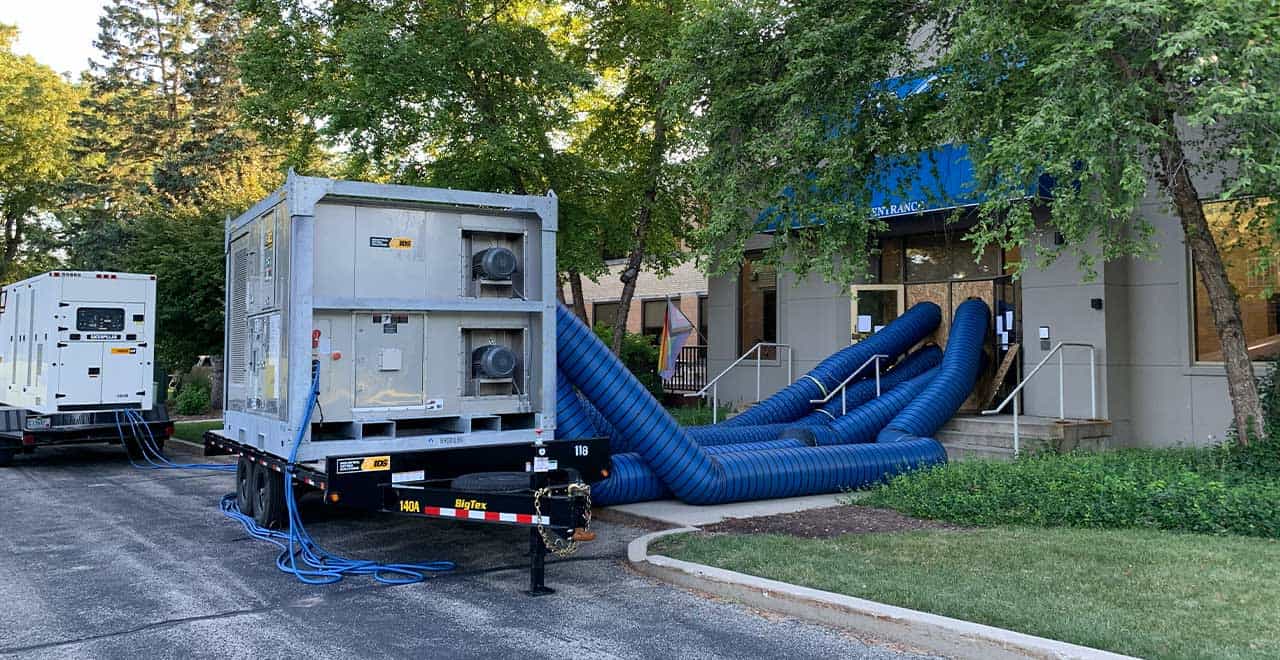
HVAC accessories, including flexible ducting, fluid hoses, and distribution components, complete the temporary installation from the cooling equipment to the spaces being served. Drying equipment addresses humidity control when the cooling failure has allowed conditions to drift outside the acceptable humidity range, alongside temperature. Generators and power distribution equipment support cooling deployments in which the original failure event has also affected the building’s electrical infrastructure.
Permanent cooling equipment replacement carries lead times that can extend for months after a major system failure. Temporary rental equipment eliminates that wait, providing the capacity needed to maintain operations while permanent equipment is sourced, delivered, and installed.
Protecting Edge Sites, Network Rooms, and Smaller Server Environments
The data center cooling planning conversation is not limited to large colocation facilities and enterprise data halls. Regional bank branches, healthcare networks running electronic medical record systems, manufacturing facilities with industrial control systems, and retail operations with point-of-sale and inventory management infrastructure all depend on smaller server rooms and network closets that often have minimal or no redundancy in cooling.
These environments face the same rapid temperature-escalation risk as larger facilities do when their single cooling unit fails. The difference is that they typically have less warning, less monitoring, and less institutional knowledge about how to respond. The floor space and access constraints of a smaller server room also affect equipment selection, because standard portable cooling units need to fit through doorways, be positioned without blocking access to equipment, and exhaust heat through pathways that may be more limited than in a purpose-built data hall.
REIC Rentals deploys compact cooling equipment through standard doorways for IDF and MDF rooms, office server closets, and edge computing sites. A single portable unit deployed to a regional server room can stabilize conditions for VPN gateways, firewall appliances, and core switches within hours of a cooling failure, maintaining connectivity and service availability for the users and systems that depend on that infrastructure.
Monitoring and Coordination During an Active Cooling Event
Temporary climate control is most effective when integrated with monitoring and coordination that provides real-time visibility into conditions across the affected facility and clear protocols for adjusting the response as those conditions change.
REIC Rentals technicians work alongside in-house facility and IT teams using existing monitoring dashboards to track server inlet temperatures, ambient conditions, and humidity throughout the event. Temporary sensors positioned at high-priority rack locations verify that cooling reaches the most critical equipment. Clear communication about who has authority to request capacity changes, how frequently status is communicated, and what thresholds trigger escalation keeps the response coordinated rather than improvised.
Documentation of the temporary cooling configuration, the conditions monitored throughout the event, and the adjustments made as the situation evolved supports post-incident review and informs updates to the emergency preparedness plan. REIC Rentals provides that documentation as part of the engagement rather than leaving it to the facility team to compile independently under pressure.
Scenario: Chiller Failure at an Active Data Center
Consider a data center supporting payment processing and application hosting where the primary chiller plant fails during a summer peak-load period. Server rack heat density is high, and inlet temperatures begin rising immediately after the failure. The facility’s permanent backup cooling system activates but does not have sufficient capacity to maintain safe temperatures under the full summer heat load.
In a facility with an emergency preparedness agreement with REIC Rentals that includes a pre-surveyed site plan documenting power connection points, staging areas, and airflow configuration, the initial call after that failure would initiate deployment logistics rather than site assessment. REIC Rentals would arrive with portable cooling units sized to address the highest-priority server rows, while larger temporary cooling systems are staged and connected to restore capacity across the full facility.
In that outcome, server inlet temperatures return to a safe range before thermal protection systems activate. Payment processing and public-facing services remain online throughout the event. The permanent chiller repair proceeds on its own timeline without the urgency of an active service interruption, forcing decisions that would otherwise be made more carefully. The pre-existing site documentation alone could save hours of deployment time that would otherwise be spent on an assessment that should have happened months earlier.
The difference between that outcome and one where services go offline, hardware is damaged, and SLA penalties accumulate is not the equipment. The equipment is the same in both scenarios. The difference is whether the site knowledge, the response process, and the relationship with REIC Rentals existed before the failure occurred or had to be built from scratch while inlet temperatures were still climbing.
Integrating Temporary Cooling into Long-Term Data Center Resilience
Emergency cooling capability is a component of a data center resilience strategy, not a standalone intervention. Facilities that treat each cooling event as a source of operational learning, updating their emergency plans, expanding their pre-surveyed site documentation, and refining their response procedures based on real experience progressively improve their ability to manage future events.
Including REIC Rentals in formal business continuity and disaster recovery documentation gives the emergency cooling response the same organizational standing as other resilience investments. Joint exercises that simulate HVAC failures and practice the deployment process build familiarity with the response procedure and identify gaps before an actual event reveals them under pressure.
Combining cooling continuity planning with power redundancy planning, including generators and power distribution equipment to support temporary cooling when building electrical infrastructure is affected, yields a more complete resilience posture than either element alone. REIC Rentals supports both and can help integrate the two into a coordinated emergency response plan.
Building the Response Capability Before It Is Needed
Cooling failures do not occur at convenient times. The facilities that manage them with the least impact on operations and users are those that built their response capability before an event made it urgent. Pre-incident site assessments, pre-approved emergency agreements, and familiarity between the facility team and the REIC Rentals response team are all investments that pay their return when the situation demands rapid, coordinated action.
Request a quote or find a location near you to schedule a pre-incident site assessment or establish an emergency response agreement for your data center or critical infrastructure facility. The right time to build that capability is before the first call is made under emergency conditions.
1.888.356.1880 | in**@**ic.com | reic.com
Service You Trust. Equipment You Need.
