
A spiral freezer compressor fails at 2 a.m. in a USDA-inspected poultry plant. Product temperatures begin climbing within minutes. Every minute of uncontrolled heat escalates microbial risk, triggers regulatory scrutiny, and pushes the facility closer to a product hold decision. In food processing, a cooling failure is not a repair ticket. It is an FSMA corrective action, a HACCP critical control point deviation, and potentially a regulatory notification requirement.
Unlike general manufacturing or commercial facilities, food processing plants operate around the clock under hard temperature limits enforced by the FDA, USDA, and major retail customers. When HVAC fails, the consequence extends well beyond comfort. It threatens food safety compliance, product disposition, and the supply chain commitments that food processors have made to customers who depend on continuous product flow.
REIC Rentals supports food processing plants and food storage facilities with emergency and temporary cooling equipment, dehumidification, and generators. This article covers how emergency HVAC rentals reduce downtime in food processing environments, what the regulatory stakes of HVAC failures actually are, and how to build a resilience plan before an event forces it.
The Regulatory and Financial Stakes of HVAC Downtime in Food Plants
Temperature excursions in cold rooms, freezers, or processing areas immediately invoke FSMA preventive controls under 21 CFR Part 117, HACCP plans, and USDA and FSIS directives. Any deviation must be documented, investigated, and in some cases formally reported. The financial exposure is compounding: scrapped raw materials and finished product, overtime labor, expedited freight, and chargebacks from retail or foodservice customers all accumulate rapidly.
Food processing facilities that experience extended HVAC failures face consequences that extend well beyond the repair timeline. A product that crosses temperature thresholds cannot be restored to compliance by cooling it back down. The disposition decision, whether to release, rework, or destroy the affected product, must be documented and defensible to regulators and customers.
The facilities that manage these events with the least financial and regulatory impact are those that have a documented emergency response plan, a pre-arranged rental partner, and equipment specifications in place before the failure occurs. Getting temporary on-site cooling within hours of a failure shrinks the deviation window and the scope of the disposition decision.
How Emergency HVAC Rentals Cut Downtime
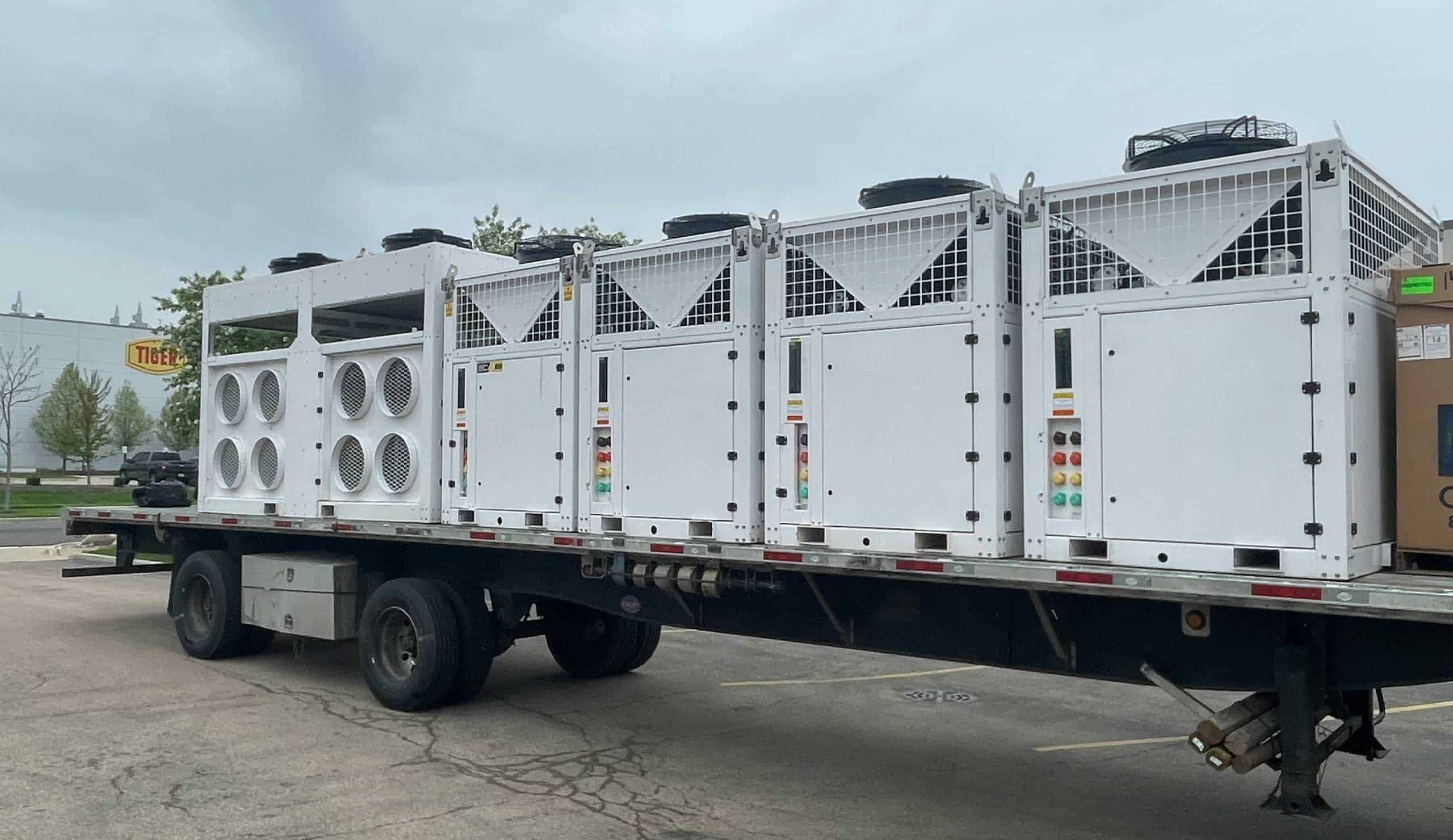
REIC Rentals maintains a ready-to-deploy fleet of temporary cooling equipment, dehumidifiers, and generator support sized for food processing applications. Emergency response follows a clear sequence that moves from initial call to stabilization as quickly as logistics allow.
The initial call establishes the scope of the failure, the size and configuration of the affected space, the urgency level, and the available power and access infrastructure. For facilities with pre-existing site documentation, much of that information is already confirmed, and the call moves directly to deployment logistics. For new sites, a rapid remote assessment establishes what is needed before arrival.
Temporary equipment ties into existing infrastructure through quick-connect hoses, temporary ducting, and plant electrical capacity or rental generators. Solutions can remain in place for days or months during complex repair jobs, equipment lead-time gaps, or planned maintenance windows, providing operational continuity throughout.
Protecting Food Safety and HACCP Critical Control Points
Emergency HVAC rentals directly support critical control points in HACCP and preventive controls plans. Temporary equipment maintains precise temperature thresholds for sensitive zones throughout the outage.
In cold storage, holding raw meat rooms at the required temperature range prevents pathogenic growth during the gap between the failure and permanent repair. In processing areas, temporary cooling maintains jacket cooling on kettles or confectionery tunnel temperatures within required limits. In packaging areas, temporary dehumidification prevents label-adhesion failures and mitigates microbial risk in high-humidity filling halls following a desiccant system failure.
Properly sized temporary equipment that maintains product within validated temperature limits enables more favorable product disposition decisions. A product that remains within the required temperature ranges during a cooling failure requires less investigation and carries a lower risk of rejection or recall than a product that experiences an uncontrolled temperature excursion.
Remote monitoring capability on temporary equipment provides time-stamped temperature data that food safety teams need for FSMA and HACCP audits, demonstrating that critical limits were maintained or promptly restored throughout the event. That documentation is as important as the equipment itself in a regulated food manufacturing environment.
Planning Ahead: Building Emergency HVAC Resilience
The best time to prepare for an HVAC failure in a food processing facility is before it happens. The facilities that respond most effectively to cooling emergencies are those that treat preparedness as a planning discipline rather than a reactive response.
- Create an emergency response plan that includes REIC Rentals contact information, pre-approved equipment lists, and documented connection points for critical zones.
- Conduct a pre-incident site walk with REIC Rentals to map electrical capacity, hose routes, and staging areas for temporary chillers and air handlers.
- Align across departments: production, QA, maintenance, and risk management should all recognize emergency rentals as an approved corrective action within FSMA and HACCP programs.
- Run tabletop exercises simulating HVAC failure during peak production, walking through how emergency calls are handled and how temperature records resume.
- Schedule planned maintenance windows with rental support staged in advance to avoid creating an unplanned event from a scheduled activity.
REIC Rentals supports food processing facilities through pre-incident site assessments that produce the documentation enabling rapid response when an event occurs. Request a quote or visit our food processing industry page to learn more about how REIC Rentals supports food manufacturing operations.
Planned Maintenance: Using Rentals to Protect the Compliance Record
Emergency HVAC rentals are not only for unexpected failures. Planned maintenance windows that take primary cooling offline create the same compliance exposure as an unplanned failure if temporary climate control is not staged before permanent systems come down.
Pre-staging temporary cooling before planned maintenance begins eliminates the temperature excursion window. The temporary equipment has been confirmed operational and is meeting the required conditions before the permanent system is taken offline. The maintenance proceeds on its own timeline. The cold chain and HACCP record show no deviation throughout.
Our teams regularly support food processing facilities through planned maintenance windows, specifically because the regulatory consequences of a temperature excursion during a scheduled outage are the same as during an emergency. A corrective action investigation does not distinguish between planned and unplanned deviations. Managing the environment throughout the maintenance window is what keeps the quality record clean.
Contact REIC Rentals to schedule a site assessment and to build a customized emergency and planned-maintenance HVAC response plan for your food processing facility. Find a location near you to connect with the team supporting food manufacturing operations in your area.
1.888.356.1880 | in**@**ic.com | reic.com
Service You Trust. Equipment You Need.
