
Manufacturing facilities generate heat from within, not just from outside. Ovens, presses, injection molding machines, welding stations, and heavy motors all contribute a continuous internal heat load that exists regardless of the season. When summer ambient conditions add to that load and the existing HVAC cannot keep pace, the result is not discomfort. It is downtime, product loss, equipment failure, and worker health risk. The same outcome can result from an unplanned chiller failure or a scheduled maintenance window that takes central cooling offline during a peak production period.
Temporary cooling provides facilities with a deployable, scalable response to all those scenarios. It is both an emergency tool and a planned strategy for capacity and resilience. REIC Rentals delivers temporary cooling equipment for manufacturing facilities across a range of applications and sizes, with planning support, delivery, setup, and ongoing service across our network.
Why Manufacturing Environments Require a Different Approach
Heat management in a manufacturing facility is a fundamentally different problem from cooling a commercial office or retail space. The internal heat load from process equipment often exceeds the solar gain from the building envelope. A production line running at full capacity near an oven or press generates concentrated heat in specific zones that general HVAC may not adequately address, even when the broader facility is within an acceptable temperature range.
The consequences fall into three categories. Worker safety is the most immediate. OSHA’s enforcement focus on indoor heat hazards has expanded significantly, and engineering controls, including cooling and ventilation, are the preferred intervention before administrative measures are considered. Process and equipment protection is the second. Electronics assembly, food processing, pharmaceutical packaging, and precision manufacturing all require temperature stability that heat spikes undermine, leading to dimensional errors, yield loss, and control system failures. The third is the schedule. Summer heat waves, combined with peak production demand, push existing systems beyond capacity at precisely the time when throughput matters most.
Temporary cooling addresses all three categories. The right equipment, correctly sized and positioned, converts an uncontrolled environment into a managed one.
Targeted Cooling for Specific Zones and Equipment
The most common requirement in manufacturing is not cooling an entire facility. It is controlling conditions in a specific zone, at a specific piece of equipment, or for a specific group of workers. A CNC machining cell, a welding booth, an injection moulding press, an electrical room, a quality control lab, or a packaging line all generate or require specific thermal conditions that are independent of the building’s other needs.
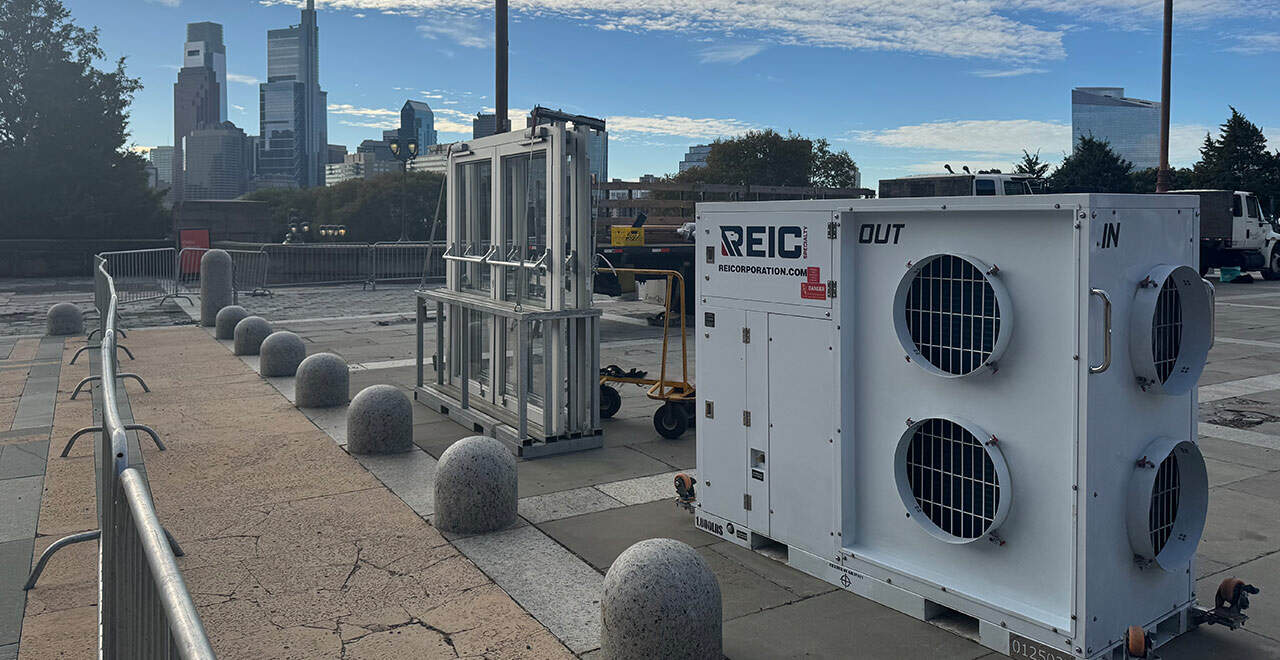
Portable air conditioners deliver targeted cooling by directing conditioned air through flexible ducting to the specific area that needs it. Units can be positioned close to the heat source, with exhaust routed through a doorway, window, or ceiling plenum, and conditioned air directed onto operators or into equipment enclosures, depending on the application. HVAC accessories, including flexible ducting and condensate management components, complete the installation from the unit to the point of use.
Targeted cooling is particularly effective in manufacturing environments where the heat source is localized rather than ambient. A portable air conditioner positioned close to a specific press, welding station, control enclosure, or operator workstation, with flexible ducting directing conditioned air precisely where it is needed, delivers the concentrated cooling effect that a general ambient approach cannot provide efficiently. That configuration is also more energy efficient than attempting to bring the full bay temperature down to address a problem in one zone. REIC Rentals advises on unit placement and duct routing as part of the equipment recommendation, so the conditioned air actually reaches the equipment or operator it is intended to protect rather than dissipating before it gets there.
Correct sizing for targeted cooling in a manufacturing environment requires more than square footage. Machine heat output, ceiling height, existing ambient temperature, proximity to other heat sources, and the available power supply all affect the required cooling capacity and configuration. REIC Rentals reviews those inputs during the planning conversation and recommends equipment sized to the actual conditions rather than applying a residential rule of thumb to an industrial problem.
The power supply is a specific constraint that must be confirmed before equipment arrives. Smaller units may run on a single-phase supply available at most facilities. Larger units require three-phase power at the correct voltage and amperage. Confirming available electrical capacity in advance prevents the situation where correctly specified cooling equipment cannot run because the supply was not planned to support it.
Ambient Cooling for Production Bays and Large Floor Areas
Some applications require reducing the general ambient temperature across a larger area rather than targeting a specific zone. Production bays, warehouse sections, shipping and receiving areas, and large assembly floors all benefit from ambient cooling that improves conditions across the full working environment rather than at a single point.
Larger portable cooling systems distribute conditioned air more broadly, either through front-facing vents across an open floor area or through ducted distribution to multiple delivery points within a large space. Industrial fans complement portable cooling in large-volume spaces by improving air distribution, breaking up heat stratification near high ceilings, and accelerating evaporative cooling for workers across the floor. Well-positioned fans mean the cooling equipment is actually serving the full space rather than creating a comfortable pocket near the unit while conditions in the surrounding area remain unaddressed.
In arid climates and partially open environments, evaporative coolers provide meaningful temperature reduction with lower power requirements than refrigerant-based systems. They draw hot air across water-saturated media to produce a temperature drop suited to open production floors and staging areas where containing conditioned air is not practical. In humid conditions, refrigerant-based cooling is the more reliable choice because evaporative cooling becomes less effective as ambient humidity rises. REIC Rentals advises on which approach suits the facility’s climate and production environment before equipment is specified.
Emergency Cooling During Unplanned HVAC Failures
An unplanned chiller failure or rooftop unit breakdown mid-summer does not allow time for a deliberate planning process. Product spoilage, process drift, control system overheating, and worker heat stress all begin accumulating immediately, and the cost compounds by the hour. The facilities that manage these situations most effectively are those that have an established relationship with a rental partner in advance, know what equipment they would need, and can initiate deployment quickly rather than starting the procurement process from zero during a crisis.
REIC Rentals provides emergency cooling response with same-day or next-day delivery for standard equipment within our service areas. The process begins with a rapid site assessment, either by phone or in person, that translates the failure scenario into a specific equipment recommendation covering type, capacity, placement, and power requirements. Delivery, setup, and commissioning follow as quickly as logistics allow.
The practical preparation for emergency response is the same as for planned cooling: confirm electrical capacity, identify access points for equipment and ducting, and document the critical zones that require priority coverage when the permanent system fails. Facilities that have that documentation in place before an emergency use it to accelerate the response. Those who develop it during the event lose time they cannot recover.
Planned Maintenance Windows and Seasonal Capacity Gaps
Not all temporary cooling needs are emergencies. Scheduled chiller maintenance, rooftop unit replacement, and seasonal production surges that push existing HVAC beyond its rated capacity all create predictable windows in which temporary cooling is needed in advance.
Pre-staging temporary cooling equipment for a planned maintenance window means production does not stop while permanent systems are offline. The temporary equipment is in place and confirmed operational before the permanent system comes down, eliminating the gap an unplanned failure would create. REIC Rentals supports planned outages with pre-delivery coordination that aligns equipment arrival with the maintenance schedule rather than staging equipment before it is needed or scrambling to deploy it after work has already started.
Seasonal capacity gaps are a planning problem rather than an emergency one. Identifying the zones and production periods where existing HVAC consistently falls short during summer peak, and reserving supplemental cooling equipment before the season arrives, is the approach that keeps production running at full capacity through the summer window. Equipment availability tightens during peak summer demand when manufacturing facilities across a region compete for the same rental inventory. Engaging REIC Rentals in spring gives facilities lead time to confirm equipment, plan logistics, and address site-specific constraints before conditions become urgent.
Dehumidification Alongside Cooling
Temperature and humidity are related but separate problems in manufacturing environments. High relative humidity accelerates corrosion in metal components and tooling, compromises electronics assembly processes that depend on stable humidity for repeatability, and creates packaging and material integrity issues in food and pharmaceutical production. Cooling a space reduces its temperature but does not necessarily bring humidity within the range required by process specifications.
REIC Rentals’ drying equipment provides dehumidification alongside cooling for manufacturing environments where humidity is a process requirement rather than just a comfort consideration. The combination of cooling and drying, planned together rather than specified independently, maintains both temperature and humidity within the ranges required by materials, processes, and regulatory requirements throughout the active production phase.
Scenario: Heat Management on an Active Production Line
Consider a manufacturing facility running a press line in August, where ambient temperatures in the production bay are pushing into ranges that affect both worker performance and control system reliability. The existing HVAC system is operating at capacity but cannot meet the combined heat load from the press equipment, summer ambient conditions, and solar gain through the facility’s metal roof.
Targeted portable cooling equipment is positioned around the press line, with flexible ducting directing conditioned air to the operator stations and the control enclosures. Industrial fans improve air circulation across the broader bay, distributing the cooling effect and breaking up the heat stratification that has been accumulating near the ceiling and radiating back down through the shift. Exhaust is routed through an overhead door to prevent hot air from recirculating into the conditioned zone.
When a cooling plan is built around the specific layout, heat sources, and power availability of a facility rather than applied from a standard template, the result is workstation conditions within an acceptable range for sustained production and equipment operating within its thermal design limits. That outcome is what a site review conversation with REIC Rentals before equipment is specified is designed to produce, because the right deployment solves the actual problem rather than approximating a solution based on general assumptions about what the facility requires.
Sector-Specific Applications
Temporary cooling requirements in manufacturing vary by sector and by the demands of the production process. Food processing plants and food storage facilities require temperature control that meets food safety regulatory requirements across both production and storage areas, with no tolerance for excursions during planned or unplanned outages. Petrochemical and refinery operations manage process heat in environments where ambient summer conditions compound internal heat generation and where control room and instrumentation cooling is a reliability requirement. Oil and gas facilities in remote locations require cooling that can be deployed independently of permanent infrastructure.
Mining operations require cooling and ventilation in enclosed processing areas and equipment rooms, where heat accumulates due to inadequate natural airflow. Coating and curing operations require controlled temperature and humidity conditions during application and cure windows that summer ambient conditions cannot reliably provide without mechanical intervention. Power stations require cooling for control rooms and critical equipment areas during planned maintenance outages when permanent systems are partially offline.
Planning with REIC Rentals
Effective temporary cooling for manufacturing starts with understanding the facility’s specific heat loads, critical zones, power constraints, and the production schedule that determines when cooling is needed and for how long. REIC Rentals conducts site assessments, either in person or through plan review, that translate those inputs into an equipment recommendation covering cooling type, capacity, placement, power requirements, and exhaust routing before any equipment is deployed.
Flexible rental terms align with actual production needs. Short-term rentals address emergency failures and brief maintenance windows. Longer-term seasonal agreements cover the full summer peak without the carrying cost of permanent equipment that sits underutilized through the cooler months. Request a quote or find a location near you to start planning for your facility’s summer cooling needs.
Keeping Production Moving When Heat Would Otherwise Stop It
Temporary cooling for manufacturing is operational infrastructure, not a last resort. The facilities that sustain production through summer heat events, planned HVAC outages, and emergency failures are the ones that treat cooling as a planned element of their operational strategy rather than a problem to solve after conditions have already affected output.
REIC Rentals provides the cooling, drying, and HVAC accessories needed for temporary manufacturing climate control, backed by planning support and on-site service across our network. Explore the full HVAC range or request a quote to build a cooling plan before production demand makes it urgent.
1.888.356.1880 | in**@**ic.com | reic.com
Service You Trust. Equipment You Need.
