
Mid-January, temperatures below 20 degrees Fahrenheit, a central boiler plant serving 30 buildings trips offline. Residence halls housing thousands of students begin losing heat within hours. Research labs with active experiments drift toward unsafe temperature ranges. Administrative offices go cold ahead of a critical enrollment deadline. This is the operational reality that university facilities teams face when a central heating outage occurs during the academic year, and it is the scenario that temporary heating exists to manage.
University campuses cannot pause. Students need safe, warm housing. Research cannot tolerate thermal swings that compromise months of ongoing work. Administrative and IT operations depend on stable environments. When central heating goes offline, whether planned or unplanned, the facilities team needs temporary heating that is in place, operational, and performing before conditions in occupied buildings become a safety issue.
REIC Rentals provides rapid-deployment temporary heating for university and institutional campuses, with indirect-fired heaters for building-wide applications and the exclusive Jet Heat flameless system for sensitive, high-risk, and flame-restricted environments. This article covers the heating challenges specific to campus central plant outages and how to plan a temporary heating deployment to keep every building type operational throughout the event.
How Campus Central Heating Systems Create Outage Risk
Most large university campuses operate centralized heating plants, steam or high-temperature hot-water boilers feeding a district loop that distributes heat to multiple buildings through underground pipes. A single plant may serve 10 to 50 buildings of different types simultaneously. When that plant goes offline, the impact cascades across every building on the loop.
Planned outages give facilities teams time to prepare. A scheduled boiler tube replacement, a pump overhaul, or a planned pipe repair can be communicated to building users in advance, and temporary heating can be staged before the primary system goes down. Unplanned failures do not offer that luxury. In early 2024, a crack in a high-temperature hot-water line forced a major university to shut off heat and hot water across a large portion of its campus with minimal warning. In early 2026, a campuswide steam outage at another major university disrupted heat and hot water in all residence halls for an extended period, prompting the establishment of emergency warming centers and drawing attention from institutional leadership.
The risk extends beyond comfort. Unheated buildings in cold weather risk frozen water-based systems in mechanical spaces. Research labs with active cultures, specimens, or sensitive instrumentation face thermal stress that can compromise months of ongoing work. Animal research facilities have specific temperature requirements that are regulatory obligations rather than comfort preferences.
Different Buildings, Different Requirements
The most significant challenge in campus temporary heating is that the buildings on a district loop do not all have the same temperature requirements, occupancy patterns, or tolerance for noise and disruption from heating equipment.
Residence halls housing students require conditions similar to a home environment, typically 68 to 72 degrees Fahrenheit, with 24-hour occupancy and low tolerance for noise, drafts, or combustion odors from heating equipment positioned near occupied rooms. Students are present around the clock and have limited capacity to self-manage exposure to cold conditions.
Research labs often require tighter temperature control than residence halls: ambient temperatures held within a narrow range, strict humidity limits, and supply air free of combustion byproducts that could compromise ongoing experiments, cultures, or sensitive instrumentation. For labs with active work, a temperature deviation is not an inconvenience. It is a research loss.
Administrative offices and classrooms tolerate wider comfort ranges but carry institutional urgency. Disruptions to enrollment operations, financial aid processing, or exam periods pose institutional risks that extend well beyond physical discomfort. The building matters, but so does the activity happening inside it.
REIC Rentals designs temporary heating layouts building by building, mapping setpoints and load profiles rather than applying a single approach across a campus with fundamentally different space types and occupancy requirements.
Indirect-Fired Heaters for Building-Wide Campus Applications
Indirect-fired heaters use fuel to heat air through a heat exchanger, with combustion gases vented outdoors. The result is clean, dry air delivered indoors without CO, moisture, or combustion byproducts. For residence halls, libraries, administrative buildings, and classroom spaces, indirect-fired equipment is the appropriate choice because it eliminates the indoor air quality concerns associated with direct-fired units in continuously occupied spaces.
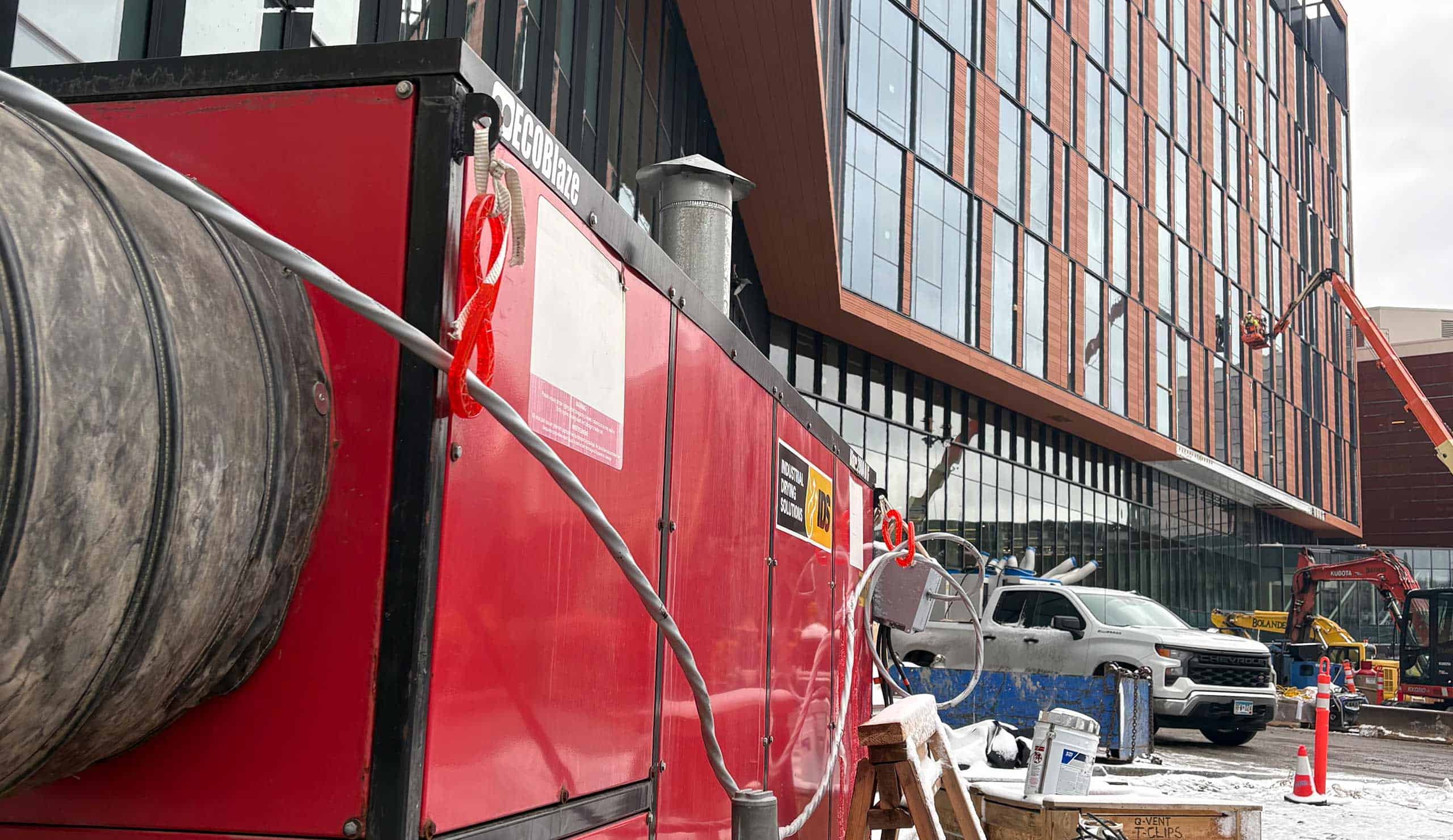
REIC Rentals deploys indirect-fired heaters at the campus scale by positioning units outside buildings and ducting heated air into mechanical rooms, existing distribution manifolds, or directly into building spaces via insulated, flexible ductwork. A large residence hall may require multiple high-output units positioned at different access points to maintain consistent conditions across all occupied floors. A classroom building undergoing a planned boiler replacement may need units feeding into existing distribution points that connect to the building’s fan-coil or air-handling units.
Fuel type selection for campus applications, natural gas where utility connections are accessible, diesel or propane where they are not, depends on site access and cost. Noise management near residence halls requires attention to equipment placement and acoustic mitigation for units positioned adjacent to occupied building perimeters. REIC Rentals addresses those requirements as part of the equipment specification rather than as field adjustments after the equipment is already on site
Jet Heat Flameless Technology for Sensitive Campus Environments
REIC Rentals’ exclusive Jet Heat flameless system delivers dry heat with no open flame and no combustion emissions, making it appropriate for campus environments where open-flame equipment is prohibited or where the building or its occupants require the cleanest possible air supply. Historic buildings where flame restrictions apply, data centers and server rooms where emissions cannot be tolerated, research labs with chemical storage or active biological work, and archival facilities where temperature-sensitive collections require stable conditions all benefit from flameless technology over indirect-fired alternatives.
Jet Heat units deliver high BTU output with long-distance ducting capability, with airflow rates confirmed at 3,900 to 7,200 CFM and fuel consumption as low as 2.9 gallons per hour per unit. That output and efficiency make Jet Heat practical for large building applications where the unit must be positioned away from the building it serves. A multi-million-dollar cryogenics lab, a museum collection storage facility, or a sensitive animal research building can be served from equipment staged in a nearby parking lot or service area, eliminating any exposure of the building’s occupants or contents to combustion equipment.
Planning for Scheduled Campus Central Plant Maintenance
Planned outages give facilities teams the planning lead time that emergency failures do not. Engaging REIC Rentals three to six months before a scheduled outage produces a temporary heating deployment engineered for the actual campus load, rather than assembled under time pressure with whatever is available.
The planning process covers load assessment by building, evaluation of campus fuel access and electrical availability, and identification of priority buildings, including residences, research facilities, and health clinic spaces that cannot tolerate any gap in heating coverage. Pre-outage site walks confirm equipment access paths, duct penetration points, and weatherproofing details before equipment arrives.
Integration with the maintenance timeline is essential. REIC Rentals coordinates with mechanical contractors and plant shutdown schedules to bring temporary heating online before valves close and primary systems are isolated. A temporary heating deployment that becomes operational after the primary system has already gone down allows conditions in occupied buildings to deteriorate before the response is ready.
Budget considerations for planned campus outages favor engaging REIC Rentals early. Equipment availability during peak winter demand is constrained across regional markets when multiple institutional facilities compete for the same rental inventory. Facilities teams that confirm equipment in advance have more options, better logistics, and lower total costs than those who initiate the process once the outage window is already open.
Emergency Response When the System Fails Unexpectedly
Unplanned central heating failures at universities demand a response that moves at the speed the situation requires. A boiler failure during a cold snap, a frozen distribution loop, or a control system failure in January leaves facilities teams with hours, not days, to restore heating in occupied buildings.
REIC Rentals supports emergency campus heating response with 24/7 dispatch capability and pre-staged equipment. The initial call covers estimated building square footage and occupancy, current indoor and outdoor temperatures, fuel and electrical access, and priority building identification. That information drives equipment specification and deployment sequencing, so the highest-risk buildings receive heating first, while logistics for the remaining buildings are coordinated in parallel.
Triage matters in a campus emergency. Residence halls where students cannot be safely left without heat for extended periods, animal research facilities with regulatory temperature requirements, and health services buildings with patient populations take priority over administrative buildings where operations can be temporarily suspended. REIC Rentals supports that prioritization decision by confirming equipment availability and deployment sequencing against the actual load requirements of each building.
Safety and Compliance on Occupied Campuses
Deploying temporary heating on an occupied university campus requires compliance with fire codes, occupational health standards, and campus-specific safety policies that extend beyond standard construction-site requirements.
Combustion air intake and exhaust routing for indirect-fired units must prevent any recirculation of combustion gases into occupied building spaces. CO monitoring is required in enclosed spaces adjacent to fuel-fired equipment. Fuel storage requires setbacks and secondary containment, particularly near residence hall entries and pedestrian routes with high student traffic.
Equipment placement near residence halls must account for noise during study periods, exam weeks, and overnight hours when sleep disruption becomes a student welfare issue. REIC Rentals plans equipment location and operation schedules with campus operations teams rather than treating noise management as a field adjustment after equipment is already running.
Communication protocols with campus operations centers, student affairs offices, and facilities leadership keep all stakeholders informed throughout an outage period. Students and faculty who receive accurate, timely information about heating restoration timelines find the process significantly more manageable than those who discover conditions have changed without warning.
Contact REIC Rentals before your next scheduled central plant maintenance outage or add REIC Rentals’ 24/7 contact information to your campus winter emergency response plan. Request a quote or find a location near you to connect with the team supporting educational institutions in your area.
1.888.356.1880 | in**@**ic.com | reic.com
Service You Trust. Equipment You Need.
