
A lithography stepper fogs when moisture reaches its precision optics. A metrology tool drifts when humidity induces mechanical creep. A vacuum pump corrodes when condensation forms on cold surfaces in an uncontrolled sub-fab. These are not edge-case scenarios. They are documented failure modes that seasonal humidity swings produce in semiconductor facilities every year, across every climate where fabs operate.
Semiconductor manufacturing operates within some of the tightest environmental tolerances in any industry. The cleanroom may hold specifications, but the mechanical rooms, sub-fabs, tool chases, and chemical storage areas surrounding it frequently experience uncontrolled conditions. Cold surfaces drop below the dew point overnight. Warm, moist outdoor air infiltrates during deliveries. The result is condensation, corrosion, and contamination in zones that feed directly into process-critical space.
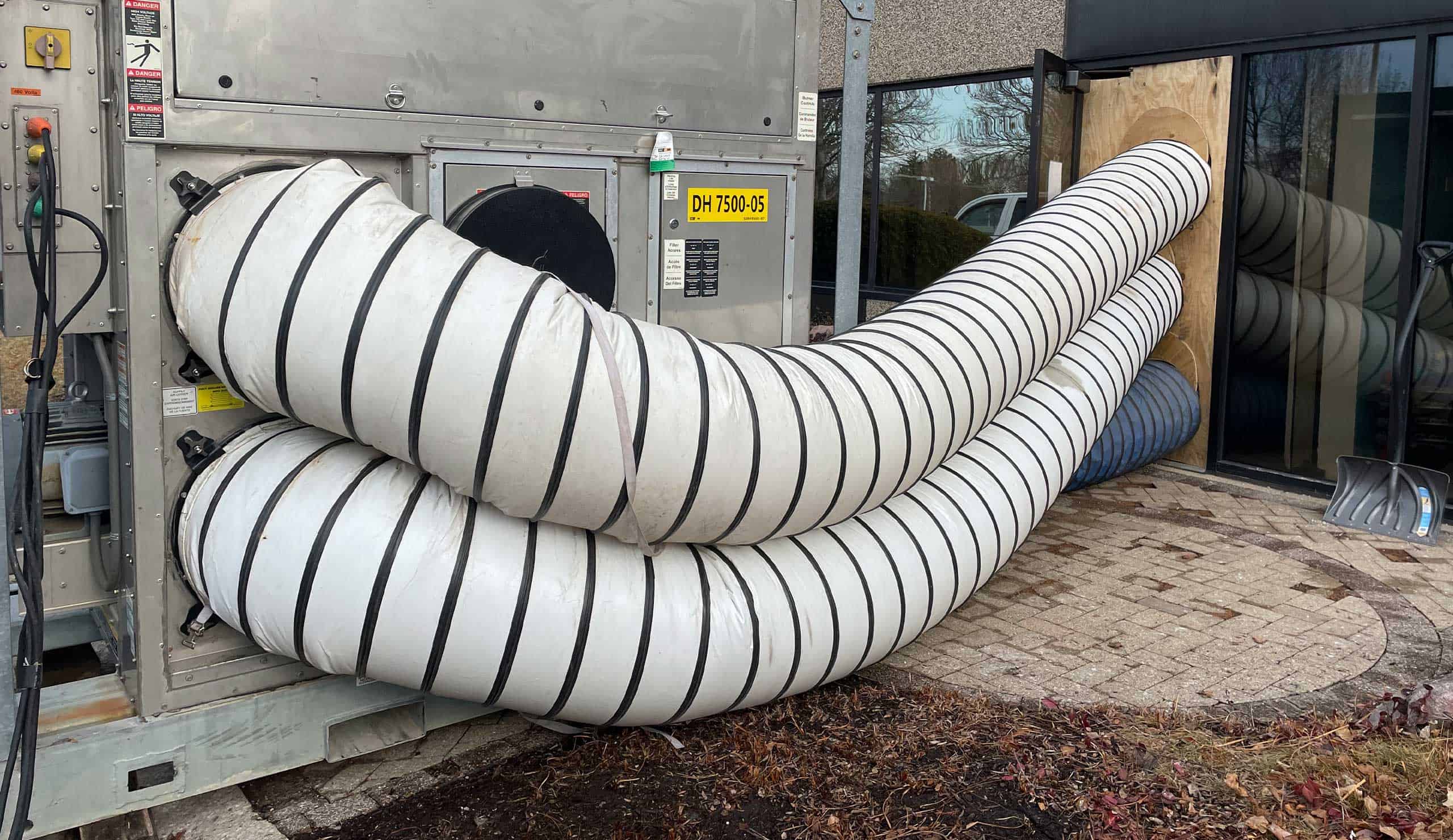
REIC Rentals provides precision dehumidification and drying equipment, temporary cooling, and HVAC accessories for semiconductor fabrication facilities, cleanroom construction phases, and tool staging environments. This article covers the seasonal moisture risks that threaten critical equipment, how those risks vary by climate and facility zone, and how to build a year-round moisture protection strategy.
Why Seasonal Moisture Is Different in a Fab
The cleanroom floor receives most of the environmental control attention in a semiconductor facility. But seasonal moisture problems almost always originate in the zones surrounding it: sub-fab levels and utility corridors where chilled water and process piping run through unconditioned air, roof-mounted mechanical plants exposed to rain and temperature swings, chemical and gas storage areas with minimal climate control, and temporary expansion spaces built ahead of permanent HVAC commissioning.
Understanding moisture risk in a fab starts with the dew point rather than relative humidity. Relative humidity shifts with every degree of temperature change. Dew point stays fixed for a given moisture content, making it a far more reliable indicator of condensation risk on cold surfaces in sub-fabs and tool chases. Fab teams that continuously monitor dew point across all zones catch seasonal problems before they lead to yield events. Those who track only relative humidity on the cleanroom floor frequently discover peripheral problems only after damage has occurred.
Seasonal changes swing outdoor conditions from extremes that stress building systems in ways unique to semiconductor fabrication. The Pacific Northwest delivers persistent damp winters with a continuous risk of condensation on cold surfaces. The Mountain West experiences dry winters with a high risk of electrostatic discharge and wet springs with rapidly changing dew points. Fabs built on compressed construction timelines may undersize dehumidification for worst-case seasonal loads, particularly in temporary or satellite clean spaces where permanent environmental control is not yet commissioned.
How Seasonal Moisture Damages Critical Equipment
Seasonal moisture does not simply make things damp. It activates specific failure mechanisms that degrade tools, infrastructure, and yield in ways that are difficult to trace back to their environmental origin once they appear.
Elevated moisture triggers oxidation on copper traces, bond pads, connectors, and backplane contacts. Contact resistance rises, signal paths become unstable, and intermittent failures multiply across systems that tested clean before the humid season arrived. In high-voltage distribution systems feeding process tools, humidity reduces dielectric strength, increasing the risk of electrical failure without producing an obvious warning before failure occurs.
Moisture that condenses on projection lenses and mirrors inside lithography steppers causes imaging fog and degrades overlay performance. Stage encoder errors compound the problem under repeated thermal and humidity cycling. CD-SEMs, atomic force microscopes, and profilometers suffer mechanical creep and dimensional instability as humidity shifts, producing measurement drift that may be attributed to tool calibration before the environmental cause is identified.
O-rings, HEPA gaskets, and epoxy assemblies absorb moisture and swell, compromising seal integrity and creating leakage paths in vacuum systems that were not present at installation. During facility expansions, equipment stored in less-conditioned staging rooms accumulates corrosion that is invisible until the tool powers up, sometimes weeks after the environmental exposure that caused it.
Moisture Control Beyond the Cleanroom Envelope
A layered moisture protection approach addresses each zone from the outside inward: building shell, mechanical plant, sub-fab, tool enclosure, and wafer environment. The zones most commonly neglected are the middle layers, where chilled water piping, electrical distribution, and process support equipment operate in spaces designed for utility functions rather than tight environmental control.
Insulating pipes prevents condensation on the surfaces of chilled water lines in sub-fabs and mechanical rooms. Positive pressure differentials keep unconditioned outdoor air from migrating inward through dock doors and construction penetrations. Vestibules and airlocks between outdoor docks and clean areas reduce infiltration of moist outdoor air during tool deliveries and material handling.
REIC Rentals operates at the middle layers of this protection chain, providing dehumidification equipment for staging areas and expansion bays, temporary cooling for tool commissioning environments, and HVAC accessories, including ducting and monitoring components, that extend environmental control into zones that permanent systems do not reach.
Protecting Tools, Materials, and Equipment in Transit and Storage
Cross-climate transport exposes semiconductor tools, spare parts, and wafers to intense moisture cycles. Shipping a tool from a humid coastal market to a high-altitude inland fab subjects it to condensation, thermal cycling, and corrosion at every transfer point. Damage that occurs during transit and storage often goes undetected until the tool is powered up weeks later.
Transit protection practices that reduce moisture exposure include vapor-barrier wrapping, sealed crates with desiccant packs, humidity indicator cards for visual verification on arrival, and vapor corrosion inhibitors on exposed metal surfaces during extended transit. On-site storage should keep equipment off concrete floors, which wick ground moisture upward into packaging and crate bases. Climate-controlled storage maintains controlled conditions for spare tools, parts, and wafer stock that would otherwise degrade in unheated warehouses during cold months.
REIC Rentals provides temporary, humidity-controlled staging environments that can be deployed in parking lots or unused pad space adjacent to active fabs during expansions or high-volume tool installations. That capability keeps sensitive materials in a controlled environment from dock to tool hookup, eliminating the exposure window between delivery and permanent installation.
Seasonal Operating Adjustments
Fabs that document seasonal operating procedures as standard practice maintain more consistent yield than those that respond to moisture events reactively.
During cold weather, very dry outdoor air can drop cleanroom relative humidity below safe thresholds if makeup air is not humidified, increasing the risk of electrostatic discharge. Cold surfaces in unheated chases accumulate condensation from indoor moisture when humidifiers raise indoor humidity. Equipment should be allowed to warm gradually before activation to manage thermal differentials that cause condensation on optics and electronic components.
During periods of high humidity in spring and after summer precipitation events in the Mountain West and Pacific Northwest, latent loads strain air-handling units and chilled-water systems. Increased condensation risk on chilled lines demands verified insulation integrity. Shoulder seasons, when rapid day-to-night temperature swings cause repeated dew-point crossings, require overnight HVAC operation to prevent cold-soaking of internal surfaces that accumulate moisture during low-traffic periods.
Monitoring Systems: Detecting Problems Before They Reach Yield
Protecting critical equipment from seasonal moisture changes requires visibility across every zone, not just the cleanroom floor. Building automation systems should track temperature, relative humidity, and dew point in mechanical rooms, makeup air handlers, tool chases, and sub-fabs, as well as in the cleanroom itself. Electrical rooms, chemical storage areas, and temporary cleanroom annexes are frequently unmonitored and represent the zones where seasonal relative humidity spikes first appear.
Trend analysis of a full year of environmental data frequently exposes recurring seasonal events: elevated relative humidity for multiple nights each spring, correlating with corrosion events in a specific bay or tool type. That pattern is not visible in point-in-time readings but becomes actionable when continuous monitoring data is reviewed with seasonal context.
One challenge our teams regularly help semiconductor facility engineers navigate is extending monitoring coverage into temporary spaces and expansion bays without requiring integration work that delays the construction schedule. Wireless sensors deployed in REIC Rentals dehumidification deployments can feed directly into a facility’s central monitoring dashboard, eliminating blind spots in temporary zones.
Maintenance and Inspection Playbooks
Consistent moisture protection requires documented routines, not just installed equipment. The fabs that hold yield through seasonal transitions are the ones that treat moisture management as a standing operational discipline rather than a response to visible damage.
Before winter:
- Inspect insulation on pipes, ducts, and cold-zone penetrations.
- Verify anti-condensation heater operation in electrical cabinets.
- Check the building envelope for air leaks at doors and panel joints.
- Confirm humidifiers are functional, clean, and calibrated.
Before high-humidity season:
- Test dehumidifier units: filters, desiccant wheels, and condensate drains.
- Verify envelope sealing around dock doors and loading areas.
- Inspect corrosion-prone sub-fab areas around chilled water piping.
- Calibrate makeup air systems for peak latent load conditions.
Quarterly:
- Calibrate relative humidity and dew-point sensors across all critical and support zones.
- Verify surface temperature differentials in tool chases and mechanical rooms.
- Inspect tool enclosures, crate seals, and panel penetrations for moisture ingress.
A moisture risk register that maps every vulnerable tool and space to specific seasonal triggers and documented responses is what converts these routines into a controlled discipline. When outdoor dew point crosses a defined threshold, the playbook prescribes a response. When a seasonal transition begins, the checklist runs. Damage is not the trigger. The calendar is.
Contact REIC Rentals to discuss moisture-protection requirements for your next semiconductor facility expansion, tool-staging project, or cleanroom construction phase. Request a quote or find a location near you to connect with the team supporting semiconductor and cleanroom projects.
1.888.356.1880 | in**@**ic.com | reic.com
Service You Trust. Equipment You Need.
