
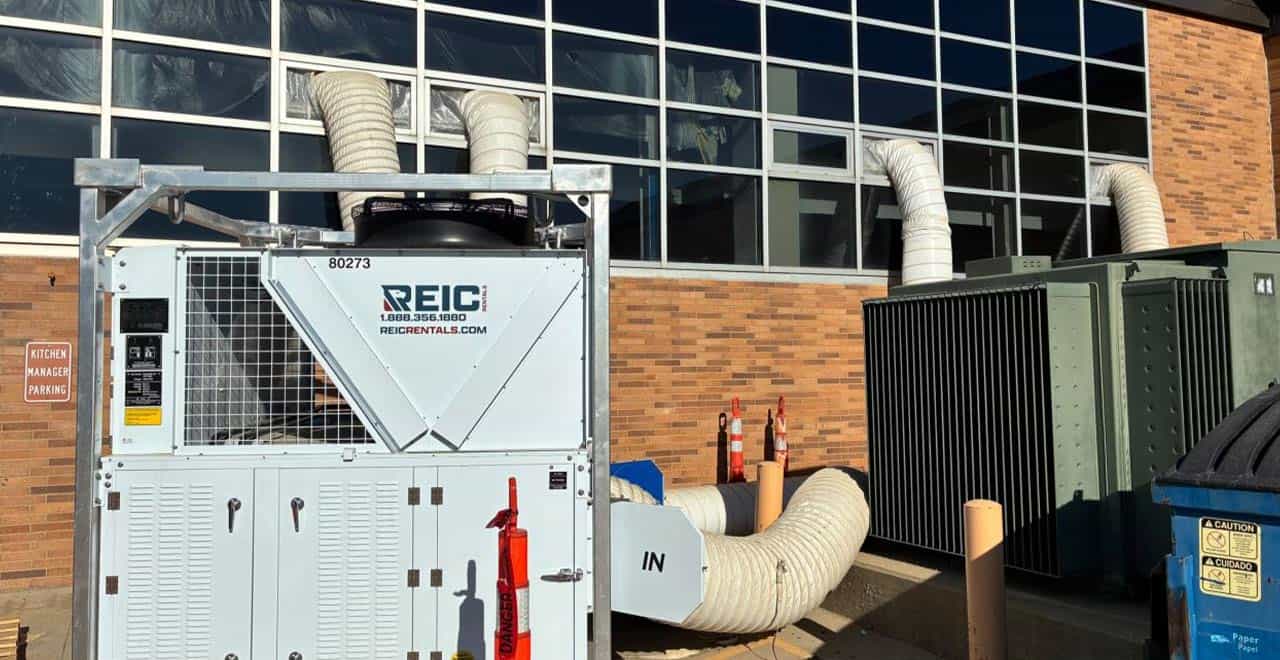
When permanent HVAC systems go offline in occupied buildings, whether for planned maintenance, equipment replacement, or the commissioning of new systems, the window to maintain safe, productive conditions is short. Indoor temperature climbs within hours. Sensitive equipment, occupant comfort, and project timelines are all at risk simultaneously. Temporary HVAC is what bridges that gap.
The challenge in occupied buildings is more complex than in vacant construction spaces. People are present and working. Patients are receiving care. Researchers are running experiments. Temperature and humidity tolerances are tighter, the consequences of failure are higher, and the tolerance for disruption is lower. Managing those conditions requires equipment that is correctly sized, correctly positioned, and deployed in accordance with a plan that accounts for the building’s contents and the project’s requirements.
REIC Rentals provides temporary HVAC solutions for occupied buildings undergoing renovations, retrofits, and commissioning work. Our cooling, heating, and drying equipment, as well as HVAC accessories, including ducting and distribution components, are available as integrated systems tailored to the specific requirements of each project. This article covers when temporary HVAC is needed in occupied buildings, how to plan for it effectively, and how it supports facility commissioning without disrupting building operations.
When Temporary HVAC Is Needed in Occupied Buildings
Planned shutdowns of permanent HVAC systems create the most predictable and manageable temporary HVAC scenarios. A chiller replacement, a rooftop unit swap, or an air handling unit refurbishment all require taking permanent capacity offline for a defined period. The length of that period determines the urgency of the temporary solution, but in an occupied building during summer, even a short outage requires a plan.
The trigger for temporary HVAC is not simply the absence of permanent cooling. It is the gap between what the building needs to remain safe and functional and what the remaining permanent systems can provide during the outage. A large building with multiple chillers may be able to manage a short, planned outage by redistributing load across the remaining capacity. A smaller facility, or one where the full cooling system is being replaced, has no such buffer and requires temporary equipment from the moment the permanent systems come down.
Emergency failures during peak cooling demand create the most urgent scenarios. A compressor failure or refrigerant leak during a heat wave can push occupied spaces above acceptable temperature thresholds within hours. The organizations that manage these situations with the least disruption are those that have established a relationship with a rental partner in advance, know what equipment they would need, and can initiate deployment quickly, rather than starting the planning process from zero during a crisis.
Critical environments require the most immediate response. Server rooms and data centers tolerate very short cooling interruptions before equipment begins to throttle or shut down. Healthcare spaces, laboratories, and pharmacies operate within tightly defined temperature and humidity ranges that carry both regulatory and operational implications. These environments should have documented temporary HVAC plans before any planned work begins. REIC Rentals supports data centers, hospitals and healthcare facilities, food processing plants, and government buildings with temporary climate solutions tailored to their requirements.
Why Permanent Systems Should Not Be Used for Temporary Conditioning
Using permanent ductwork and air handling equipment to provide conditioning during construction phases creates risks that are not always visible until well after the project closes. Construction activity generates dust, particulates, VOCs from adhesives and coatings, and other contaminants that, when drawn through permanent ductwork, contaminate the system and potentially distribute those contaminants to occupied areas throughout the building even after construction is complete.
Industry guidance advises against using permanent HVAC systems for conditioning during active construction precisely because of these contamination risks. The cost of cleaning or replacing contaminated ductwork and air handling components after the fact regularly exceeds what temporary equipment would have cost during the active phase. And discovering the contamination after commissioning is complete, when the permanent system has already been tested and signed off, is a worse outcome still.
Temporary HVAC equipment deployed for the construction and commissioning phase keeps the permanent system isolated until it is ready to be tested and commissioned in its final state. That isolation is what allows commissioning to proceed against a known baseline rather than trying to verify system performance in equipment that has already been compromised by construction conditions.
Planning Temporary HVAC: Starting Before the Work Begins
Effective temporary HVAC planning starts well before any shutdown. The inputs needed to size and position equipment correctly are available during the planning phase: the occupied zones that will be affected, the temperature and humidity ranges those zones require, the heat load from occupants and equipment, the duration of the outage, and the power and physical infrastructure available for temporary equipment. Gathering those inputs during the planning phase produces a deployment that works as intended. Gathering them under time pressure during an emergency produces guesswork.
Identifying critical zones within the building is the first step. Not all occupied spaces have the same tolerance for temperature variation. Server rooms and data closets have very tight limits. Patient care areas require precise control. Office floors can tolerate somewhat wider ranges before occupancy becomes untenable. Mapping those zones and their requirements against the planned outage scope determines where temporary equipment must be deployed and at what capacity.
Infrastructure verification is as important as equipment selection. Temporary cooling equipment requires power, and the power supply must match the equipment’s requirements to operate correctly. Condensate drainage from cooling equipment must be routed to appropriate drainage points rather than accumulating in equipment rooms or on floor plates. Physical access for delivery and duct routing must be planned in advance rather than resolved on the day equipment arrives. REIC Rentals handles these logistics as part of the pre-deployment planning process to ensure the installation proceeds without delay.
Power coordination is a recurring constraint on temporary HVAC deployments. When the existing building’s power cannot support the temporary cooling load, generators provide the necessary supply. Coordinating cooling and generator requirements through a single conversation with REIC Rentals ensures both systems are sized to work together from the start. Power and lighting accessories, including distribution equipment, route power from the generator or existing supply to temporary cooling units across the building.
Equipment Selection for Occupied Building Conditions
Occupied buildings require temporary HVAC equipment that delivers conditioned air cleanly, quietly enough to allow normal work, and without introducing contaminants from external sources. REIC Rentals’ cooling equipment includes portable air conditioners suited to occupied office, healthcare, and institutional environments, as well as evaporative coolers for appropriate climate conditions and industrial fans for supplemental air movement. HVAC accessories, including insulated flexible ducting, distribute conditioned air from central equipment to the specific zones that need it without running new permanent infrastructure.
Ducting enables temporary HVAC systems to operate across complex floor plates. A portable cooling unit at the perimeter does not meaningfully affect interior zones without ductwork that routes conditioned air to where occupants are actually working. Properly sized and insulated flexible ducting maintains the temperature of that air from the unit to the delivery point, ensuring occupied zones receive the conditioning the equipment is capable of providing.
When both moisture and temperature are challenging, drying equipment provides dehumidification alongside cooling. In healthcare spaces, laboratories, and environments where humidity is a specification requirement rather than just a comfort consideration, relative humidity matters as much as temperature. REIC Rentals advises on the combination needed to maintain both within the required ranges simultaneously.
Intake placement is equally important. Temporary equipment intakes positioned near exhaust fans, loading docks, or active construction zones draw contaminants directly into the conditioned air stream and distribute them through the building. Equipment that is incorrectly positioned can introduce the very contaminants it is supposed to exclude. REIC Rentals reviews intake placement during the planning process rather than leaving it to be resolved on delivery day.
Pressure Relationships and Air Quality in Occupied Spaces
Occupied building zones undergoing renovation or commissioning work require controlled pressure relationships to prevent construction contaminants from migrating into areas where people are working. Maintaining positive pressure in occupied zones, where supply air exceeds exhaust, creates an outward pressure differential that prevents dust and fumes from infiltrating through doors and partition gaps from adjacent construction areas.
Construction zones adjacent to occupied areas should be maintained at negative pressure, where exhaust exceeds supply, to contain contaminants within the work area and route them out of the building through controlled pathways. The combination of positive pressure in occupied zones and negative pressure in construction zones provides a contamination barrier that maintains acceptable air quality for occupants without halting active construction.
Temporary barriers between construction and occupied zones are only as effective as the pressure relationships behind them. A partition that is not backed by controlled airflow can be breached by a door opening, a gap in the sheeting, or a pressure reversal caused by a change in the ventilation configuration. The barrier is visible. The pressure differential that makes it work is not, which is why verifying and maintaining it throughout the active phase matters as much as installing it correctly on day one.
Temporary HVAC in Facility Commissioning
Facility commissioning verifies that building systems perform as designed before handover. For HVAC systems, that means testing controls, verifying airflow, and confirming temperature and humidity performance under realistic load conditions. Temporary HVAC supports that process in two ways: it maintains occupied zones while permanent systems are tested section by section, and it creates the load conditions that allow commissioning to proceed against summer design conditions rather than whatever the outdoor temperature happens to be on the day of testing.
Phased cutovers, where permanent capacity comes online zone by zone, require temporary equipment to maintain conditions in areas not yet served by the commissioned system. REIC Rentals participates in that coordination, adjusting temporary configurations as permanent capacity comes online to avoid coverage gaps and conflicts between systems running simultaneously.
Runtime hours, performance records, and equipment condition data from the temporary deployment are provided at project closeout. REIC Rentals Expert Solutions integrates temporary climate equipment with the broader commissioning schedule for major scopes.
Scenario: Chiller Replacement in an Occupied Medical Office Building
Consider a multi-story medical office building scheduled for chiller replacement during the summer. The building houses outpatient clinics, imaging suites, and administrative offices, all of which remained occupied throughout the replacement window. The permanent chiller will be offline for several weeks, during which the building will have no central cooling.
The temporary cooling plan must maintain acceptable temperature and humidity in all occupied zones throughout the outage. Portable cooling equipment is sized to cover the full building cooling load, with ducting routed from equipment staged at ground level or on the roof to the occupied floors above. Power requirements are confirmed against the building’s electrical infrastructure in advance, with temporary generation staged if the existing supply cannot support the full temporary load.
Intake placement is confirmed away from the loading dock and the construction staging area, where chiller removal is active. Pressure relationships are established to keep construction zone contaminants out of the clinical areas. Condensate drainage is routed to building sanitary connections rather than floor drains in clinical areas where standing water is a compliance issue. The commissioning team confirms temporary system performance before the permanent chiller comes offline, so the transition does not leave the building without cooling.
REIC Rentals supports this kind of coordinated deployment by reviewing the specific requirements of the building and the project before equipment is specified, and by staying engaged throughout the active phase to adjust as conditions change. That approach is the difference between a temporary HVAC deployment that works as planned and one that requires field problem-solving under time pressure in an occupied clinical environment.
Sector-Specific Applications
Temporary HVAC requirements vary significantly by sector. Hospitals and healthcare facilities require continuous control within tightly defined ranges, with filtration that prevents construction particulates from entering patient care areas. Data centers require immediate cooling response when primary systems fail to prevent thermal throttling or shutdown. Education facilities need comfortable conditions maintained while permanent systems come online during summer programs.
Commercial office and retail tenants expect minimal disruption during HVAC replacement. Hotels and resorts face the added pressure of guest-facing standards, where temperature directly affects their reputations. Food processing plants and food storage facilities must meet regulatory food safety requirements whenever permanent systems are offline.
Planning Timeline: When to Engage REIC Rentals
For planned HVAC outages and commissioning projects, the planning conversation with REIC Rentals should begin well before the work starts. The lead time required depends on the scale of the temporary system, the complexity of the building, and whether the project involves straightforward portable cooling or a coordinated multi-zone deployment with power and distribution infrastructure.
Early engagement allows equipment availability to be confirmed before the project schedule is locked, infrastructure requirements to be identified and addressed before delivery day, and duct routing and placement to be planned without the time pressure of an active outage. Projects that engage REIC Rentals early in the planning phase consistently achieve faster deployment, lower total cost, and fewer field modifications than those that initiate the process under time pressure.
For emergency deployments triggered by unexpected equipment failures, REIC Rentals’ network of locations across North America supports rapid response. Having an established account and a documented equipment plan in advance is what converts an emergency into a managed response rather than an uncontrolled disruption. Organizations that operate critical environments should have a temporary HVAC contingency plan in place before they need it.
Contact REIC Rentals to begin planning your next HVAC outage, retrofit, or commissioning project. Request a quote or find a location near you to connect with the team supporting your area.
Keeping Buildings Operational Through HVAC Work
Temporary HVAC in occupied buildings is not a simple equipment delivery. It is a coordinated system that must maintain conditions defined by the building’s occupants, the sensitivity of its contents, and the requirements of the commissioning process, simultaneously, throughout a period when the permanent systems that normally handle that task are offline. Getting it right requires planning, proper equipment selection, proper installation, and a rental partner who stays engaged throughout the active phase rather than handing over the keys at delivery.
REIC Rentals provides the cooling, heating, drying, and accessory equipment needed for temporary HVAC in occupied buildings, backed by planning support and on-site service across our network of locations. Explore the full equipment range, or request a quote to build a temporary HVAC plan that protects your building and your schedule.
1.888.356.1880 | in**@**ic.com | reic.com
Service You Trust. Equipment You Need.
