
It is 10 p.m. on a Presidents’ Day weekend at a Mountain West ski resort. Every room is sold. Families, corporate groups, and couples who booked months in advance are settling in for the night. Outside, a heavy snowstorm is building. Inside, the central heating system fails. Cold air is beginning to migrate into guest corridors. The front desk phones light up simultaneously. The window between a managed incident and a reputational and financial crisis is not measured in hours. It is measured in minutes.
HVAC failures during peak winter occupancy are not the same problem as a residential furnace going out. Hotels and resorts face a compressed, high-stakes scenario where hundreds of guests, a building full of vulnerable plumbing, and an entire revenue engine are simultaneously at risk. Indoor temperatures can fall dangerously low within hours without heat, and the infrastructure damage from frozen pipes in a multi-story hotel can extend the property’s recovery timeline by weeks or months beyond the original heating failure.
REIC Rentals provides emergency and temporary heating for hotels, motels, and resorts with indirect-fired heaters, electric heaters, and generators for emergency response and planned maintenance windows. This article covers what to do when the heating system fails during peak season and how to build an emergency plan to reduce response time for the next event.
When an HVAC Failure Becomes a True Hotel Emergency
Not every mechanical issue qualifies as an emergency. A single air handler going down in one wing during mild cold weather is urgent but manageable through standard maintenance channels. Emergency heating becomes critical when the scope and conditions escalate beyond normal repair timelines.
A heating failure crosses into full emergency territory when any of the following conditions apply: outdoor temperatures are below 25 degrees Fahrenheit and indoor temperatures are projected to drop below 60 degrees Fahrenheit within two to four hours; the entire central plant or primary distribution loop is down affecting all or most guest floors; the property is at or near full occupancy with no realistic ability to consolidate guests internally; or building infrastructure including plumbing, sprinkler systems, or water features is at risk of freezing. Any one of those conditions demands immediate activation of the emergency response plan. More than one event occurring simultaneously is not unusual during a severe cold event at a fully occupied property.
The compounding factor during peak season is that all mitigation options are constrained simultaneously. There are no empty floors to consolidate guests into. Nearby properties hosting the same regional events are equally full. Meeting and event spaces that might serve as warming areas are booked. The revenue and guest-relations consequences of a slow response during a once-a-year booking are severe in ways that a low-occupancy midweek failure is not.
The First 15 Minutes: Triage and Activation
The first 15 minutes after a heating failure set the trajectory for the entire incident. Speed and sequence within this window determine how quickly temporary heating becomes operational and how much deterioration in condition guests experience before relief arrives.
Initial triage:
- Verify the scope through the building management system: is it a single air handler, a single riser, or the entire central plant?
- Check the breakers serving the mechanical equipment and confirm the power status before assuming equipment failure.
- Rule out simple causes: thermostat settings, blocked supply registers, tripped safety controls on individual units.
- If smoke or sparks are visible, evacuate the affected area and call emergency services before any troubleshooting.
Once the scope is confirmed, activate the emergency vendor contact list, including REIC Rentals for temporary heating dispatch, and loop in the front office, guest services, and the manager on duty. They need to begin guest communication immediately, and consistent messaging across all channels requires a single incident commander to approve the narrative before the front desk is fielding calls from uncomfortable guests on every occupied floor.
Document the failure from the first minute: timestamp, ambient indoor and outdoor conditions, BMS alarm codes, and every action taken. That documentation supports insurance claims and is the basis for the corrective action record.
Stabilizing Guest Conditions While Temporary Heat Is Mobilized
In the one to three hours between system failure and temporary heating becoming operational, staff interventions can meaningfully slow the rate of temperature decline in occupied rooms.
Distribute extra bedding immediately to all occupied rooms. Consolidate guests from scattered, partially heated wings into the warmest stacks or floors where residual heat is holding. Close doors to unoccupied meeting spaces, unused rooms, and service corridors to contain whatever warmth remains in occupied zones. Open cabinet doors under sinks on exterior walls in both occupied and unoccupied rooms to allow ambient warmth to reach vulnerable plumbing.
Set up hot beverage stations in the lobby and on occupied floors. This is not just a comfort measure. It signals to guests that staff are actively engaged and communicating. The perception that the hotel responds quickly and attentively materially affects how guests interpret objectively uncomfortable conditions.
Use every available communication channel to deliver honest, calm updates with approximate timelines. Avoid technical language. Guests do not need to know about heat exchanger failures. They need to know you are solving it, what you are doing right now, and when they can expect the heat to return. A single incident commander approving all messaging prevents the inconsistent narratives that emerge when front desk, engineering, and food and beverage are each fielding guest questions with different information and no shared script.
Emergency Heating Equipment Options for Hotels
Equipment selection for hotel emergency heating depends on the property’s heating system type, the scope of the failure, the building layout, and which zones require priority coverage. No single type of equipment serves every hotel scenario.
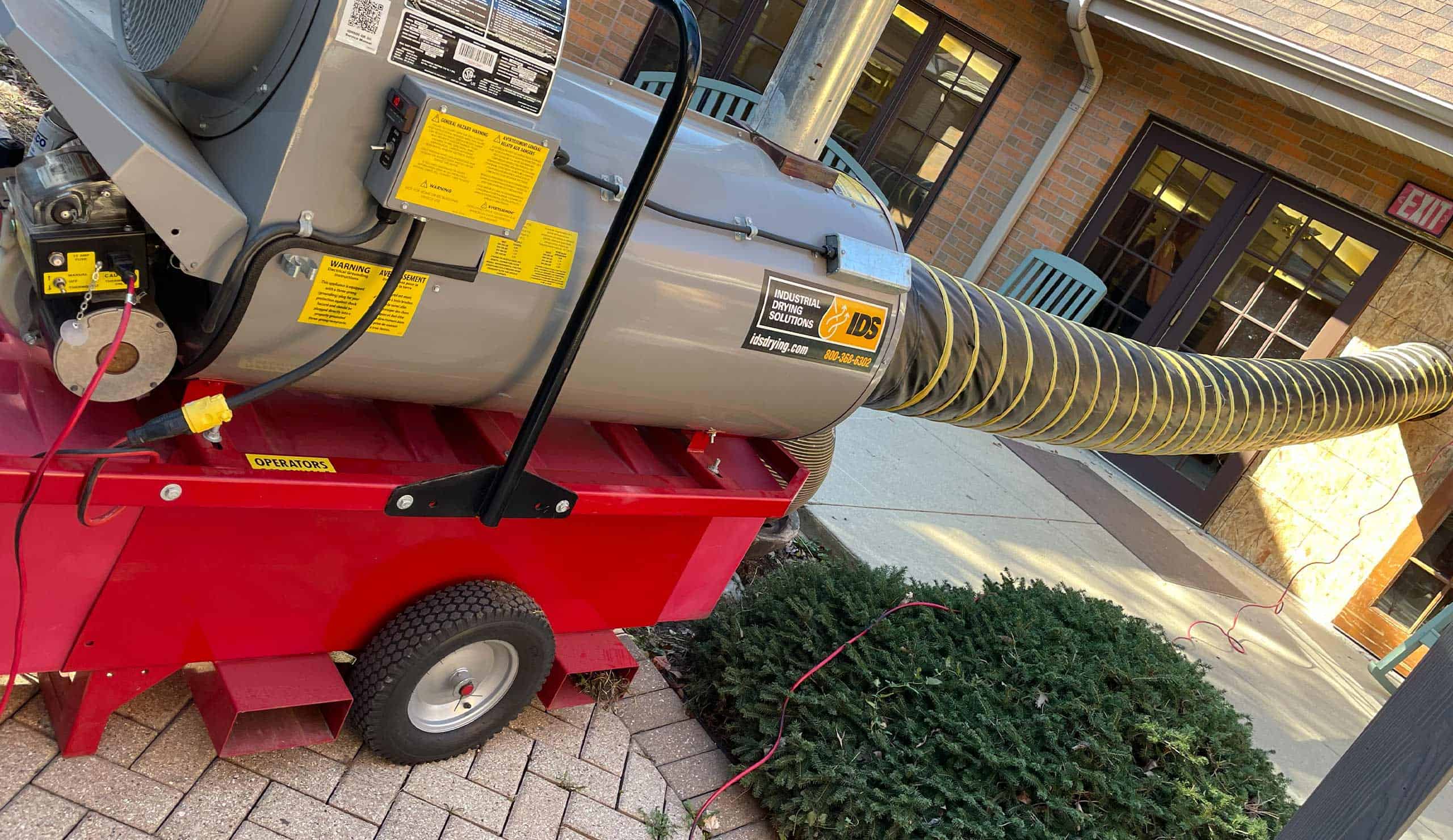
Indirect-fired heaters are the primary solution for large-volume hotel spaces: ballrooms and pre-function areas, indoor pool enclosures, long guest-room corridors, ski resort base-lodge areas, and back-of-house service corridors. They combust fuel in an outdoor unit and duct clean, dry heated air indoors, eliminating combustion byproduct concerns in occupied guest areas. A single large indirect-fired unit can maintain comfortable temperatures across thousands of square feet of occupied hotel space, with flexible ducting adapting distribution to the specific building layout and the zones that require priority coverage.
Electric heaters provide clean, emission-free heating for localized applications: supervised staff areas, front desk zones, specific cold stacks where one or two rooms need supplemental heat alongside other solutions. They carry no combustion risk and require no fuel logistics. Their limitation in hotel applications is circuit capacity: a standard 15- to 20-amp guestroom circuit supports a single 1,500-watt heater, and deploying multiple units across a floor risks tripping breakers or overloading aging electrical infrastructure. Electric heaters are a supplement to indirect-fired solutions in a hotel emergency, not the primary system.
Generators from REIC Rentals support emergency heating deployments where permanent power to mechanical systems has been disrupted by a failure, or where the temporary electrical load from heating equipment exceeds the available panel capacity. Generators, positioned outdoors in accordance with applicable safety codes, provide the additional power needed to keep both heating equipment and critical hotel systems operational while permanent repairs are underway.
Protecting Infrastructure: Plumbing, Sprinklers, and Mechanical Systems
Guest comfort drives the immediate response, but infrastructure protection determines whether the heating failure costs thousands or millions. Frozen pipes in a multi-story hotel can flood dozens of rooms before the source is located and isolated.
Maintain ambient temperatures above 45 degrees Fahrenheit in all zones with plumbing, particularly in exterior wall locations, parking levels, rooftop mechanical spaces, and any area without adequate insulation. Run a trickle of water through fixtures on exterior walls in at-risk rooms to prevent standing water in supply lines from freezing. Monitor hydronic loop temperatures and circulating pump status continuously: if the heat transfer fluid approaches freezing, the entire heating distribution system is at risk.
Sprinkler system freeze risk is particularly dangerous because a frozen sprinkler head constitutes a life-safety failure mode that compounds the original mechanical event. A burst sprinkler line floods ceiling assemblies and guest areas, with no connection to the heating failure, and the resulting water damage extends the property’s recovery timeline well beyond what the heating failure alone would have required.
Revenue Management During an Active Outage
Revenue management decisions made in the first hours of a heating failure affect both the immediate guest experience and the property’s recovery timeline.
Mark affected rooms out of order in the PMS immediately and pull them from all distribution channels. A room sold into a cold zone after the failure is known creates a guest relations problem that is entirely avoidable and compounds an already difficult operational situation. Consolidate guests onto the warmest stacks and floors: this concentrates the heating demand in a smaller zone, makes temporary heating equipment more efficient, and creates a manageable occupied footprint for housekeeping and engineering.
Handle group blocks with direct personal contact. Groups attending conferences, weddings, or corporate events have contracted expectations that differ from those of transient guests. Early communication with group contacts, offering room moves rather than cancellations, protects relationships that have long-term booking value that a single incident should not permanently damage.
Compensation should be proportional and deliberate. Amenity credits for brief discomfort, partial refunds for extended outages, and loyalty points or future-stay certificates for significant impact are appropriate responses scaled to actual guest experience. A peak-season HVAC failure that ruins a family’s annual ski vacation warrants a different response than an overnight interruption during a shoulder-season conference. The documentation for every compensation offer supports both insurance claims and any subsequent brand audit.
Safety and Brand Compliance During Emergency Heating
Temporary heating equipment deployed in a hotel must satisfy life safety codes, fire marshal requirements, and brand standards. For properties operating under major flags, brand compliance carries consequences alongside the safety and regulatory dimensions. Violations during an emergency do not receive a pass from brand compliance auditors reviewing the incident after the fact.
REIC Rentals selects and positions equipment with egress routes, noise limits, and visual impact on the guest environment in mind. Temporary heating systems are engineered to meet life-safety requirements as a baseline, not as an aspiration. Placement documentation, fuel delivery logs, and equipment inspection records are maintained throughout the deployment to support the compliance record that brand audits and insurance carriers expect after a significant operational incident.
The temporary heating deployment is also an opportunity to identify the equipment deficiencies and maintenance gaps that contributed to the failure. A dirty heat exchanger, deferred coil maintenance, or inadequate pre-season inspection are the upstream causes of most winter HVAC failures that emergency heating responds to. REIC Rentals’ team provides that assessment and equipment deployment as part of the engagement.
Building the Emergency Heating Playbook Before the Season
The hotels and resorts that manage winter HVAC failures with the least impact on guests and the fastest recovery are not simply lucky. They planned for the scenario before the season began, when planning was under their control, rather than reacting in a crisis.
A property-specific emergency heating playbook covers defined roles and responsibilities within the incident command structure, internal escalation thresholds that activate different response levels, pre-drafted guest communication templates for each communication channel, and REIC Rentals contact information, including pre-approved equipment types and pre-negotiated terms, to eliminate procurement delays during the event.
Floor-by-floor priority maps identify ADA rooms, premium suites, high-value group blocks, and areas with vulnerable plumbing as first-priority zones for temporary heating deployment. Diagrams showing where temporary equipment can be staged with minimal guest disruption, including fuel delivery routes and electrical tie-in locations, are tools that the engineering team can use immediately rather than figuring out in the field under time pressure.
REIC Rentals conducts pre-season site assessments for hospitality properties to document connection points, staging areas, and deployment logistics before an emergency creates the pressure that makes those logistics difficult. Request a quote or find a location near you to connect with the REIC Rentals team before the cold season arrives, while planning is still under your control.
1.888.356.1880 | in**@**ic.com | reic.com
Service You Trust. Equipment You Need.
