
Picture a Tuesday morning in July. A chiller failure in a Class A office tower is reported at 7:30 a.m. Within an hour, upper-floor tenants are calling management. Server rooms are alarming. A law firm and a medical suite are asking about lease compliance. By early afternoon, the property manager is fielding questions about habitability from a national tenant whose lease renewal is three months out. The repair bill is manageable. The downstream consequences are not.
That scenario plays out more often than property managers expect, and the difference between a building that manages through it and one that absorbs weeks of tenant fallout is almost always the same: a documented emergency response plan, pre-arranged vendor relationships, and a clear chain of command that does not require improvisation at 7:30 in the morning. Emergency preparedness for multi-tenant commercial properties is not a binder that collects dust on a shelf. It is an operational discipline that determines how your building performs when systems fail.
REIC Rentals supports property managers and facility teams with temporary cooling equipment, heating, drying, dehumidification, and generators for multi-tenant commercial properties during planned maintenance windows, unplanned failures, and seasonal demand peaks. This article covers how to build an emergency response plan that actually works when you need it, and how REIC Rentals fits into that plan.
What an Emergency Response Plan for Commercial Properties Actually Covers
An emergency response plan for a multi-tenant commercial property is a building-specific document that defines exactly how your team responds when critical systems fail. For office towers, retail centers, and mixed-use properties with shared mechanical systems, the plan addresses life safety, business continuity, and building systems continuity simultaneously, because all three are at risk when a central chiller fails on a hot afternoon.
The difference between a generic emergency plan and a building-specific one is the difference between a checklist and a playbook. A generic plan tells you to contact maintenance when a system fails. A building-specific plan identifies the trigger thresholds that escalate the response, the pre-approved and pre-qualified vendor relationships, the electrical tie-in points where temporary equipment connects, and the communication templates that go to specific tenant contacts rather than a general building list.
Our teams regularly support property managers with the first type of plan, and discover during an incident that it does not tell them what to do in the first hour. Building a plan that covers critical decisions in advance, before the pressure is on, turns a potential crisis into a managed incident. The components that matter most are risk and threat assessment, trigger thresholds, response procedures for mechanical and utility failures, a resource inventory that includes a rental equipment strategy, an emergency communication plan with pre-built templates, and a training and drill schedule that keeps the plan current.
Risk Assessment: Understanding What Your Building Actually Faces
Risk profiles differ significantly by asset type and location. A downtown high-rise with a central chilled-water plant faces different vulnerabilities than an open-air retail center with multiple rooftop units or an enclosed mall with anchor tenants that require continuous operations. A risk assessment that does not reflect the specific mechanical profile of your building produces a plan that does not reflect what will actually happen when something goes wrong.
For commercial office and retail properties, the threat categories worth assessing include regional weather events relevant to the building’s geography, utility outages from grid failure or water supply interruption, mechanical failures, including chiller or boiler failure, rooftop unit failure, cooling tower issues, pump failures, and controls failures, including building automation hardware faults and sensor errors. Tenant-driven incidents, including kitchen exhaust failures, refrigerant leaks, and tenant modifications affecting shared systems, also belong in the assessment because they are more common causes of building-wide disruption than most property managers anticipate.
Aging mechanical equipment carries an elevated risk of failure that warrants specific attention in any risk assessment. Chillers approaching or past their design life, single-point-of-failure cooling towers, and rooftop units without redundancy all represent concentrations of risk that determine how the emergency plan should be structured. A building whose central chiller has no backup capacity needs a more developed rental equipment response plan than one with N+1 redundancy, because the consequences of that single failure are more severe and the response timeline is more constrained.
Rating each identified risk by likelihood and operational impact, and updating that rating annually or after any significant capital equipment change, lease mix shift, or real incident, keeps the risk assessment relevant rather than a static document that no longer reflects the building’s actual profile.
Assigning Roles, Responsibilities, and Spending Authority
Delays in assigning decision authority during an HVAC or power emergency add hours of downtime that compound into tenant-relations problems and lease-compliance exposure. When no one knows who can approve an emergency rental deployment at 6 a.m. on a Saturday, the delay is not a process failure in that moment. It is a planning failure that happened weeks or months earlier when the authority was never defined.
The roles that matter in a commercial property emergency response are the incident commander, who holds overall decision authority and manages ownership communication; the operations lead, who handles mechanical assessment, system isolation, and repair coordination; the vendor coordinator, who manages pre-approved contacts and has authority to mobilize equipment around the clock; and the communication lead, who handles tenant notifications and ownership updates. Each role needs a named alternate so the response does not depend on a specific individual being available at the time of the incident.
Spending authority is the component most commonly left undefined. The vendor coordinator needs to be able to initiate a rental equipment deployment without requiring approval from someone who may not be reachable at the time. Pre-defining the spending threshold that triggers escalation versus the threshold that can be approved immediately by the vendor coordinator allows the response to move at the speed the incident demands, rather than at the pace of an approval chain not designed for emergencies.
After-hours protocols deserve specific attention because HVAC failures do not respect business hours. The security supervisor may serve as the acting incident commander until the property manager arrives. The on-call engineer becomes the operations lead. The vendor coordinator role requires 24/7 availability because the rental partner must be reachable at any hour.
Essential Contacts, Vendor Relationships, and Pre-Arranged Agreements
Effective emergency response depends on having accurate, accessible contacts established before the crisis starts. The emergency contact sheet should be available in multiple formats and locations: digitally on a shared drive accessible from any device, as hard copies at the security desk and the engineering office, and offsite with the regional manager. A contact sheet stored only in a property management system that requires a network login is inaccessible when the network is down.
Contact categories that should appear on a single-page emergency contact sheet include local utility providers for electric, gas, and water, the HVAC service contractor with both primary and backup options, the elevator service contractor, building ownership and asset management, key national tenants’ corporate facility contacts, and the REIC Rentals 24/7 dispatch contact.
Pre-negotiated service agreements with rental equipment providers eliminate the legal review and approval delays that consume response time during an active incident. These agreements should cover pricing structures, logistics terms, and mobilization timelines so that, when the call is made, deployment begins rather than entering into a commercial negotiation. REIC Rentals conducts pre-incident site surveys to document electrical tie-in points, hose routing paths, crane access requirements, and equipment staging areas, ensuring deployment planning is complete before the emergency occurs. One challenge our teams commonly help property managers solve is the access and logistics coordination required in the first hour of an incident. When the survey is done in advance, that hour is spent deploying equipment rather than planning where to place it. Explore REIC Rentals Expert Solutions for integrated planning support for commercial properties.
Scenario: HVAC Failure in a Multi-Tenant Office Tower
Consider the scenario that opened this article, reframed as a planning exercise. A chiller failure is reported at 7:30 a.m. on a Tuesday in July in a multi-story commercial office tower. A building with a documented emergency response plan and a pre-arranged relationship with REIC Rentals responds as follows.
In the first fifteen minutes, the building automation system alarm triggers a response from the chief engineer, who assesses and confirms a loss of cooling across the upper floors. The property manager is notified, and the emergency response plan is activated. Immediate checks on server rooms, medical suites, and food retailers confirm which tenants have the most time-sensitive exposure.
Within the first hour, the vendor coordinator contacts REIC Rentals to confirm equipment availability. The pre-existing site survey identifies the staging location and the electrical connection approach, so no field assessment is required. The first tenant notification goes out via email and SMS using the pre-built template, confirming that the issue has been identified, that equipment is being deployed, and that the next update will follow within two hours.
By mid-morning, temporary cooling equipment is on site and connected, restoring conditions in priority zones, including server rooms and medical suites. A second tenant update confirms progress on restoration and provides an estimated timeline for full building coverage. The permanent repair is underway in parallel.
The difference between that outcome and one where the property manager is still making calls at noon trying to find available equipment is the plan, the pre-arranged vendor relationship, and the site survey that eliminated the first hour of logistics scrambling. The financial consequences of the two outcomes are not comparable.
Emergency Response for Different Failure Types
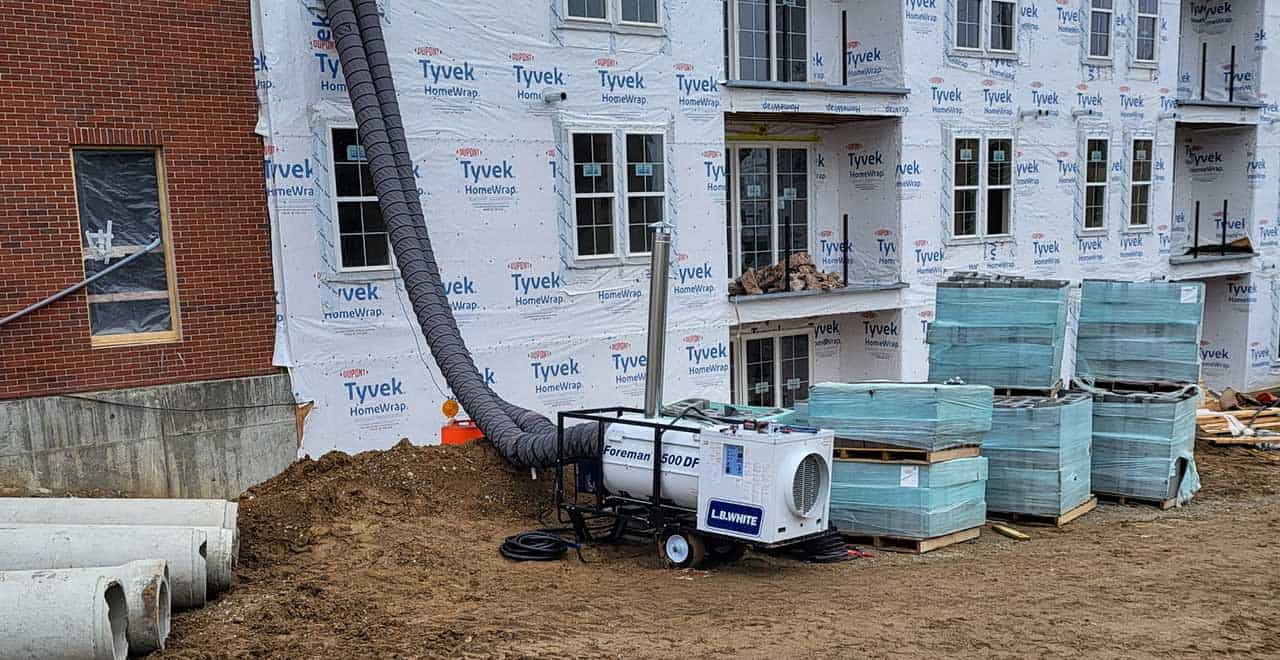
HVAC failures are the most common emergency scenario for multi-tenant commercial properties, but the plan needs to cover the full range of critical system failures. Boiler shutdowns in winter create a mirror-image urgency to chiller failures in summer. Temporary heating equipment, including indirect-fired units that deliver clean, dry air without combustion contaminants, is the appropriate response for occupied commercial buildings where indoor air quality is as important as temperature. Power outages due to grid events require temporary generators sized to maintain critical loads throughout the building until permanent power is restored. Water intrusion from roof damage, burst pipes, or sprinkler events requires drying and dehumidification equipment deployed within hours to prevent moisture damage that compounds rapidly in commercial building materials and finishes.
The decision criteria for activating rental equipment should be pre-defined in the plan rather than evaluated on a case-by-case basis during the incident. Anticipated downtime exceeding a defined threshold, outside temperatures above or below a defined level, contractual obligations with anchor tenants requiring continuous climate control, and critical loads such as server rooms and medical equipment at risk are all trigger conditions that should appear in the plan with specific thresholds rather than general descriptions that require judgment calls under pressure.
Preparing for Extended Utility Outages and Severe Weather
Extended utility outages from severe weather events combine building system failures with supply chain constraints, making emergency equipment procurement harder precisely when it is most needed. Equipment that is readily available during normal operations may be fully committed across a region when a grid event affects multiple properties simultaneously.
Pre-season preparation that staggers equipment reservations before peak demand periods, confirms fuel supply arrangements for generator-powered equipment, and verifies that mechanical systems are in good condition before weather season peaks is the approach that keeps a property in control of its response rather than competing for available equipment with every other building in the area.
REIC Rentals works with property managers ahead of peak seasons to assess requirements, confirm equipment availability, and stage units where logistics allow, so activation is a logistics call rather than a procurement process. Explore the full cooling range and HVAC accessories to understand the equipment configurations available for different building types and failure scenarios.
Coordinating with anchor tenants before extended weather events is an often-overlooked component of commercial property emergency planning. Grocery stores, pharmacies, and medical clinics that must remain open during a weather emergency have their own continuity requirements that affect the building’s response. Understanding those requirements in advance and incorporating them into the property’s plan prevents conflicts between the building’s response plan and the tenant’s operational requirements during an active incident.
Building an Effective Tenant Communication Plan
A mechanical failure that is handled competently but communicated poorly can still become a tenant relations crisis. Tenants who do not receive timely, factual communication during a building emergency fill the information gap with assumptions, and those assumptions are rarely favorable to the building owner. Clear, consistent communication during an incident is not a soft skill. It is a measurable operational factor that determines tenant confidence and, ultimately, lease renewal decisions.
Effective emergency communication for commercial properties uses multiple channels simultaneously: email to tenant contact lists, SMS alerts for after-hours or time-critical notifications, tenant portal updates, lobby signage, and recorded voicemail updates on the building management line. No single channel reliably reaches every tenant, and the channels that work in normal operations may be less reliable during events affecting building systems.
The first message during an HVAC or power outage should cover what happened in brief and factual terms: which areas are affected, what steps are being taken, including any rental equipment deployment underway, the estimated time of the next update, and any specific instructions for tenants in affected areas. Building message templates for each scenario type before an incident occurs means response speed is not limited by drafting time at the worst possible moment. All outgoing emergency notifications should be documented for post-incident review and potential lease compliance questions.
Training, Drills, and Plan Maintenance
An emergency plan that is never tested is a document, not a capability. The response behaviors that determine how well a building performs during an incident are developed through practice, not by reading the plan. Annual drills that include simulated HVAC and power-failure scenarios, not just fire evacuation, are what turn the written plan into a practiced response.
Training topics for on-site teams should cover role-specific responsibilities and decision-making authority, how to contact REIC Rentals and other critical vendors, how to implement partial-floor or full-building responses, and after-hours incident management protocols. Tenant education about the building’s emergency procedures, including where cooling zones are located during a summer heat event and what the communication sequence looks like, reduces the incoming call volume that the management team has to handle during the first hour of an incident.
The plan requires both maintenance and training. Update it after tenant mix changes, major capital equipment changes, or any real incident. A post-incident review within two to four weeks of any significant building emergency captures the operational learning while it is still fresh and produces the plan updates that improve the next response. Quarterly reviews of contact lists and vendor agreements confirm that the information in the plan is current and does not contain personnel and relationships from a previous year.
How REIC Rentals Supports Your Emergency Preparedness Strategy
REIC Rentals provides temporary climate control and power solutions for commercial office and retail properties across planned maintenance windows, unplanned HVAC failures, and extended utility outages. Our team understands commercial building systems, SLA requirements, and the logistics of deploying equipment into occupied properties with active tenant operations. That operational understanding is what makes our support relevant during an incident, rather than adding coordination complexity for the building team.
Pre-incident site assessments are the most valuable thing a property manager can do to reduce emergency response time. When the tie-in points are documented, the staging logistics are planned, and the service agreement is in place before an event occurs, the response to an actual incident begins with equipment deployment rather than with the planning that should have happened earlier. Our teams conduct those assessments as part of our engagement with commercial properties and maintain the documentation to keep it up to date and accessible when needed.
Schedule a pre-incident planning walkthrough with REIC Rentals as part of your annual emergency planning cycle. Request a quote or find a location near you to connect with the team that supports commercial properties in your area and begin building the emergency response capability your tenants depend on.
The Property Managers Who Retain Tenants Plan for This
The property managers who retain national tenants, command competitive rents, and build long-term asset value are not the ones who respond best when systems fail. They are the ones who planned for it. The documentation, the vendor relationships, the pre-arranged agreements, and the communication templates that make a competent emergency response possible are all built before the incident, during the planning work that rarely feels urgent until the morning a chiller fails on the hottest day of the year.
REIC Rentals provides the cooling, heating, drying, power, and HVAC accessories that commercial properties need to stay operational through system failures, backed by planning support and a network across North America. Explore the full HVAC range or request a quote to build your emergency response capability before the next incident decides the timeline for you.
1.888.356.1880 | in**@**ic.com | reic.com
Service You Trust. Equipment You Need.
