
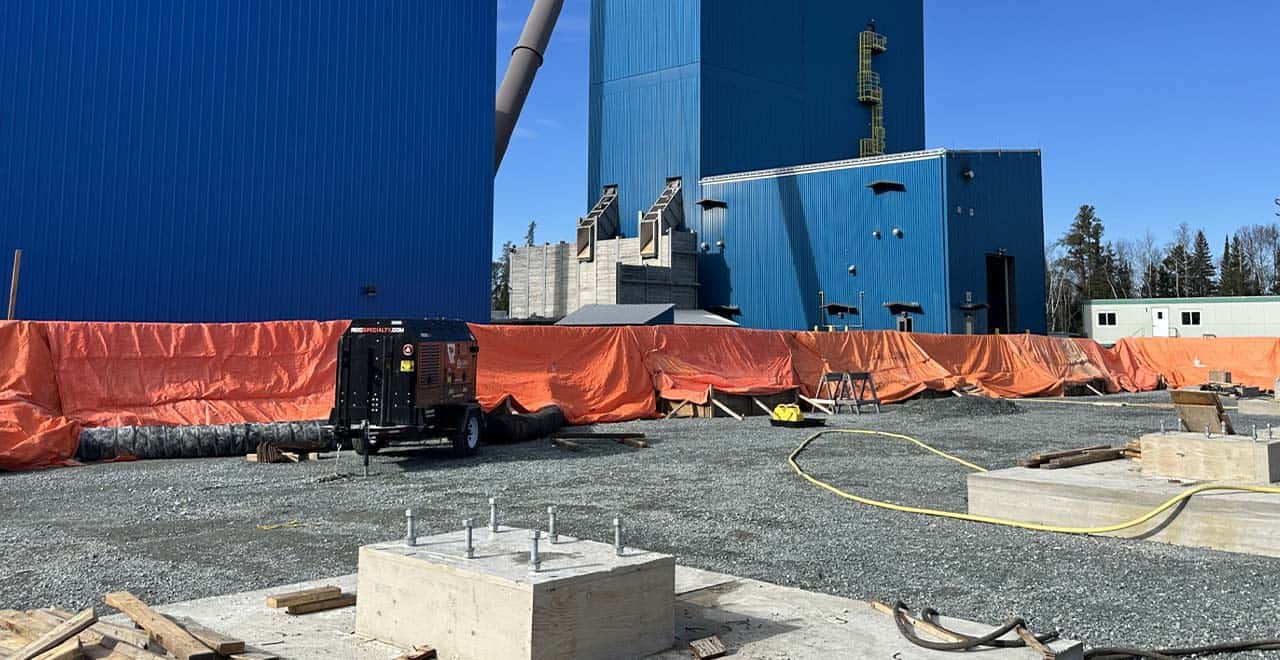
Climate control in a warehouse or distribution center is not about comfort. It is an operational one. Temperature, humidity, ventilation, and airflow all affect whether inventory arrives at its destination in acceptable condition, equipment runs without interruption, and the crew working across long shifts in a large facility stays productive and safe. When any of those variables goes unmanaged, the cost shows up in damaged product, slowed throughput, and heat-related incidents that were entirely preventable.
Summer conditions push all those variables in the wrong direction simultaneously. Heat accumulates in high-bay spaces with limited natural ventilation. Loading dock doors that open repeatedly let hot, humid outdoor air flood staging areas. Mezzanines and upper rack levels run significantly hotter than the floor. In a facility processing high volumes of temperature-sensitive product, the margin between acceptable conditions and conditions that cause damage or compliance failure can be narrow.
REIC Rentals supports warehouses and distribution centers with temporary and supplemental cooling, heating, drying and dehumidification, and HVAC accessories suited to large-scale operational environments. Our team conducts site assessments that account for building volume, power availability, airflow constraints, and the specific needs of each zone before making any equipment recommendations.
What Climate Control Actually Covers in a Warehouse Environment
A high-bay warehouse or cross-dock distribution center is not a single climate zone. It is a collection of distinct environments within one building, each with different requirements. Bulk storage areas have different needs than active pick zones. Loading docks operate differently from mezzanine offices. Cold rooms or temperature-controlled enclosures within the larger facility require their own management separate from the ambient space around them.
Understanding those distinctions is what drives effective climate control planning. Attempting to solve a pick zone heat problem by cooling the entire warehouse volume is inefficient and often impractical in a large facility. Targeted solutions that address the specific zone, load, and risk produce better outcomes at lower cost than applying a single approach across the full footprint.
Common inventory categories that require controlled conditions include electronics, pharmaceuticals, food and beverage products, adhesives, plastics, and packaging materials. Each has specific temperature and humidity tolerances that, when exceeded, result in damage, spoilage, or noncompliance. Managing those conditions throughout the summer peak, and during planned or unplanned HVAC outages at any time of year, is what climate control in a distribution center actually requires.
Mechanical Ventilation: The Foundation of Controlled Airflow
Mechanical ventilation uses fans and air handling equipment to move air in a controlled direction at a specified volume, independent of outdoor conditions. It is the most reliable foundation for climate control in large warehouse and distribution center environments because it delivers consistent airflow regardless of wind conditions, outdoor temperature, or whether dock doors are open or closed.
REIC Rentals provides mechanical ventilation equipment, including fans, air movers, and ducting components for seasonal peaks, construction phases, and HVAC maintenance windows. Properly designed mechanical ventilation moves air from cleaner to dirtier zones, maintains the air exchange rate needed for the specific occupancy and hazard level, and creates the pressure relationships that prevent hot air from accumulating in areas where workers and inventory are concentrated.
In large facilities, the placement of supply and exhaust points determines how effectively air actually moves through the occupied and storage zones rather than short-circuiting between intake and exhaust. REIC Rentals reviews airflow strategy alongside equipment selection so the system, as installed, achieves the intended results rather than just moving air in the general vicinity of the problem.
Natural Ventilation and When It Is Useful
Natural ventilation, which relies on wind and thermal buoyancy to move air through openings in the building envelope, has a role in warehouse climate management during mild conditions. Opening dock doors, roof vents, and personnel doors to create cross-ventilation can provide meaningful air exchange in spring and fall when outdoor conditions support it.
The limitation is consistency. On a still, hot summer day, there is no meaningful natural airflow to drive exchange. Security requirements may prevent overnight operation with openings that cannot be monitored. Outdoor air quality during wildfire events or high pollution periods may make unfiltered natural ventilation counterproductive. And in humid climates, introducing large volumes of unconditioned outdoor air can worsen indoor humidity rather than improve it.
The practical approach for most warehouse and distribution center operations is to use natural ventilation when outdoor conditions support it and supplement or replace it with mechanical systems when they do not. REIC Rentals supports facilities in enhancing existing natural ventilation with mechanical equipment during heat waves and high-demand periods when natural airflow alone is insufficient.
Portable and Temporary Cooling for Targeted Zone Control
Cooling the full volume of a large warehouse is often impractical and unnecessary. The more effective approach is to identify the zones where temperature control matters most and direct cooling there. Pick lines, packing stations, conveyor areas, mezzanines, dock zones, IT rooms, and office pods within a larger warehouse all benefit from targeted cooling that does not require conditioning the full facility to achieve acceptable conditions in the areas that need it.
REIC Rentals’ cooling equipment includes portable air conditioners for enclosed work zones and office areas, evaporative coolers for arid climates and partially open spaces, and industrial fans for air movement in areas where active cooling is impractical or unnecessary. HVAC accessories, including flexible ducting, route conditioned air from equipment positioned at the building perimeter or roof level to the interior zones that need it.
Temporary cooling also bridges the gaps that occur during planned HVAC maintenance, equipment replacement, and system commissioning. A facility that schedules rooftop unit replacement during summer or experiences an unexpected equipment failure during peak heat does not have to choose between stopping operations and exposing workers and inventory to uncontrolled conditions. REIC Rentals deploys temporary cooling to maintain acceptable conditions through those windows so operations continue and the project proceeds on schedule.
Dehumidification: Protecting Inventory and Preventing Damage
Humidity control in warehouses and distribution centers protects inventory, equipment, and the building structure itself. High relative humidity accelerates corrosion in metal components and storage equipment, enables mold growth in packaging materials, drywall, and insulation, and compromises the integrity of moisture-sensitive products, including electronics, pharmaceuticals, and food items. In facilities with regulated storage requirements, humidity excursions create compliance exposure beyond direct product loss.
REIC Rentals’ drying equipment provides dehumidification for warehouse and distribution center environments, removing moisture from the air to maintain the humidity levels required by product specifications and facility standards. Dehumidification works in combination with ventilation and cooling rather than as a standalone solution. Moving dry air through the space and exhausting humid air out is the mechanism that sustains acceptable humidity levels, not simply running a dehumidifier in a sealed environment.
Humidity problems in warehouses frequently originate at the loading dock, where repeated door openings introduce humid outdoor air into the conditioned space. Managing dock-area ventilation alongside interior dehumidification yields better results than addressing either in isolation. REIC Rentals considers the full airflow picture when advising on dehumidification solutions for large-footprint facilities.
Loading Dock Ventilation: The Hottest Zone in the Building
Loading docks are consistently the most thermally challenging area in a warehouse or distribution center. Dock doors open repeatedly throughout each shift, allowing hot outdoor air to enter the operational space. Trailers parked at the dock create enclosed volumes that heat rapidly in direct sun. Workers in dock areas transition repeatedly between outdoor and indoor conditions, increasing their heat-stress risk compared to workers in stable interior environments.
Portable fans and air movers, positioned to create directional airflow through dock areas, reduce the temperature differential between the dock and the interior and improve working conditions during peak heat periods. Supply and exhaust arrangements that move hot air out of the dock zone rather than pushing it deeper into the building keep heat accumulation from compounding across a shift.
REIC Rentals stocks dock-area ventilation and portable cooling equipment suited to common warehouse dock configurations. Equipment selection for dock areas accounts for the intermittent nature of door operation, the footprint constraints of active loading operations, and the exposure to outdoor conditions that make enclosed-space cooling solutions impractical in dock areas that cannot be sealed.
Mezzanines and Upper Rack Levels: Managing Heat Stratification
Heat stratifies in large-volume spaces. Upper rack levels and mezzanines consistently run several degrees warmer than the floor level, which means inventory stored at height and workers on mezzanine pick levels are exposed to significantly worse conditions than ground-floor monitoring points would suggest.
Addressing heat stratification requires moving air vertically, not just horizontally. Directional fans positioned to push air downward from upper levels, or to pull cooler floor-level air upward through rack aisles, disrupt the stratification and produce more uniform conditions throughout the building volume. REIC Rentals’ cooling and fan equipment can be configured to address stratification in specific zones rather than requiring a facility-wide approach that may not be warranted.
For temperature-sensitive products stored at upper rack levels, consistent conditions across the full rack height protect inventory that would otherwise be exposed to substantially worse conditions than floor-level monitoring indicates. In facilities that maintain climate logs for regulatory compliance, monitoring upper rack levels rather than just floor level provides a more accurate picture of actual inventory conditions.
Worker Safety in Summer Warehouse Conditions
Heat stress in warehouse and distribution center environments is a genuine operational risk, not just a regulatory concern. Workers in active pick zones, dock areas, and mezzanines are exposed to elevated temperatures, physical exertion, and, in many facilities, limited access to immediate relief. The progression from heat fatigue through heat exhaustion to heat stroke can happen faster than supervisors can recognize the early signs, particularly in facilities where workers are moving quickly and focused on production targets.
Engineering controls, including cooling, ventilation, and dehumidification, are the most effective heat stress mitigation available because they improve conditions for everyone in the affected area rather than relying on individual behavior. OSHA guidance prioritizes engineering controls before administrative measures such as scheduling and rotation, and before personal protective equipment. Deploying adequate cooling and ventilation in high-heat zones is the most direct way to reduce heat stress risk across the workforce.
Cooled break areas positioned near active work zones reduce the time workers spend in transit between heat exposure and relief, thereby improving the effectiveness of rotation protocols and the likelihood that workers will actually use them. REIC Rentals supports planning the placement of cooling equipment to create effective relief zones alongside active work areas that pose a heat-stress risk.
Temporary Power for Climate Control Deployments
Large-scale temporary cooling and ventilation equipment requires reliable, correctly sized power. Running multiple portable air conditioners, fans, and dehumidification units across a large warehouse footprint can add up to a significant electrical load. When existing facility power cannot support the full temporary climate load, generators from REIC Rentals provide the necessary supply.
Power and lighting accessories, including distribution panels and cabling, route power from the generator or existing supply to climate equipment positioned throughout the facility. Coordinating cooling and power requirements through a single conversation with REIC Rentals ensures both systems are sized to work together rather than discovering a power constraint after climate equipment is already on site.
Planning Ahead: Securing Equipment Before Peak Demand
Temporary cooling and ventilation equipment availability tightens significantly during peak summer demand. Regional heat waves create simultaneous demand from facilities across a wide area, and equipment that is readily available in spring may be fully committed during a July heat event. Facilities that plan their summer climate requirements in advance, confirm reservations before peak season, and have an established relationship with a rental partner are consistently better positioned than those that initiate the process during a heat emergency.
The planning inputs are available before summer arrives: current hot zone locations identified from last year’s experience, any planned HVAC maintenance or replacement work scheduled for the summer window, known changes in facility operations, such as new product lines or increased throughput that will add to the heat load, and power infrastructure capacity. Working through those inputs with REIC Rentals in the spring produces a summer climate plan that is in place before it is urgently needed.
Request a quote or find a location near you to start the planning conversation for your warehouse or distribution center climate control strategy.
Applications Across Warehouse and Distribution Sectors
Not every facility has the same exposure. Food storage facilities operate within regulatory temperature requirements that apply to the full storage environment, not just the areas where conditions are most visible. Food processing plants require controlled conditions across both production and storage. Pharmaceutical storage demands humidity and temperature management within ranges defined by regulatory standards. Data centers co-located within larger facilities require targeted cooling regardless of ambient conditions in the surrounding space.
REIC Rentals has supported climate control across all these environments, and the planning process reflects the specific requirements of each rather than applying a standard approach regardless of the facility’s contents.
Building Your Summer Climate Plan with REIC Rentals
Summer heat is a manageable problem for facilities that plan ahead and an expensive one for those that do not. The combination of correctly selected cooling, ventilation, dehumidification, and power equipment, planned to the facility’s actual requirements and deployed before conditions demand it, is what separates operations that manage through summer heat from those that absorb its cost.
REIC Rentals provides the equipment, the planning support, and the on-site service to make that practical across facilities of any scale. Explore the full equipment range or request a quote to build a climate plan before the heat arrives.
1.888.356.1880 | in**@**ic.com | reic.com
Service You Trust. Equipment You Need.
