
Heat stress has moved from a seasonal consideration to a documented operational risk affecting construction, industrial maintenance, and infrastructure work throughout the summer. Summers have grown longer, hotter, and less predictable across North America, and the workforce most exposed to these conditions works outdoors or in unconditioned indoor facilities where heat accumulates due to inadequate ventilation or cooling. Occupational safety agencies are responding with expanded enforcement, and employers who have not built heat management into their operational planning are increasingly exposed to both regulatory and human consequences.
REIC Rentals supports contractors and facility managers with temporary cooling equipment, ventilation, and power solutions designed to keep crews safe and projects on schedule. This article covers what every employer needs to understand about heat stress risk, what OSHA expects, and what practical cooling and ventilation solutions look like on an active jobsite.
What Heat Stress Is and Why It Matters on Active Sites
Heat stress occurs when external heat and internal metabolic heat overwhelm the body’s ability to cool itself. It exists on a spectrum. Heat exhaustion involves heavy sweating, weakness, dizziness, and nausea. Heat stroke is a life-threatening emergency marked by confusion, seizures, loss of consciousness, and dangerously elevated core temperature. Both can escalate quickly in hot environments, and the progression from early symptoms to a medical emergency can happen faster than supervisors recognize it on a busy site.
Several factors compound the risk in construction and industrial environments. Concrete, asphalt, metal decking, and heavy machinery surfaces absorb and re-radiate solar heat, pushing the felt temperature significantly above ambient. High humidity slows sweat evaporation, the body’s primary cooling mechanism, reducing how effectively the body sheds heat during sustained exertion. PPE and work clothing trap body heat and further restrict evaporative cooling. Strenuous manual labor generates intense metabolic heat on top of all those environmental factors.
Indoor environments create their own version of the same problem. Warehouses, manufacturing plants, data centers, and mechanical rooms frequently lack adequate airflow. Interior build-outs underway before permanent HVAC is operational can trap heat from equipment, occupants, and solar gain within sealed floor plates with no pathway to relief. The compounding effect in those environments can produce conditions as dangerous as direct outdoor sun exposure, and they are easier to underestimate because the work is happening inside.
OSHA’s Evolving Enforcement Focus on Heat
OSHA has moved from general awareness guidance to targeted enforcement. The agency’s National Emphasis Program on Outdoor and Indoor Heat-Related Hazards, launched in 2022 and updated in 2026 for a five-year term, covers more than 50 high-risk industries and ties inspections to weather advisories. Citations can be issued under OSHA’s General Duty Clause even in the absence of a specific federal heat standard, because employers are required to protect workers from recognized hazards. Heat is now a recognized hazard with active enforcement behind it.
Targeted sectors include construction, roofing, manufacturing, warehousing, oil and gas, agriculture, and healthcare. Several states, including Washington, Oregon, California, Minnesota, and Colorado, have specific heat regulations that go beyond federal guidance and have their own enforcement mechanisms. Employers operating in those states face requirements that are more specific and more immediately enforceable than the federal framework alone.
OSHA’s guidance centers on three pillars: water, rest, and shade or cooling. Engineering controls, meaning systems that actively reduce environmental temperature rather than relying on individual behavior, are the preferred intervention. Temporary cooling systems, fans, and improved ventilation are specifically cited as the appropriate response before administrative measures and PPE are considered. REIC Rentals helps safety managers develop cooling plans aligned with these requirements and defensible under regulatory scrutiny.
What OSHA Expects from Employers in Practice
OSHA’s proposed rule, published in 2024, calls for documented heat illness prevention programs that cover acclimatization, emergency response, monitoring, and work-rest schedules. The practical requirements are specific and enforceable.
Acclimatization is one of the most important and most overlooked elements. New workers and those returning from absence face an elevated risk because their bodies have not adapted to sustained heat exposure. Gradually increasing exposure over one to two weeks before workers are expected to work full-duration shifts in high-heat conditions significantly reduces the risk of acute heat illness. Workers with previous heat-related illness episodes carry an elevated future risk and require particular attention.
Work-rest schedules must be structured around heat index or Wet Bulb Globe Temperature readings rather than the calendar or the clock. Cooling areas must be accessible during every break, not located at the site perimeter, where transit time reduces the benefit of the rest interval. Written prevention plans, supervisor training, and non-punitive symptom reporting protocols are all components of a compliant program. REIC Rentals can participate in pre-job planning meetings to ensure the cooling and ventilation equipment plan supports and complements the safety program rather than operating independently of it.
Recognizing Heat Exhaustion and Heat Stroke
Field supervisors and workers need to quickly distinguish between heat exhaustion and heat stroke because the responses differ and the stakes are not equal.
Heat exhaustion presents as heavy sweating, weakness, headache, dizziness, nausea, and an elevated heart rate. The affected worker is still conscious and responsive. The response is to move them to a cool area immediately, remove excess clothing and PPE, provide fluids, and monitor closely. If symptoms do not improve within a short period, seek medical attention.
Heat stroke is a medical emergency. Confusion, loss of consciousness, seizures, hot skin that may be dry or still damp, and a core temperature above safe thresholds require an immediate 911 call. Do not wait for transport before beginning active cooling. Move the worker to conditioned air or shade, apply ice to the neck, armpits, and groin, and use fans where available. Organ damage and death are possible outcomes of untreated heat stroke, and the time between recognition and active cooling directly determines the outcome.
Having a cooled break area or a temporary conditioned space on site, supplied by rental cooling equipment, reduces the distance and time between when a worker first experiences symptoms and when they can access relief. That proximity matters when early intervention is the difference between heat exhaustion and a medical emergency.
How Heat Affects Productivity and Project Cost
Heat stress not only threatens safety. It directly erodes jobsite output and project economics in measurable, compounding ways over the course of a season. Research on construction workers exposed to elevated temperatures consistently shows productivity loss above heat index thresholds that active summer sites regularly exceed. Cognitive function and physical coordination are impaired before heat illness symptoms become obvious, which means workers produce lower-quality output and make more errors while appearing to function normally.
The hidden costs accumulate alongside the visible ones. Rework due to heat-related mistakes adds labor hours that were not budgeted for. Over time, recovering lost production increases costs without a proportional increase in output. Medical claims and potential OSHA penalties add further financial exposure. Schedule delays that push completion into bad weather or past contract milestones carry their own consequences. The combined cost of an unmanaged summer heat season for a large project regularly exceeds the cost of planned temporary cooling by a meaningful margin.
The productivity case and the safety case for the temporary cooling point are in the same direction. Crews working in managed conditions sustain output across a full shift. Crews working in unmanaged heat slow progressively, make more errors, and require more recovery time. On a project with a compressed schedule, that difference compounds across weeks in ways that are difficult to recover from once they accumulate.
Scenarios: Where Heat Becomes a Project Problem
Consider an interior warehouse build-out in July. Slab finishing, racking installation, and electrical work are all active simultaneously in a space without permanent HVAC. Ambient temperature climbs throughout the morning and continues to rise into the afternoon. Without active cooling, trades slow significantly by midday, and the schedule begins to slip in ways that are hard to recover from. Portable cooling equipment with ducting routed to active work zones, combined with a cooled break area, maintains conditions that allow full-shift production rather than reduced-output heat management.
Consider a manufacturing facility during a planned summer shutdown. Process heat persists in the building even with production equipment offline. Summer humidity compounds ambient conditions, and maintenance tasks requiring precision and sustained effort become increasingly difficult without adequate ventilation and spot cooling. Temporary cooling and ventilation equipment stabilizes conditions, protects the maintenance timeline, and allows the facility to return to production on schedule rather than absorbing the cost of an extended outage.
In both cases, the principle is the same. Temporary cooling converts an uncontrolled environment into a managed one, and a managed environment produces the output and safety outcomes that an uncontrolled one cannot sustain.
Temporary Cooling Solutions for Jobsite Heat Management
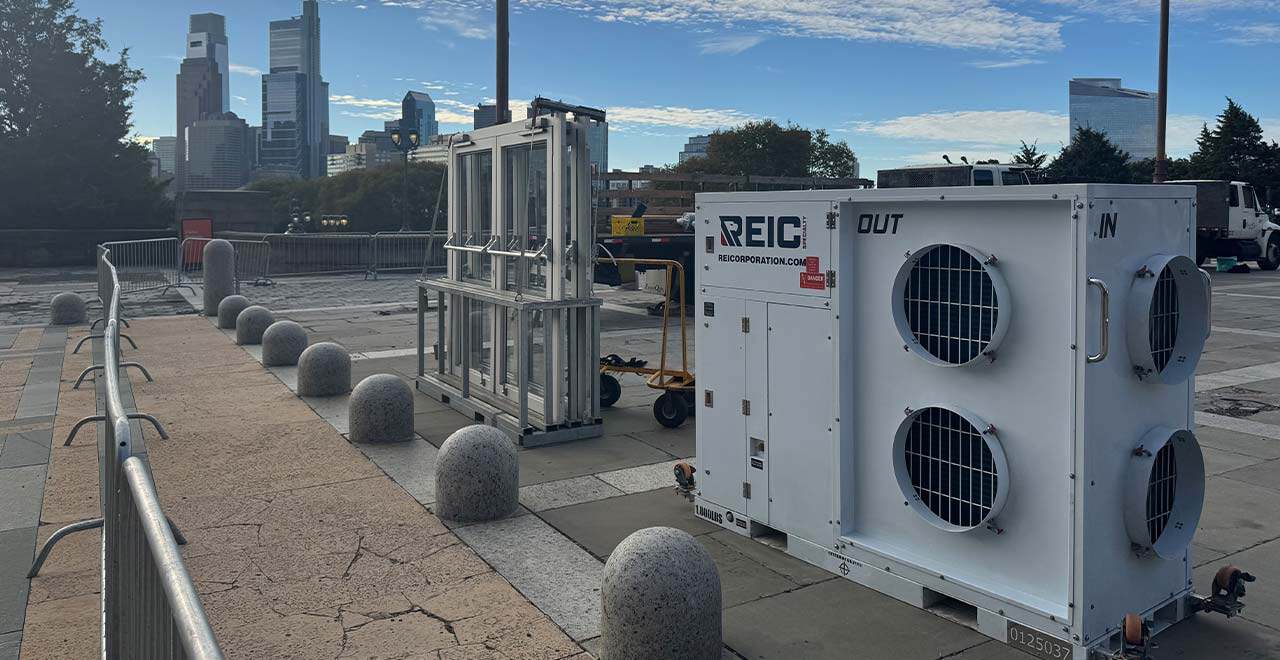
Engineering controls are the most effective and most defensible heat stress mitigation available because they improve conditions for everyone in the affected area rather than relying on individual behavior under production pressure. REIC Rentals’ cooling equipment includes portable air conditioners for enclosed spaces requiring active refrigerant cooling, evaporative coolers for arid climates and partially open environments, and industrial fans for air movement in areas where active cooling alone is not sufficient to distribute conditioned air effectively.
Portable air conditioners suit break rooms, site offices, trailers, server rooms, and enclosed work zones where cooling can be contained and directed. Evaporative coolers work well in dry conditions and partially open spaces where humidity allows the evaporative process to produce a meaningful temperature drop. Industrial fans improve air movement and the effectiveness of evaporative cooling where active refrigerant systems are not practical. HVAC accessories, including flexible ducting, route conditioned air from equipment positioned at the perimeter to the interior zones where workers are actually working, which is what makes portable cooling effective across complex floor plate geometries rather than just in the immediate vicinity of the unit.
Temporary generators and distribution equipment support cooling deployments where existing site power cannot carry the load. Coordinating cooling and power requirements through a single conversation with REIC Rentals ensures both systems are sized to work together rather than discovering a power constraint after cooling equipment is already on site.
Designing Cooling Zones and Break Areas
Cooling zone placement determines how much of the safety benefit of cooling equipment crews actually receive. A break area that requires five minutes of transit to reach is used less frequently than one that is two minutes from the work face, and the difference in rotation frequency is significant over a full shift in high heat. Recovery zones should be positioned near active work zones, out of direct sun, upwind where conditions allow, and clearly signed so every worker can navigate to them quickly.
Dedicated cooled break areas near the work face, portable cooling at staging areas and high-traffic corridors, and conditioned spaces for tool storage and site offices all create a layered environment in which workers encounter cooled air more frequently than during formal break periods. REIC Rentals can assess airflow, supply and return locations, and equipment placement during the site planning conversation, so the cooling deployment is designed around the actual workflow rather than positioned for convenience and hoped to work.
Planning Ahead with REIC Rentals
The most effective heat management plans are built before the summer season arrives. Equipment availability tightens when demand across a region peaks simultaneously, and organizations that have equipment confirmed and staged in advance are consistently better positioned than those that initiate procurement during an active heat event. Reviewing the previous season, identifying where heat affected production or safety, and engaging REIC Rentals in the spring gives project teams the lead time to address site-specific constraints before the season demands it.
REIC Rentals provides site assessments, equipment sizing, layout planning, delivery, setup, and ongoing support across our network. During heat waves or unplanned HVAC failures, our team deploys rapidly and scales equipment as conditions change. Request a quote or find a location near you to build a cooling plan before the heat season makes it urgent.
1.888.356.1880 | in**@**ic.com | reic.com
Service You Trust. Equipment You Need.
