
Harvard Kennedy School research found that each one-degree Fahrenheit increase in school-year temperature reduces learning by approximately 1 percent, with the impact falling disproportionately on lower-income students. Schools with adequate air conditioning offset the majority of that loss. The academic performance case for climate control is not aspirational. It is measurable and documented.
The fall semester means full occupancy. From K-12 classrooms to university lecture halls, every seat is taken, every lab is running, and every schedule is locked in. When HVAC upgrades or equipment failures coincide with active instruction, facilities teams face a difficult operational problem: how to keep buildings comfortable and safe without shutting down the spaces where learning happens.
REIC Rentals supports education facilities with temporary cooling, heating, and dehumidification equipment for fall-semester renovation projects, planned maintenance windows, and emergency HVAC failures. This article covers the operational constraints that make fall campus work particularly challenging, as well as how temporary climate control helps keep learning environments functional throughout the semester.
Why Fall Semester Renovations Are Uniquely Challenging
More education projects are happening during the academic year than ever before. Multi-year capital plans increasingly push mechanical upgrades into the fall semester rather than relying solely on summer windows, which are short and packed with activities. With a large share of public school districts requiring HVAC upgrades across significant portions of their building stock, construction cannot wait for ideal scheduling conditions.
Fall work on occupied campuses introduces constraints that summer projects do not face: noise and vibration limits during class periods, restricted laydown space in hallways and parking areas, and the absolute requirement to keep fire exits and accessible routes clear throughout all phases.
The pressures differ by institution type. In K-12 settings, a rigid bell schedule from roughly 8 a.m. to 4 p.m., plus after-school programs and meal service, limits the times when loud construction can occur. Replacing rooftop units on an older elementary wing, room by room, requires temporary climate control in adjacent classrooms during each phase.
In higher education, the complexity multiplies. Universities balance daytime classes, research labs, athletics, evening events, and residence halls simultaneously. A central chiller replacement in October can affect multiple buildings at once, impacting everything from a chemistry laboratory to a performing arts rehearsal space.
The Impact of Temperature and Air Quality on Learning
The connection between indoor environmental quality and academic performance is well documented. Maintaining indoor temperatures between 68 and 75 degrees Fahrenheit improves cognitive performance. Indoor air quality also affects concentration, absenteeism, and health outcomes for everyone in the building.
Fall introduces specific air quality challenges. Lingering pollen, construction dust from mechanical room work, off-gassing from new materials, and fluctuating humidity from autumn weather can all degrade indoor conditions. Without temporary filtration, ventilation, and dehumidification during HVAC shutdowns, these conditions accumulate quickly in enclosed spaces with limited air exchange.
Our teams regularly support education facility managers who have underestimated the combined effect of construction activity and reduced ventilation on indoor air quality in occupied classrooms. The challenge is most acute in older buildings where existing ventilation is already marginal, and construction work eliminates what little buffer existed.
Common Fall Renovation Scenarios Requiring Temporary Climate Control
Central plant upgrades are among the most disruptive fall renovation scenarios. When a university shuts down its chiller plant in mid-October for compressor or condenser replacement, chilled water supply to multiple buildings drops simultaneously. Portable cooling equipment connected to the existing chilled-water distribution system maintains conditions in the highest-priority spaces while the permanent plant is offline.
Phased K-12 wing refurbishments present a different challenge. A district replacing air-handling units in a classroom wing, working room by room throughout the semester. Portable air conditioners keep individual classrooms functional during each phase, while dehumidifiers manage humidity during days that remain warm and humid into October across much of the Pacific Northwest and Mountain West.
Performing arts centers hosting fall concerts and student recitals cannot tolerate humidity swings that damage wooden instruments or temperature spikes from stage lighting. Temporary cooling prevents moisture damage in renovated arts spaces while sound-attenuated air handlers avoid acoustic interference during rehearsals and performances.
Residence halls add another layer. Students live in the buildings being upgraded and cannot be displaced. Temporary climate equipment maintains comfortable conditions in dormitory spaces while mechanical upgrades progress in adjacent areas.
Scenario: Phased HVAC Replacement on an Occupied K-12 Campus
Consider a district launching a phased HVAC replacement in October across an older elementary school that remains fully occupied. Each wing’s aging air handling units are taken offline in sequence, with adjacent classrooms continuing to operate throughout.
In that scenario, portable air conditioners and temporary heaters deployed room by room maintain comfortable temperatures in classrooms adjacent to the active work phase. Dehumidification addresses the humidity that accumulates when permanent ventilation is offline, and construction activity introduces moisture from wet materials. The project runs through November without a missed instructional day, and building conditions remain within acceptable ranges throughout each phase.
That outcome depends on the temporary climate plan being integrated into the construction phasing schedule before work begins, not assembled reactively when the first classroom becomes uncomfortable. REIC Rentals engages with education facility teams and construction managers during preconstruction to align equipment with the phase sequence, ensuring continuous coverage rather than catch-up.
Equipment for Educational Environments
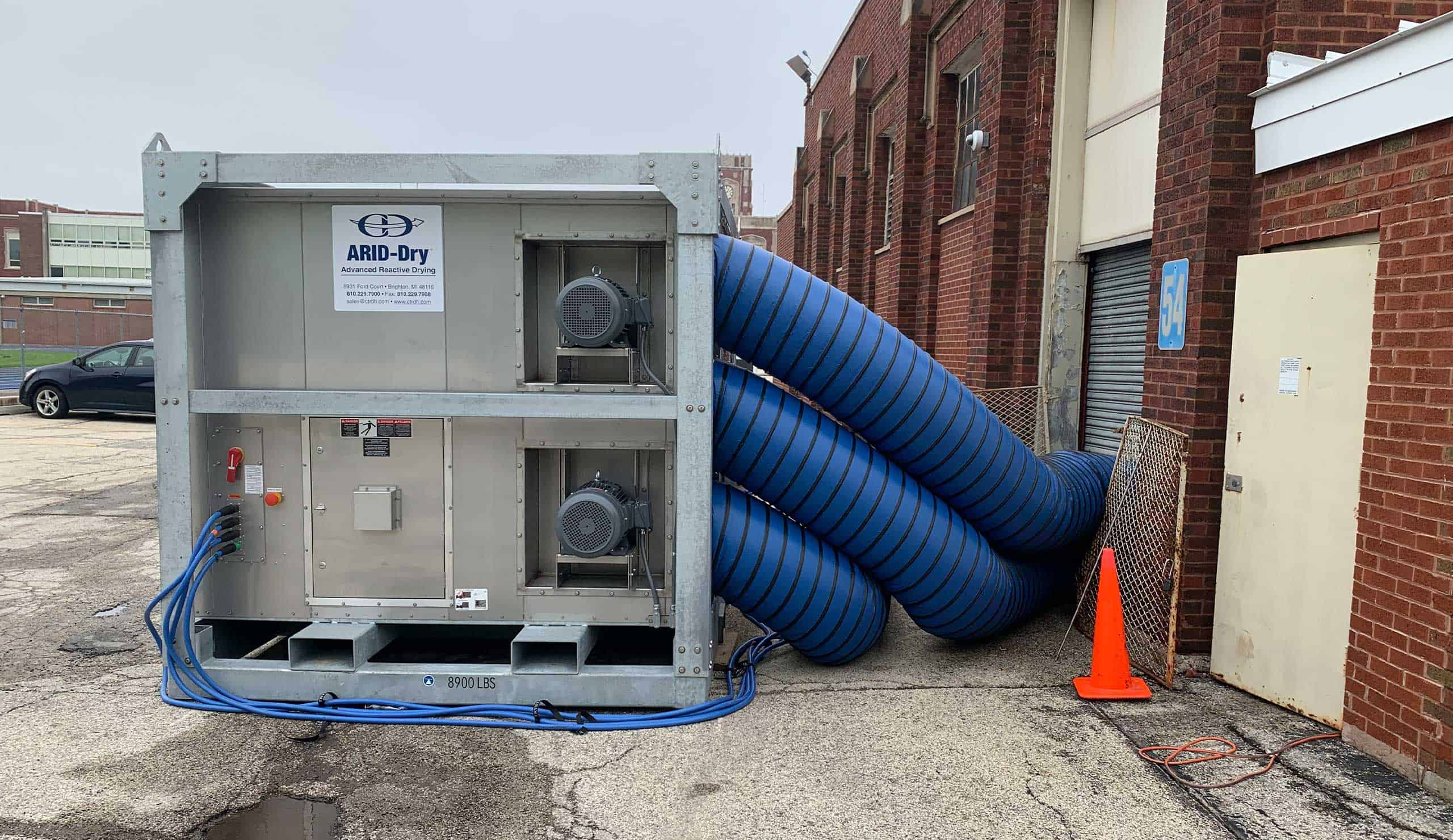
REIC Rentals deploys a range of equipment suited to the specific constraints of educational facilities. Portable air conditioners serve individual classrooms and offices. Larger systems connect to existing chilled water distribution for buildings undergoing central plant work. Indirect-fired and electric heaters maintain conditions in spaces without active heating during cold shoulder-season phases. Desiccant and refrigerant dehumidifiers protect humidity-sensitive areas, including instrument storage, science labs, and library collections.
Acoustic performance matters in educational environments. REIC Rentals specifies sound-attenuated units, acoustic enclosures, and duct routing designed to avoid disrupting lectures, exams, and study periods. For lecture halls and libraries, noise levels must stay within ranges that preserve speech intelligibility and support concentration.
Equipment placement on occupied campuses requires coordination with campus security, parking operations, and accessibility requirements. REIC Rentals works with facilities teams to stage equipment without blocking emergency access, bus drop-off zones, or accessible routes that serve all building users throughout the renovation.
Planning Around Class Schedules
Executing fall construction on an occupied campus requires coordination that goes well beyond equipment selection. Loud work, including equipment delivery, crane lifts, and duct penetrations, must be scheduled outside core teaching hours. Early mornings before classes, weekends, and fall break windows are the primary targets.
Communication is as important as timing. Faculty, custodial staff, and campus security all need advance notice of which equipment is arriving, where it will be staged, which connections will be made, and when it will be removed. REIC Rentals provides clear documentation of equipment placement, connection points, and removal timelines to support that communication process.
Budget-conscious planning is also essential for K-12 districts and universities operating under tight capital constraints. Right-sizing equipment to actual occupancy and load, rather than running oversized permanent systems inefficiently through partial shutdowns, yields better cost outcomes. REIC Rentals engineers each deployment to match capacity to the specific conditions of each phase rather than applying a standard configuration regardless of scale.
Planning Timeline for Fall Campus Projects
Early engagement is what separates fall campus projects that execute without disruption from those that lead to faculty complaints and scheduling pressure. Facilities directors and construction management partners should contact REIC Rentals several months before planned fall work begins.
A practical planning sequence covers an initial consultation to define scope, identify affected spaces, and establish performance criteria; a site assessment to evaluate building age, existing HVAC type, occupancy patterns, and any specialized sensitivities; integration with construction documents to confirm electrical capacity, temporary duct penetrations, and equipment staging locations; and commissioning before permanent systems go offline so the transition is seamless from the occupant’s perspective.
Whether the project involves a single classroom wing or a multi-building district capital program, strategic planning with REIC Rentals ensures every phase is covered. Request a quote or find a location near you to start the conversation before the fall semester schedule is set.
1.888.356.1880 | in**@**ic.com | reic.com
Service You Trust. Equipment You Need.
