
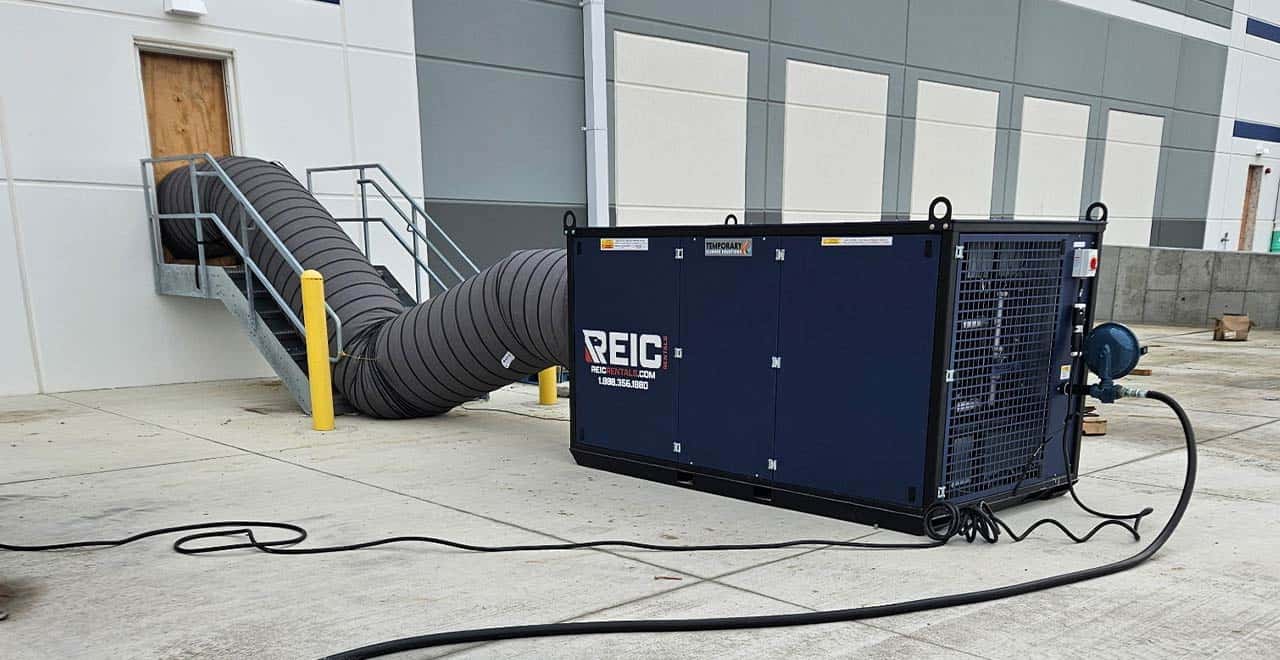
In a refrigerated food warehouse, the margin between compliant storage and a product safety event is measured in degrees. When ambient temperatures climb during a summer heat wave and rooftop refrigeration units start losing efficiency, that margin can disappear faster than the repair timeline allows. For food warehouses and cold-chain distribution centers, temporary cooling is operational insurance.
Cold-chain facilities operate under hard temperature limits enforced by the FDA, USDA, and major retail customers. Even brief excursions outside those bands can trigger FSMA non-compliance, product holds, and insurance claims. The financial exposure from a single unmanaged temperature event in a refrigerated distribution center consistently exceeds the cost of a well-planned temporary cooling deployment by a significant multiple.
REIC Rentals supports food storage facilities and food processing plants with temporary cooling equipment, drying and dehumidification, and generators for peak demand support, planned maintenance windows, and emergency HVAC failures. This article covers what makes cooling in food storage and cold-chain distribution different from general warehousing, and how to plan before conditions lead to a product safety event.
How Excessive Heat Affects Refrigerated Warehouses
When ambient temperatures exceed design conditions, rooftop condensers reject heat less efficiently. Compressors run longer cycles, suction and discharge pressures rise, and coil capacity drops. At dock doors, every opening floods the cooler with warm air and humidity, spiking the load on already strained systems.
For food products, the consequences are direct. Frozen goods exposed to rising warehouse temperatures risk partial thawing. Repeated freeze-thaw cycles degrade texture and increase drip loss. Bacterial growth in dairy, produce, and meats accelerates above 41°F. Retailer specifications are equally specific, with major grocery customers requiring defined temperature ranges for each product category. Short excursions outside those bands trigger corrective actions, holds, or outright rejection of the product.
Worker safety in dock areas, mezzanines, and battery charging rooms is an additional concern. When summer heat backs into the facility and permanent systems are strained, ambient zones can reach temperatures that pose a heat-stress risk to crews performing physically demanding tasks throughout the shift.
What Distinguishes Cold-Chain Cooling from General Warehousing
A general warehousing temperature event is a productivity problem. A cold-chain temperature event is a food safety event with regulatory documentation requirements, product disposition obligations, and potentially a customer notification requirement. The response to a temperature excursion in a food storage facility does not end when the temperature returns to the setpoint. It continues through the investigation, the corrective action, and in some cases, the regulatory communication.
That distinction matters for how temporary cooling is planned and deployed. In a food storage facility, temporary equipment must maintain the temperature ranges required by the product, not just reduce ambient conditions to a generally acceptable level. The documentation that demonstrates conditions were maintained throughout the temporary cooling deployment is as important as the equipment itself. Our teams regularly support food storage operators through this process and understand the compliance documentation that auditors and customers expect to see alongside the operational records.
Assessing the Cooling Shortfall Before Specifying Equipment
Effective temporary cooling planning starts with understanding the actual gap between the installed refrigeration capacity and the facility’s peak load during summer conditions. Installed tonnage adequate during the design year may not be sufficient when ambient conditions exceed design assumptions, when facility throughput increases, or when door cycle frequency at busy docks has grown with operations.
The zones that require priority attention are receiving docks handling chilled or frozen loads, buffer rooms between freezer and ambient areas, QA inspection areas processing temperature-sensitive inventory, and staging lanes for outbound trucks that must hold temperature until loaded. Each zone has its own temperature requirements and heat load characteristics that drive equipment selection.
Building envelope matters as well. Insulation condition, roof reflectivity, dock seal integrity, and air curtain performance at dock doors all affect the total heat load that cooling systems must manage. Addressing the most significant envelope gaps before or alongside the deployment of temporary cooling improves the effectiveness of the deployed equipment.
Equipment Options for Food Storage and Cold-Chain Facilities
REIC Rentals’ cooling equipment for food storage and cold-chain applications covers a range of approaches suited to different zone types and load requirements.
Portable air conditioners provide targeted cooling for isolated zones, including dock coolers undergoing door replacement, QA lab trailers within the facility, and small staging areas requiring precise temperature control. These units deploy quickly, connect to standard or three-phase power depending on size, and can be operational within hours of arriving on site. Condensate management is a specific requirement in food storage environments: drip pans or condensate pumps must route water away from product and prevent floor hazards in active areas.
Larger temporary cooling systems serve full wings or multiple zones through connections to the facility’s existing cooling infrastructure. These configurations require more lead time for connection planning and commissioning, which is why engaging REIC Rentals before a heat event or planned maintenance window, rather than during one, makes a material difference in how quickly the equipment can be operational.
Humidity control, alongside cooling, is important in food storage environments where condensation on packaging can cause label failure and increase the risk of mold. Drying and dehumidification equipment, paired with cooling, maintain both temperature and humidity within the ranges required for food safety and product quality. REIC Rentals reviews both parameters when advising on temporary climate equipment for food storage applications.
Power Planning for Cold-Chain Cooling Deployments
Temporary cooling equipment in a food storage facility requires reliable, correctly sized power. Running supplemental cooling alongside existing refrigeration adds a meaningful electrical load. Where existing infrastructure cannot support that combined load, generators provide the required supply. A power constraint discovered after cooling equipment arrives on site during an active temperature event is not recoverable. Confirming electrical capacity is a prerequisite for effective deployment of temporary cooling, not a detail to address during installation.
Planned Maintenance: Avoiding Product Safety Events During HVAC Work
Planned maintenance in a food storage facility requires keeping product within temperature specification throughout the maintenance window, not just restoring conditions after the work is complete. A rooftop unit replacement that allows dock cooler temperatures to drift outside the product’s required range creates a product safety event even if the maintenance itself goes exactly as planned.
Pre-staging temporary cooling before permanent systems come offline enables planned maintenance to proceed without creating compliance exposure. The temporary equipment is confirmed operational before the permanent system goes down. The maintenance window proceeds on its own timeline. Return to permanent cooling is coordinated to maintain continuous conditioning throughout the transition.
Our teams support food storage facilities and cold-chain operators through planned maintenance windows specifically because the sequencing stakes are higher in those environments. Getting the pre-staging right is not a detail. It is the difference between a successful maintenance window and a product disposition event.
Scenario: Supplemental Cooling During a Summer Heat Wave
Consider a refrigerated distribution center handling grocery products where an extended heat wave pushes ambient temperatures well above the design condition for the facility’s cooling systems. The rooftop refrigeration equipment runs continuously but cannot maintain dock cooler temperatures within specification during the hottest hours of the day.
With a pre-arranged relationship with REIC Rentals in place, supplemental portable cooling equipment is deployed to the dock cooler zones and staging areas where temperature drift is most pronounced. The temporary equipment reduces the heat load on the permanent refrigeration systems, extending their effective capacity through the peak period. Temperature log continuity is maintained throughout the event, and documentation demonstrating that conditions were maintained is available for customer and regulatory review.
Product throughput continues within compliance. The permanent systems return to normal operation as ambient temperatures moderate. The total cost of the supplemental cooling deployment is a fraction of what a single product hold or rejection event would represent on high-value grocery inventory.
Compliance, Documentation, and Audit Readiness
QA and regulatory teams in food storage operations need to ensure that any temporary cooling deployment is reflected in the facility’s FSMA preventive control plan and HACCP documentation. A change in the cooling system serving a critical temperature control point requires documented risk assessment, updated monitoring protocols, and defined corrective action procedures.
Documentation that auditors expect to see alongside a temporary cooling deployment:
- Continuous temperature and humidity data logs from the deployment period.
- Equipment specification sheets confirming cooling capacity and supply temperatures.
- Startup and commissioning records confirming that the equipment achieved the required conditions before the product entered the zone.
- Deviation reports and corrective actions for any period where conditions drifted outside specification.
- Calibration records for any sensors used to monitor conditions during the deployment.
REIC Rentals supports this documentation by providing equipment spec sheets, startup records, and validation support that integrate with existing food safety programs rather than creating a separate documentation track.
Planning Before Peak Season
The cold-chain operators that manage summer heat events and maintenance windows with the least exposure are not better resourced than their peers. They planned earlier. Equipment availability tightens during peak summer demand when multiple food storage facilities across a region compete for the same rental inventory, and that competition peaks precisely when the need is most urgent.
A spring engagement with REIC Rentals confirms equipment availability, establishes the site documentation that allows rapid deployment, and produces the contingency plan that is ready to activate when conditions exceed what permanent systems can manage. Our teams regularly support cold-chain and food storage operators through this process, and the facilities that engage before the season arrives are consistently better positioned than those that call during a heat event when inventory is already strained and lead times have compressed.
Find a location near you to connect with the team supporting food storage and cold-chain distribution in your area, or request a quote to start the planning conversation before peak season arrives.
1.888.356.1880 | in**@**ic.com | reic.com
Service You Trust. Equipment You Need.
